🔘 IN GR TR AL OF CO xxxxx ✅ 2️⃣ 3️⃣ 4️⃣ 5️⃣ 6️⃣ 7️⃣ 8️⃣ xxxxx AN RP IV alia
0070 IN Gaudete in dominoModus 1
0064 ⟽ IN 1 ⟾ 0080 xxx ⏹️ xxx GT 21 - GN 1/11 - BzG 21/284️⃣ AB - CD - CD - EYF
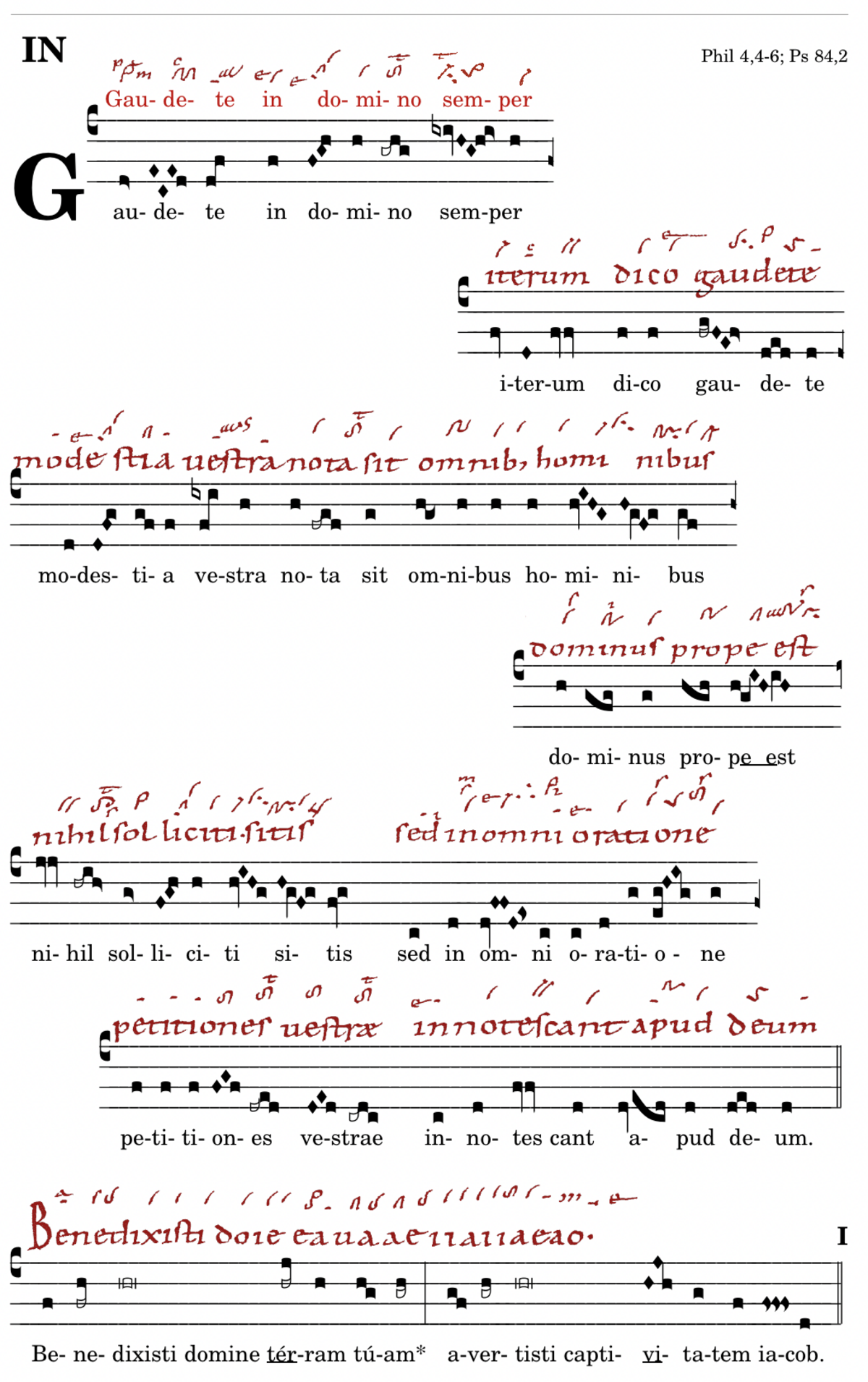
„Gau-de-te“ Der PrrFlx ist völlig kurrent (celeriter), daher unsere Notation mit Puncta.
„Gaude-te“ Der Pes quilismaticus (vulgo: QuilismaScandicus) wird von den Zisterziensern, die grundsätzlich und ausnahmslos auf das Quilisma verzichten, als TerzPes notiert, das Quilisma ist kein Ton. In Ch steht das Oriscuszeichen (= Quilismazeichen) für den Zielton, den Ton über dem Leerraum. In allen von uns konsultierten Quellen wird das Quilisma nur in Kl als Ton übertragen.
„domi-no“ Trc der Wortartikulation. Der erste Ton ist so leicht, dass er sogar entfallen kann; vide: Bv34, A + Y + Mp !
„sem-per“ Mit einem nkTon „sa“ vorbereitete circulatio.
„iterum“ Die Binnensilbe des PPO ist in L und E als leicht, kurz notiert. Aq + Bv tun/können das nicht mehr. Die Bivirga auf der Endsilbe ist in MR + Ch wie sehr oft eine Bivirga urgens, sie wird portamentoartig angesungen.
„gau-déte“ Der ClmRes bereitet den Akzent am Ende des Sprachbogens vor. Die Zistercienser bringen die Neume in ihrer Reinform. Alle anderen Quellen schließen unisonisch mit der vorhergehenden Rezitation „fa“ an (portamentoartiger Einstieg) was die Funktion der Neume etwas verschleiert.
„gau-déte“ Der nkTrc auf der vorletzten Silbe ist im Messrepertoire die klassische Neume am Satzende. Damit ist das Bisherige als in sich geschlossener ganzer Satz definiert.
„vestra“ Der Quartaufstieg „fa-sa“ ist, typisch für die westfränkische Tradition, zum 4tonigen Sca aufgefüllt (Plerosis), nur Kl führt lediglich bis „la“, um die Halbtonspannung „la-sa“ zu vermeiden (do-Revision).
Wenn das Quilisma, wie wir überzeugt sind, kein Ton ist (Quilisma nur in Mp + MR, alle anderen schreiben einen Ton und kein Quilisma, so L ! Ch, A, Y), so bleiben Mp + MR, die als dreistufiger Sca „fa-la-sa“ zu lesen sind, wobei der Oriscus anzeigt, das das „sa“ über die Rezitation „la“ führt, auf dem die folgenden Silben weiterlaufen. Die Untersuchungen an den Responsoria prolixa weisen aber darauf hin, dass der Oriscus einerseits das Übersteigen der Retitatzionsebene anzeigt, andererseits aber auch das Qulisma („singe höher als hier üblich“) zusätzlich interpretiert („singe hier noch höher als das Quilisma ohnehin schon verlangt“). Zusätzlich verlangen noch L + E, dass der folgende Ton „ves-tra“ unter die Rezitation geführt werden muss.
 „no-ta sit“ Trc der Wortartikulation. vide supra.
„om-nibus“ Der Por, den nur Zt schreibt, wird durch den Epiphonus verhindert, zur Clv verkürzt, vide Ch !
„homi-ni-bus“ Die Graphie in L + Ch steht für ein anlautendes „sol“ (Trc inito debilis) der folgende Pressus wird von uns verschmolzen notiert. Ebenso in „prope est“, und „sitis“. Bei „propeest“ wird offensichtlich, dass die Kontraktion nicht wieder zerstört werden kann/soll, indem man die Resupinnote und den Oriscus als zwei getrennte Töne singt.
„propeest“ Kl Revision zum „do“, daher das „sibemolle = sa“ im GT falsch. Das GN hat das bereits ausgebessert.
„sollici-ti“ Ein „si“ verbietet sich auf Grund des Formelvergleichs.
„sed in“ L praetonische Puncta, ebenso bei
„inno-tescant“.
„a-pud“ Neume A-Prr
Freut euch im Herrn allezeit / noch einmal sage ich euch: Freut euch!
Eure Güte / soll allen Menschen bekannt werden /
Der Herr ist nahe / um nichts sollt ihr in Sorge sein /
sondern bei jedem Gebet / sollen eure Bitten / bekannt werden bei Gott.

Rejoice in the Lord always / once again I say to you: Rejoice!
Your goodness / shall be known to all people /
The Lord is near / You shall not be anxious about anything /
but with every prayer / our requests / shall be made known to God.
“Gau-/de-te” The PrrFlx is completely celeriter, hence our notation with puncta.
“Gaude-/te” The Pes quilismaticus (vulgo: QuilismaScandicus) is notated as a TerzPes by the Cistercians, who generally and without exception do without the quilisma; the quilisma is not a tone. In Ch, the oriscus sign (= quilisma sign) stands for the target tone, the tone above the space. In all the sources we consulted, the quilisma only is transmitted as a tone in Kl.
“domi-no” Trc of the word articulation. The first tone is so light that it can even be omitted; vide: Bv34, A + Y + Mp !
“sem-per” With a nk tone “sa” prepared circulatio.
“iterum” The internal syllable of the PPO is notated in L and E as light, short. Aq + Bv do/can no longer do this. The bivirga on the final syllable in MR + Ch is very often a bivirga urgens, it is sung portamento-like.
“gau-déte” The ClmRes prepares the accent at the end of the speech arc. The Cistercians use the neume in its pure form. All other sources follow in unison with the preceding recitation “fa” (portamento-like introduction), which somewhat obscures the function of the neume.
“gau-déte” The nkTrc on the penultimate syllable is the classic neume at the end of a sentence in the Mass repertoire. This defines the previous as a self-contained whole sentence.
“vestra” The fourth ascent “fa-sa” is, typical of the West Franconian tradition, filled up to the 4-tone sca (plerosis), only Kl only leads up to “la” in order to avoid the semitone stress “la-sa” (do revision).
If, as we are convinced, the quilisma is not a tone (quilisma only in Mp + MR, all others write a tone and not a quilisma, so L ! Ch, A, Y), then Mp + MR remain, which are to be read as a three-step sca “fa-la-sa”, whereby the oriscus indicates that the “sa” leads over the recitation “la”, on which the following syllables continue. However, studies of the responsoria prolixa indicate that the oriscus on the one hand indicates that the retitatzion level has been exceeded, but on the other hand also interprets the qulisma (“sing higher than usual here”) (“sing here noch higher than the quilisma already demands”). In addition, L + E require that the following tone “ves-/tra” be placed under the recitation.
“no-/ta sit” Trc of the word articulation. vide supra.
“om-nibus” The Por, which only Zt writes, is prevented by the epiphonus, shortened to Clv, vide Ch !
“homi-ni-bus” The graphia in L + Ch stands for an initial “sol” (Trc inito debilis), the following pressus is notated by us as fused. Likewise in “prope est”, and “sitis”. In “propeest” it is obvious that the contraction cannot/should not be destroyed again by singing the resupin note and the oriscus as two separate notes.
“propeest” Kl Revision to “do”, hence the “sibemolle = sa” in the GT is wrong. The GN has already corrected this.
“sollici-ti/” An “si” is out of the question due to the formula comparison.
“sed in” L praetonic puncta, likewise with
“inno-tescant”.
“a-pud” Neume A-Prr