🔘 IN GR TR AL OF CO xxxxx 1️⃣ ✅ 3️⃣ 4️⃣ 5️⃣ 6️⃣ 7️⃣ 8️⃣ xxxxx AN RP IV alia
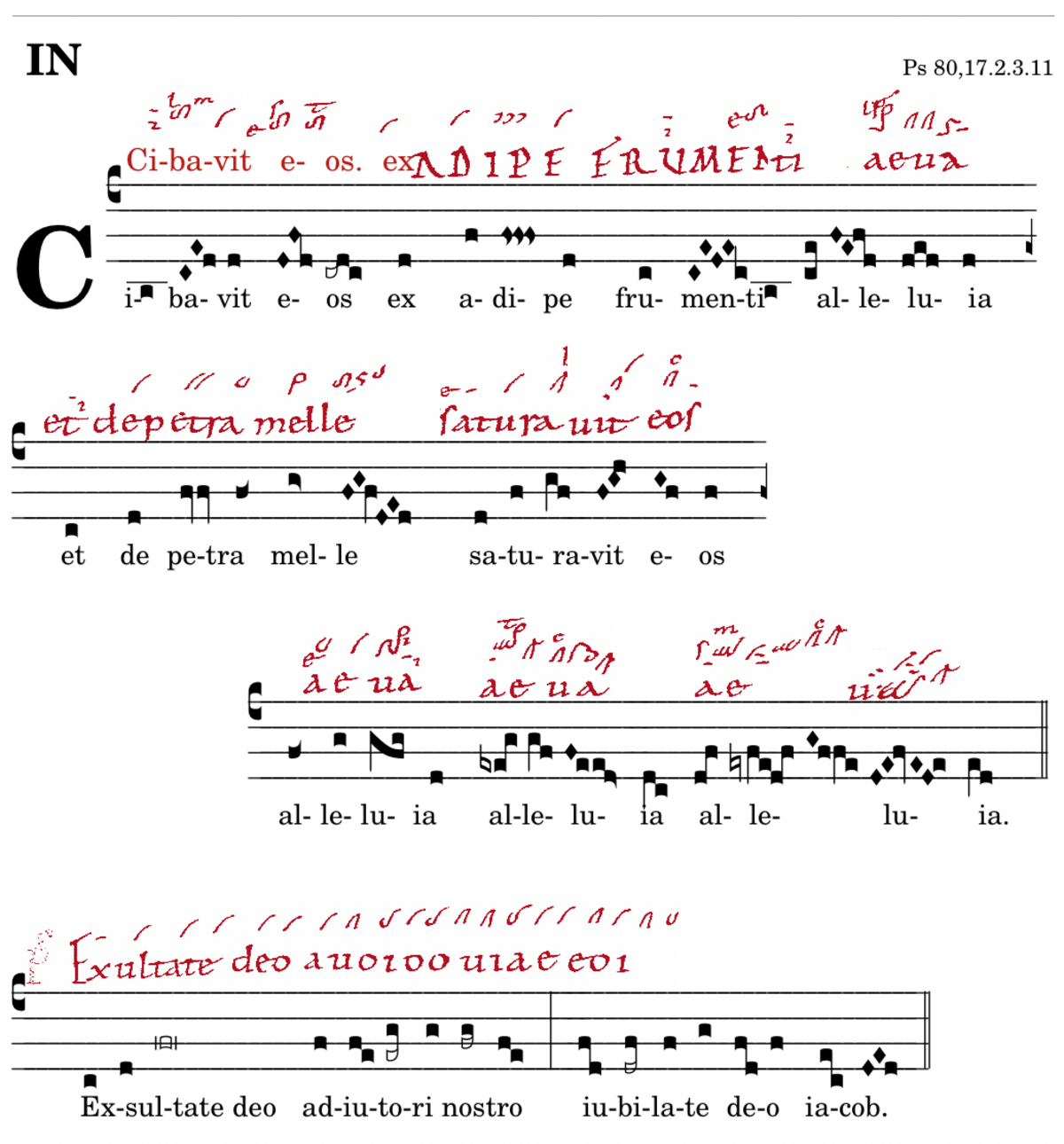
0011 IN Cibavit eosModus 2
0164 ⟽ IN 2 ⟾ 0013 xxx ⏹️ xxx GT 377 - GrN 1/364 - BzG 34.35/162️⃣ AB - EYYF
 „Ci-ba-vit eos“ Nach Studium der Responsorien stellt sich die Frage, ob dieser Trc nicht ursprünglich wie in RP2 A i ein Trc „do-mi-re“ gewesen ist.
Die adiastematischen Zeugen:
MR und L machen keine Aussage,
Ch Der erste Ton ist tiefer als der Trc-Anfang, Tol und Bv, der erste Ton ist eine Terz tiefer als der Trc-Anfang.
Den Trc selbst notieren alle diastematischen Quellen als Trc 'do-re-do'.
In der St.Galler Tradition sind nur zwei Quellen relevant;
Bam, knapp nach 1000 verweist mit dem 'inferius' auf die allgemeine Version hin, der letzte Ton des Trc ist tiefer als der nächste Ton.
E hingegen (vor 1000) kann/muss anders gelesen werden: 'ìnferius' und 'levare'notieren den Aufstieg „la- do“ recht genau, die Frage ist, was sagt 'mediocriter' aus? Wäre der zweite Ton des Trc ein„re“, wäre der Buchstabe überflüssig: der zweite Ton des Trc muss per se höher sein als der erste. Ein Trc zur Quart „do-fa-re“ ist denkbar (vide „eos“) ihn verhindert das 'mediocriter'.
Der übliche Trc „do-re-do“ macht den Schlussakzent dieses Cento zum Hauptakzent „Cibavit éos“. Im Kontext ist aber offensichtlich: „Cibávit eos ex adipe frumenti“ der Hauptakzent liegt auf „Cibávit“. cf.: 0688.
Er nährte sie aus dem Besten des Weizens,
Halleluja,
und mit Honig aus dem Felsen sättigte er sie.
Halleluja, Halleluja, Halleluja.

He fed them with the finest wheat, Hallelujah,
and satisfied them with honey from the rock. Hallelujah, Hallelujah, Hallelujah.
“Ci-ba-vit eos” After studying the responsories, the question arises whether this Trc was not originally a Trc “do-mi-re” as in RP2 A i.
MR and L make no mention,
Ch: the first note is lower than the start of the Trc; Tol and Bv: the first note is a third lower than the start of the Trc.
All diastematic sources notate the Trc itself as Trc “do-re-do”.
In the St. Gall tradition, only two sources are relevant;
Bam, shortly after 1000, refers to the general version with 'inferius', the last tone of the Trc is lower than the next tone.
E, on the other hand (before 1000), can/must be read differently: 'ìnferius' and 'levare' note the rise “la-do” quite accurately, the question is, what does 'mediocriter' mean? If the second note of the Trc were a “re,” the letter would be superfluous: the second note of the Trc must per se be higher than the first. A Trc to the fourth “do-fa-re” is conceivable (see “eos”), but this is prevented by “mediocriter.”
The usual Trc “do-re-do” makes the final accent of this cento the main accent “Cibavit éos”. However, in context it is obvious: “Cibávit eos ex adipe frumenti” the main accent is on “Cibávit”. cf.: 0688.