🔘 IN GR TR AL OF CO xxxxx ✅ 2️⃣ 3️⃣ 4️⃣ 5️⃣ 6️⃣ 7️⃣ 8️⃣ xxxxx AN RP IV alia
0064 IN Gaudeamus --- agathaeModus 1
0063 ⟽ IN 1 ⟾ 0070 xxx ⏹️ xxx GT 545 - GN 2/238 - BzG 36/153️⃣ AxIxB - .xD - xF
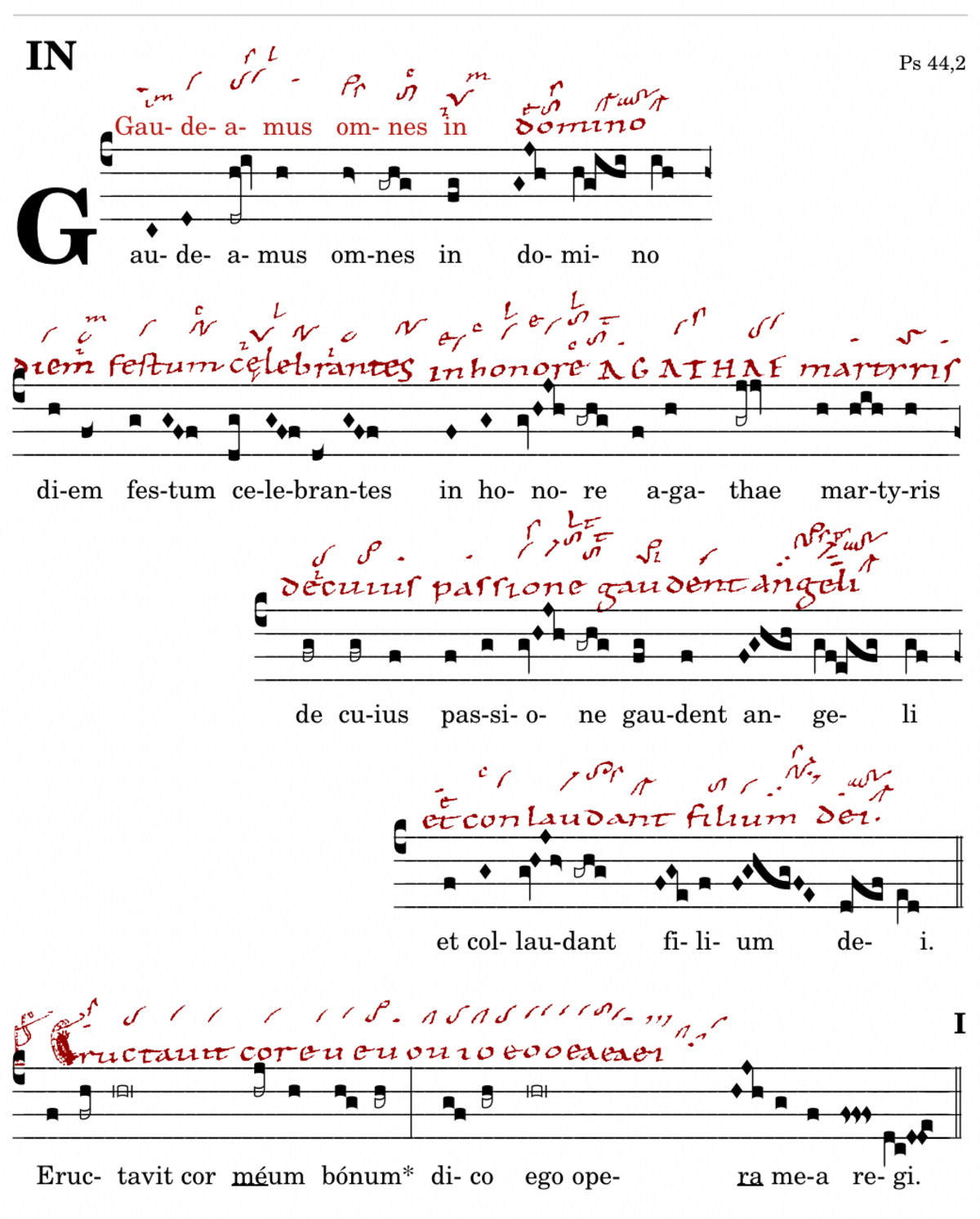
 Wenn dieser Introitus typisch ist für die Kompositionstechnik der Antiphonen des Messrepertoires, so ist im Vergleich zum Offiziumsrepertoire (AN + RP) festzustellen, dass hier nicht mehr reine Sprachkunst angewendet wird, sie wird in keiner Weise vernachlässigt, sondern zusätzlich der Wille zu musikalischer Struktur zu erkennen ist.
Das korreliert mit der Vermutung, das Messrepertoire (nur Teile ?) stellt einen jüngeren Entwicklungsstand dar als die Melodien des Offiziums.
Wenn dieser Introitus typisch ist für die Kompositionstechnik der Antiphonen des Messrepertoires, so ist im Vergleich zum Offiziumsrepertoire (AN + RP) festzustellen, dass hier nicht mehr reine Sprachkunst angewendet wird, sie wird in keiner Weise vernachlässigt, sondern zusätzlich der Wille zu musikalischer Struktur zu erkennen ist.
Das korreliert mit der Vermutung, das Messrepertoire (nur Teile ?) stellt einen jüngeren Entwicklungsstand dar als die Melodien des Offiziums.
IN „Gaudeamus omnes“ findet sich noch nicht im codex Milano (9.Jh), aber in L und ist in C genannt.
Die pentasyllabische Kadenz der Messpsalmodie im 1. Modus wird als Modell verwendet (5., 4. und 3. Silbe der Kadenz) und macht den Kern aller vier Zeilen des Introitus aus. Alle vier Zeilen münden in einer der üblichen Kadenzen (CAD 4E, TrcSF, CAD 1D, CAD mikro m).
Bleiben als incipites außer 1INC 5Pes (1.Zeile) nur ein nullum („de cuius“ 3.Zeile) und ein Cento FA-RE „diem festum celebrantes“ cf.: 0855 „tota die“).
Man könnte diese Art der Komposition als variierende Wiederholung bezeichnen.
Freuen wir uns alle im Herrn,
feiern wir den festlichen Tag zu Ehren der Märtyrin Agatha.
An deren Leidensfest freuen sich [mit uns] die Engel
und loben Gottes Sohn.

Let us all rejoice in the Lord,
We celebrate the festive day in honor of the martyr Agatha.
On her feast of suffering, the angels rejoice [with us]
and praise God's Son.
If this introit is typical of the compositional technique used in the antiphons of the Mass repertoire, then it can be observed that, in comparison to the Office repertoire (AN + RP), pure linguistic artistry is no longer used here; it is not neglected in any way, but rather the desire for musical structure is also evident.
This correlates with the assumption that the Mass repertoire (only parts of it?) represents a more recent stage of development than the melodies of the Office.
IN ‘Gaudeamus’ is not yet found in the Codex Milano (9th century).
The pentasyllabic cadence of the Mass psalmody in the 1st mode is used as a model (5th, 4th and 3rd syllables of the cadence) and forms the core of all four lines of the introit. All four lines end in one of the usual cadences (CAD 4E, TrcSF, CAD 1D, CAD micro m).
Apart from 1INC 5Pes (1st line), the only incipits remaining are a nullum (‘de cuius’ 3rd line) and a Cento FA-RE ‘diem festum celebrantes’ cf.: 0855 ‘tota die’).
This type of composition could be described as varying repetition.