🔘 IN GR TR AL OF CO xxxxx 1️⃣ 2️⃣ 3️⃣ ✅ 5️⃣ 6️⃣ 7️⃣ 8️⃣ xxxxx AN RP IV alia
0018 IN De necessitatibus meisModus 4
0001 ⟽ IN 4 ⟾ 0023 xxx ⏹️ xxx GT 84 - GrN 2/39 - BzG 54/29
Der Deuterus lebt vom, ja ist das Spiel mit dem Halbtonschritt „mi-fa“ (=si-do). Diese mi-fa Spannung ist aber genau das erste Opfer im Übergang vom authentischen Choral zur zweiten Gregorianik.
• Die ersten Ansätze dieser do-Revision sind bereits im 10. Jahrhundert, noch vor der Jahrtausendwende festzustellen. Nun ist aber unser Leitcodex E erst um 1000 geschrieben worden.
• Ein weiteres Factum ist bei der Restitution des „authentischen“ Chorals zu beachten. Beim Studium der Responsoria prolixa wird offensichtlich, dass es um die Jahrtausendwende bereits eine deutlich unterscheidbare westfränkische (frOc) und ostfränkische (frOr) Melodietradition gibt, die sich ab dem Aussterben der Karolinger (870/840) herausgebildet haben. Im Antiphonenrepertoire bedeutet das, es stehen MR+Wc (frOc) gegen H+Ka (frOr). Interessanterweise folgen die aquitanischen Quellen meist frOr, die beneventanischen Quellen aber frOc.
• Ein Drittes wird sichtbar: Während die ostfränkischen Handschriften aus einer einzigen Quelle (St.Gallen) sprudeln und in einer germanischen Umwelt sprachlich isoliert, ungestört die Tradition weitergeben, ist die westfränkische Umwelt lateinisch (romanisch, eigentlich muttersprachlich), dezentral (Metz, Lyon, Chartres…) und neue stilistische Strömungen können so viel leichter in den Gregorianischen Choral eindringen. Kurz gesagt, die westfränkische Tradition ist moderner.
Es spricht nichts dagegen, diese Erkenntnisse auch bei der Restitution der Messgesänge zu berücksichtigen.
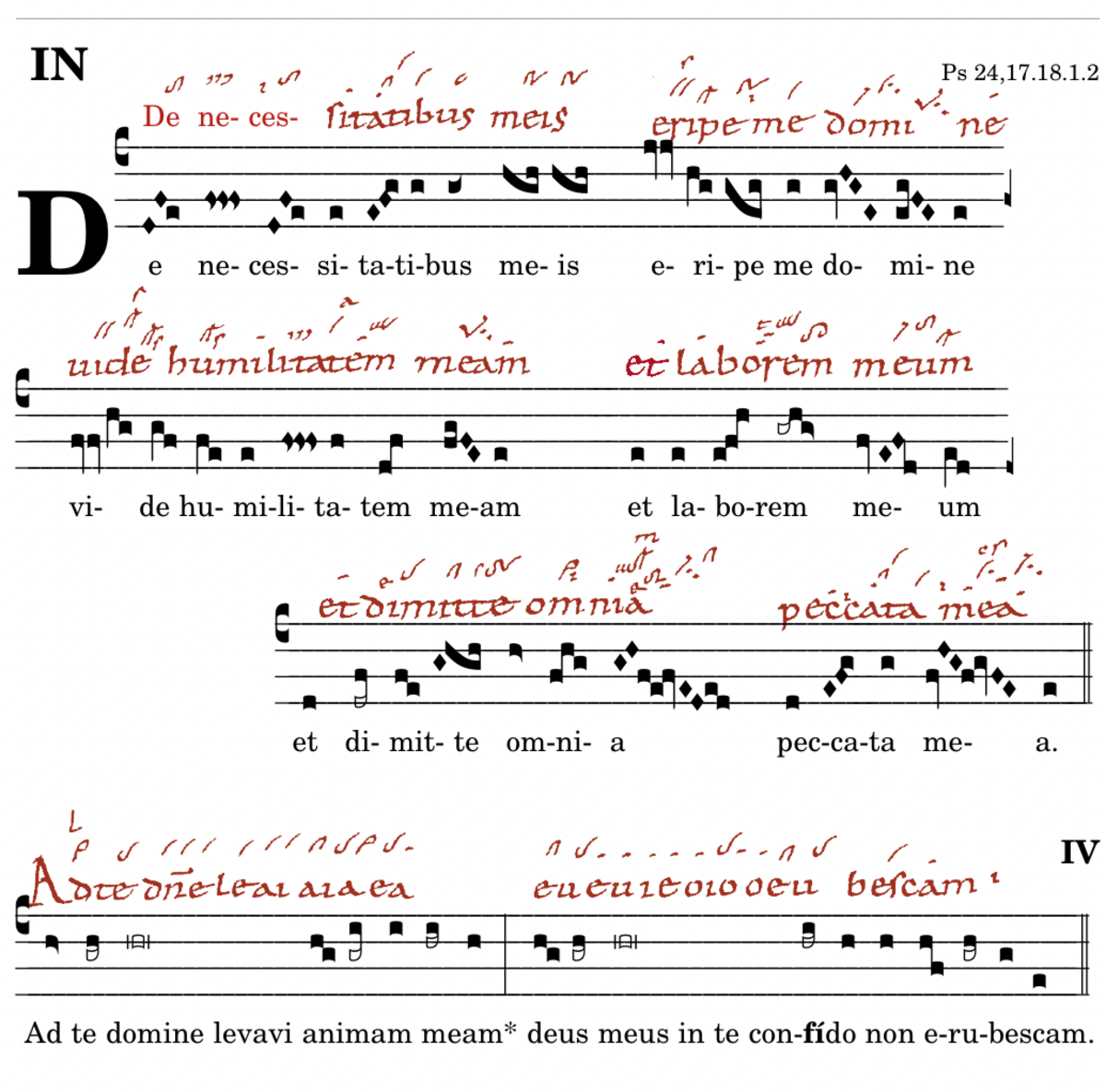
„eri-pe“ Porrectus „sol-mi-sol“ beneventanisch gegen „sol-fa-sol“ in Aquitanien. Die adiastematischen Quellen geben keine Information außer E mit seinem inferius. Interessant dass auch Mp + Mod das ältere „mi“ bezeugen: unzweifelhaft Porrectus „sol-mi-sol“.

„do-mi-ne“ Der Fall ist etwas komplexer.
Ch + Bv33 unisonisch auf “fa” ? oder doch auf “mi”!
Mod, Kl, Zw wechseln den Ton im Silbenübergang ab, typisch für die do-Revision in Kl. Der unisonische Anschluss in Ch + Bv33 scheidet diese Lösungen a priori aus.
L schreibt ungenau. Versucht sich der Schreiber durch das Problem zu schwindeln? Im Zweifelsfall ist der Schlusston des PesSbp tiefer als der nächste Ton, also sicher “mi”. Noch deutlicher ist der Uncinus auf “-ne” tiefer als die folgende Bivirga.
Rupert Fischers Faustregel “Bv gegen A+Y ist eine 50:50 Situataion. Geht eine der beiden aquitanischen Quellen mit Bv, so ist das das Ergebnis” ist hier zu relativieren. Ch, L+ Bv33 zusammen sprechen hier für Y.
„hu-mi-litatem“ Ist der Ton vor der Tristropha ein „fa“ oder ein „mi“. Grundsätzlich ist die Tristropha die Neume, die eine tiefere Rezitation zur festen Stufe (Tenor/Finalis) hochzieht. Ausnahme ist der 5.Modus. Das spricht gegen „fa“. Ch + Bv33 (wohl auch MR) schreiben einen wie Bv34 einen unisonischen Anschluss zur Tristropha. L , auffällig ungenau notierend wohl auch eher so. Dagegen stehen die meist mit frOr assoziierten Aquitanier A + Y und vor allem der Tractulus in E. E müsste, sollte der Ton ein „fa“ sein, eine Virga schreiben (ex parte post). Aufschlussreich ist ein Vergleich der vorliegenden G Handschriften dem Alter nach: Mi (Milano 9.Jh! - E - G342 - G339 schreiben „mi“. Bam (bald nach 1000?) und die G-Quellen danach schreiben Virga, G374 - G376 sogar mit Episem. Wir entscheiden uns daher gegen das GrN für „mi“.
Aus meinen Nöten /
errette mich, Herr!
Sieh meine Erniedrigung
/ und meine Plage an
und vergib mir all / meine Sünden!

From my distress / deliver me, Lord!
See my humiliation / and my affliction
and forgive me all / my sins!
The Deuterus lives from, indeed is the play with the semitone step “mi-fa” (=si-do). However, this mi-fa tension is precisely the first victim in the transition from authentic chant to second Gregorian chant.
• The first signs of this do revision can already be seen in the 10th century, even before the turn of the millennium. However, our main codex E was not written until around 1000.
• Another fact to consider in the restitution of the “authentic” chant is that when studying the Responsoria prolixa, it becomes apparent that by the turn of the millennium there was already a clearly distinguishable West Frankish (frOc) and East Frankish (frOr) melodic tradition, which had developed since the extinction of the Carolingians (870/840). In the antiphon repertoire, this means that MR+Wc (frOc) contrasts with H+Ka (frOr). Interestingly, the Aquitanian sources mostly follow frOr, while the Beneventan sources follow frOc.
• A third point becomes apparent: While the East Frankish manuscripts spring from a single source (St. Gallen) and pass on the tradition in a linguistically isolated, undisturbed manner in a Germanic environment, the West Frankish environment is Latin (Romance, actually the mother tongue), decentralized (Metz, Lyon, Chartres…), and new stylistic trends can thus penetrate the Gregorian chant much more easily. In short, the West Frankish tradition is more modern.
There is no reason not to take these findings into account when restoring the chants for Mass.
“eri-pe” Porrectus “sol-mi-sol” Beneventan versus “sol-fa-sol” in Aquitaine. The adiastematic sources give no information except E with its inferius. It is interesting that Mp + Mod also attest to the older “mi”: undoubtedly Porrectus “sol-mi-sol.”
“do-mi-ne” The case is somewhat more complex.
Ch + Bv33 unison on “fa” ? or on “mi” after all!
Mod, Kl, Zw change the tone in the syllable transition, typical of the do revision in Kl. The unison connection in Ch + Bv33 rules out these solutions a priori.
L writes imprecisely. Is the writer trying to cheat his way through the problem? In case of doubt, the final note of the PesSbp is lower than the next note, so it is definitely “mi.” Even clearer is that the uncinus on “-ne” is lower than the following bivirga.
Rupert Fischer's rule of thumb, “Bv against A+Y is a 50:50 situation. If one of the two Aquitanian sources goes with Bv, that is the result,” must be qualified here. Ch, L+ Bv33
together argue for Y here.
“hu-mi-litatem” Is the note before the tristropha a “fa” or a “mi”? Basically, the tristropha is the neume that raises a lower recitation to the fixed pitch (tenor/finalis). The exception is the 5th mode. This argues against “fa.” Ch + Bv33 (probably also MR) write a unison connection to the tristropha, as does Bv34. L, conspicuously imprecise in its notation, probably also tends to do so. This is contradicted by the Aquitanians A + Y, which are mostly associated with frOr, and especially by the Tractulus in E. If the note were a “fa,” E would have to write a virga (ex parte post). A comparison of the available G manuscripts according to age is revealing: Mi (Milan 9th century! - E - G342 - G339 write “mi.” Bam (shortly after 1000?) and the G sources after that write virga, G374 - G376 even with episem. We therefore decide against GrN in favor of “mi.”