🔘 IN GR TR AL OF CO xxxxx ✅ 2️⃣ 3️⃣ 4️⃣ 5️⃣ 6️⃣ 7️⃣ 8️⃣ xxxxx AN RP IV alia
0017 IN Da pacemModus 1
3599 / 0855 ⟽ IN 1 ⟾ 0019 xxx ⏹️ xxx GT 336 - GN 1/325 - BzG 44/193️⃣ AB - CD - EF
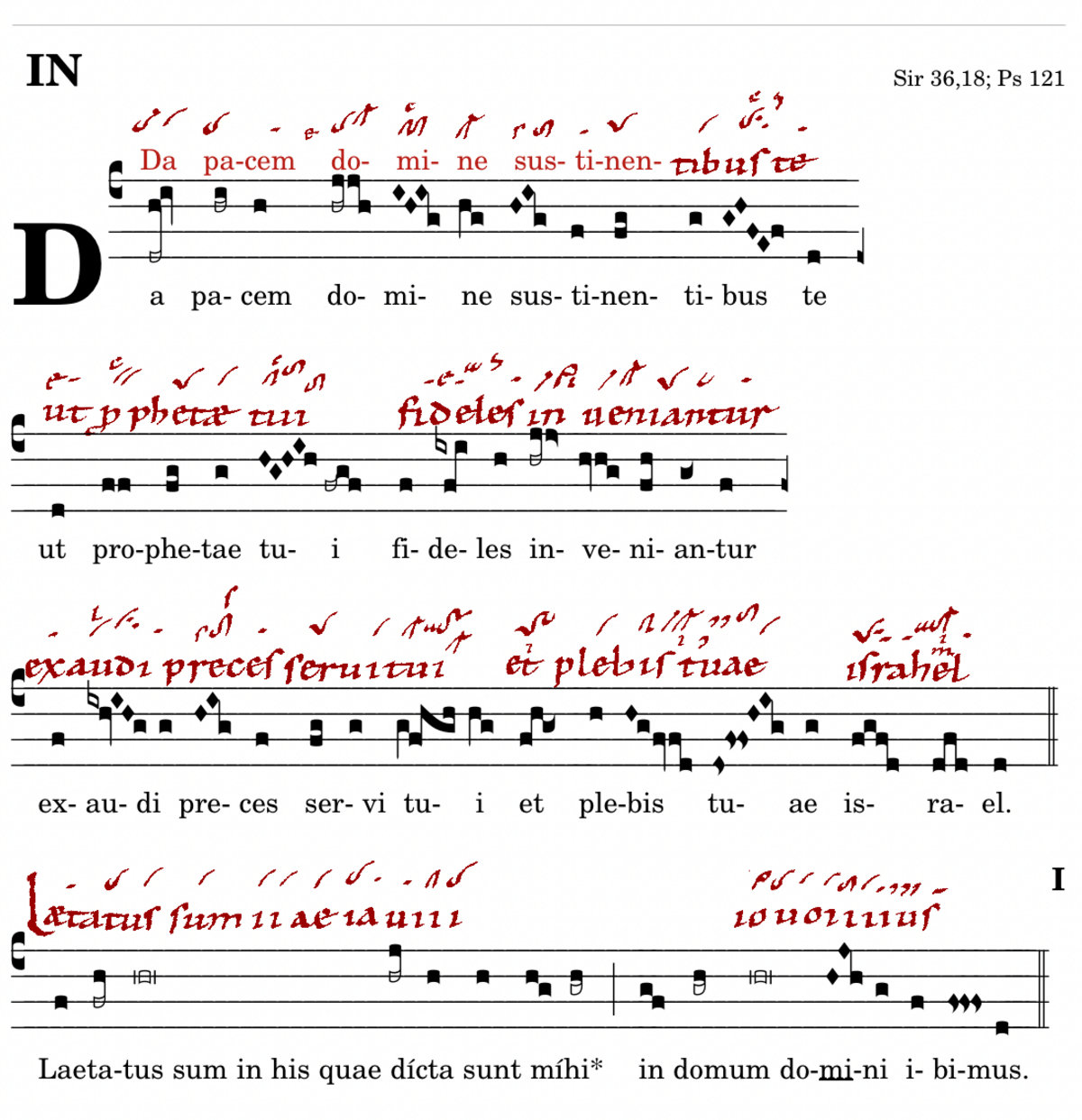
„Da pa-cem domine“ steht im Schatten des „do“ in „do-mine“, ebenso die folgende Silbe „do-mi-ne!\\, muss also auch nach Agustoni „si“ sein (EIGC 1 S.50).
“sus-tinentibus„ und „prophetae tu-i“: Kl geht zum „do“, ebenso in “pre-ces„ und “tu-ae israel„, daher in diesen vier Fällen immer „si“!
„tu-i“ Es gibt keinen Grund warum die 'circulatio' wie in allen diastematischen Quellen zum „sol“ führen sollte, vor allem wenn der folgende erste Ton des Trc kein „fa“ sondern nur nur ein portamento ist.
„fi-dé-les“ steht zwar ebenfalls im Schatten eines folgenden „do“, aber ein QuartPes, unsere übliche Interpretation dieser Neume, kann keine übermäßige Quart sein, daher „sa“.
So auch bei „ex-au-di“ ( Kl ! ).
“pre-ces„. Unmittelbar darauf folgend wieder „si“,'sursum'in E.
Den ganzen Introitus ist die Tritonusspannung „si-fa“ latent: „sustinentibus“ - „tui“ - „preces“ - „tuae israel“, aber bei „fidéles - exáudi“ erklingt „sa“.
25.10.23
Gib Frieden, Herr, denen / die auf dich hoffen,
damit deine Propheten / als treu erfunden werden!
Erhöre die Gebete deines Dieners / und deines Volkes Israel.

Give peace, Lord, to those / who hope in you,
that your prophets / may be found true.
Hear the prayers of your servant / and of your people Israel.
“Da pa-cem domine“ stands in the shadow of ‘do’ in ‘do-mine,’ as does the following syllable ‘do-mi-ne!\\, so according to Agustoni it must also be ’si” (EIGC 1 p.50).
“sus-tinentibus” and “prophetae tu-i”: Kl goes to “do,” as in “pre-ces” and “tu-ae israel”, therefore in these four cases it is always “si”!
“tu-i” There is no reason why the 'circulatio' should lead to “sol” as in all diastematic sources, especially when the following first tone of the Trc is not a “fa” but only a portamento.
“fi-dé-les” is also in the shadow of a following “do,” but a quartPes, our usual interpretation of this neume, cannot be an augmented fourth, therefore “sa.”
The same applies to “ex-au-di” ( Kl ! ).
“pre-ces”. Immediately following this is “si” again, 'sursum' in E.
The tritone tension “si-fa” is latent throughout the entire introit: “sustinentibus” - “tui” - “preces” - “tuae israel,” but “sa” is heard in “fidéles - exáudi.”