🔘 IN GR TR AL OF CO xxxxx ✅ 2️⃣ 3️⃣ 4️⃣ 5️⃣ 6️⃣ 7️⃣ 8️⃣ xxxxx AN RP IV alia
0855 IN Iustus non conturbabiturModus 1
0151 ⟽ IN 1 ⟾ 1155xxx ⏹️xxx GT xx - GN xx - BzG xx
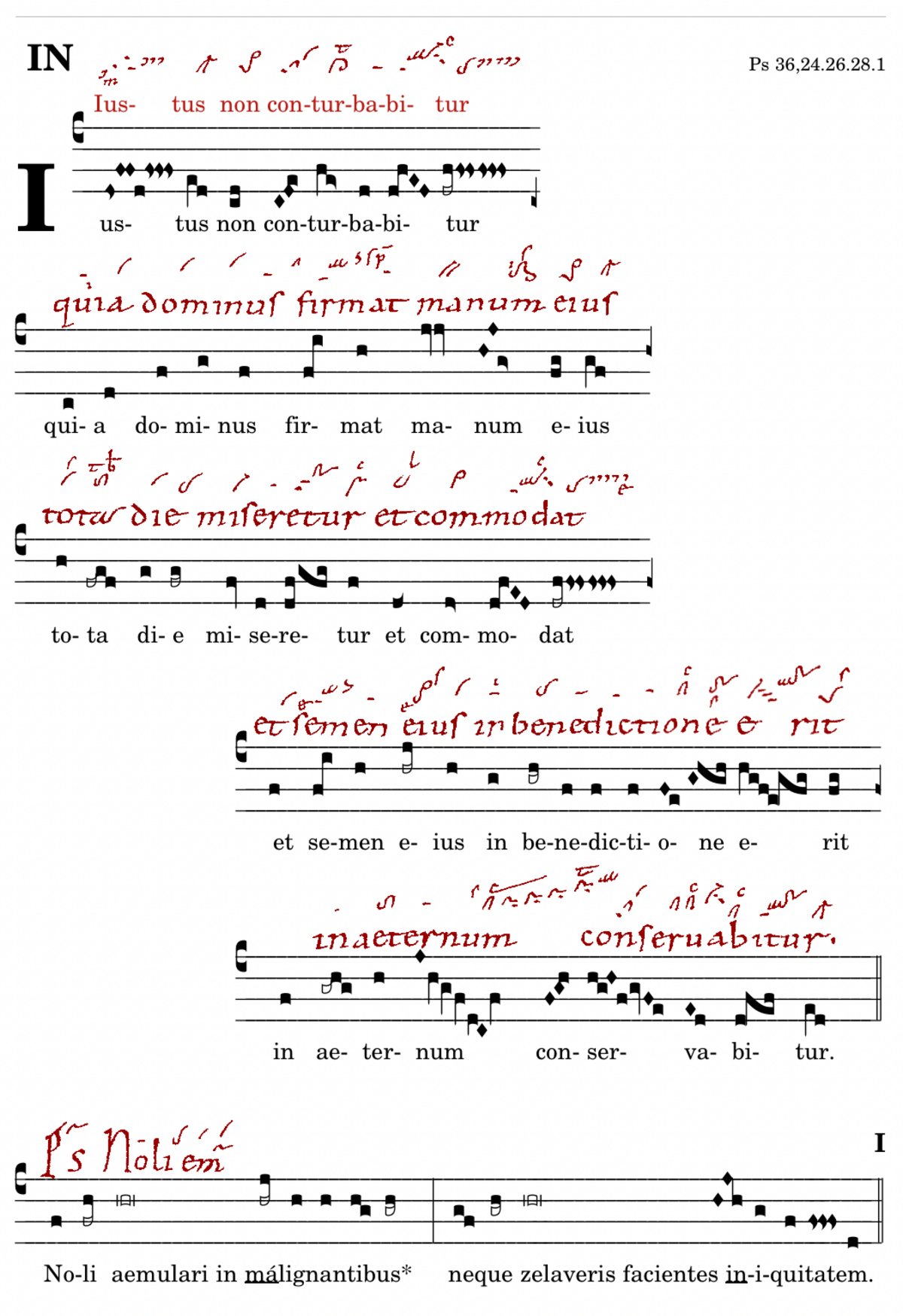
Die erste und dritte Zeile dieses fünfzeiligen Introitus des Protus sind gewöhnliche plagale Melodien „re-fa“ (2INC ad3), stark strophisch aufgeladen (keine Betonung aber Zeit). Das 'mediocriter' zum ersten Ton von „Iustus“ verhindert die ab der Jahrtausendwende beliebte (Auftakt-)Quart, die dem Tertardus zuzurechnen ist.
1. Zeile „non con-“ geht unter die Finalis.
3. Zeile beginnt auf „la“ ('sursum') „tóta díe“ ist die Hauptaussage dieser Zeile, „dí-e“ bleibt noch auf „sol“, der TrcFIN ist mit 'tenete bene' abgesichert. Der zweite Akzent „miserétur“ streift das „sol“ nur mehr. PesSbp und Strophicus 'fa' bilden den Abschluss sowohl der 1. als auch der 3.Zeile.„commodat“ - „-babitur“. Ungewöhnlich ist 'celeriter' und Episem auf dem oberen Ton des PesSbp bei „comm-mo-dat“ und „-ba-bi-tur“. Es ist der Versuch eine ausgewogene Akzentuierung zu erreichen: Betone, aber nicht zu viel!
„miseretur com-“ Das Episem auf dem Morphem („mis-“) sorgt dafür, dass es im Schatten des grammatikalischen Akzents „-re-“ nicht vernachlässigt wird. Die VStr „-tur“ kündigt den Terzsprung nach unten an, die Liqueszenzen „et comm-“ sorgen für bloße Rezitation auf der Finalis „re“. Das 'levare' auf “et“ meint den sonoren Mehrwert der Liqueszenz.
1 Iustus non conturbabitur
2 quia dominus firmat manum - eius
3 tóta die miserétur et commodat
4 . . . . . . . . . . . et sémen éius - in benedictione erit
5 . . . . . . . . . . . in aeternum - conservabitur.
 Der kompositorische Kern diese Introitus ist aber die variierende Wiederholung in den Zeilen 2, 4 und 5.
Die Kernpunkte dieses Cento sind „fa-la-do-fa“. Der Aufstieg „fa-la“ ist zweimal mit dem Quartpes „fa-sa“ als Akzenneume komponiert. Das Quilisma (TerzPes) ist durch den Oriscus zum oberen Ton als QuartPes ausgezeichnet. Im ersten Fall sichert das 'sursum parvulum“ die reine Quart „sa“.In der 5. Zeile geschieht der Aufstieg „fa-la“ mit dem Akzentvorbereitenden Trc (TrcPAR) „in ae-térnum“.
Der zweite Teil des Cento, Abstieg „do-fa“, geschieht in der 2. Zeile mit Bivirga „do“ und Trc „la-do-sol“- „mánum“. Das „fa“ wird mit der FML PeCL erreicht „éius“.
In der 4. Zeile führt die Melodie nach dem kPes „la-do“ ('sursum' ergo „do“) stufenweise zur Rezitation „fa“. Die 5. Zeile nutzt den Abstieg zum Gang durch die Oktav „do-do“, den gesamten Tonraum des 1. Modus zur Ausdeutung des Wortes „aeternum“. Eine Kette von vier Pressus gibt dem Abstieg Nachdruck, das 'celeriter' über allem fordert aber eine flüssige Darstellung dieser'Ewigkeit' (den Oriscus als eigenen Ton zu verstehen würde die Melodie zu einem Töneklopfen verkommen lassen).
Die 2. Zeile ist durch 2INC asc eingeleitet und endet mit FML PeCl auf „fa“ „quia dominus → firmat manum - eius
Die 4. und 5. Zeile haben keine eigene Einleitung, sie sind muteigenem Cento ausgeleitet. Auf
„semen eius“ folgt der Resonsorial-Cento RP1 D „in benedictione erit“ mit Pes am Schluss statt Clv : colon.
„in aeternum“ führt in den Resonsorial-Cento RP1 F, eine CAD mikro mit entsprechenden INCCAD.
Alles in allem betrachtet ist vorläufig festzustellen: IN und CO sind wesentlich geprägt durch die 'variierende Wiederholung' und durch die FML aus dem Antiphonen-Repertoire und die Centones aus den Responsorien.
Der Gerechte stürzt nicht hinab, denn der Herr stützt ihm seine Hand.

Den ganzen Tag erbarmt er sich und leiht,
und seine Kinder werden gesegnet sein,
in Ewigkeit bleiben sie bewahrt.

The righteous will not fall, for the Lord supports him with his hand.
All day long he shows mercy and lends,
and his children will be blessed; they will be preserved forever.
The first and third lines of this five-line introit by Protus are ordinary plagal melodies “re-fa” (2INC ad3), strongly strophic (no accent but time). The ‘mediocriter’ to the first note of “Iustus” prevents the (upbeat) fourth, which was popular from the turn of the millennium onwards and can be attributed to the Tertardus.
The first line “non con-” goes below the finalis.
The third line begins on “la” (‘sursum’). “tóta díe” is the main statement of this line, “dí-e” remains on “sol,” and the TrcFIN is secured with ‘tenete bene’. The second accent ‘miserétur’ only touches the “sol.” PesSbp and Strophicus ‘fa’ form the conclusion of both the 1st and 3rd lines. “commodat” - “-babitur”. Unusual is ‘celeriter’ and episem on the upper tone of the PesSbp at “comm-mo-dat” and “-ba-bi-tur”. It is an attempt to achieve balanced accentuation: emphasize, but not too much!
“miseretur com-” The episem on the morpheme (“mis-”) ensures that it is not neglected in the shadow of the grammatical accent “-re-”. The VStr “-tur” announces the third leap downwards, the liquefactions “et comm-” ensure mere recitation on the finalis ‘re’. The ‘levare’ on “et” refers to the sonorous added value of the liquefaction.
1 Iustus non conturbabitur
2 quia dominus firmat manum - eius
3 tóta die miserétur et commodat
4 . . . . . . . . . . . et sémen éius - in benedictione erit
5 . . . . . . . . . . . in aeternum - conservabitur.
However, the compositional core of this introit is the varying repetition in lines 2, 4, and 5.
The key points of this cento are “fa-la-do-fa.” The ascending “fa-la” is composed twice with the quartpes “fa-sa” as an accent. The quilisma (third Pes) is distinguished by the oriscus to the upper note as a fourth Pes. In the first case, the ‘sursum parvulum’ secures the pure fourth “sa.” In the fifth line, the ascent “fa-la” occurs with the accent-preparing Trc (TrcPAR) “in ae-térnum.”
The second part of the cento, the descent “do-fa,” occurs in the second line with Bivirga “do” and Trc “la-do-sol”- “mánum.” The ‘fa’ is achieved with the FML PeCL “éius.”
In the fourth line, the melody leads gradually to the recitation “fa” after the kPes “la-do” (‘sursum’ ergo ‘do’). The fifth line uses the descent through the octave “do-do,” the entire range of the first mode, to interpret the word “aeternum.” A chain of four pressus emphasizes the descent, but the ‘celeriter’ above everything else demands a fluid representation of this ‘eternity’ (understanding the Oriscus as a separate tone would reduce the melody to a series of notes).
The second line is introduced by 2INC asc and ends with FML PeCl on “fa” „quia dominus → firmat manum - eius
The fourth and fifth lines have no introduction of their own; they are derived from the centon itself. On
“semen eius” is followed by the resonorial cento RP1 D “in benedictione erit” with Pes at the end instead of Clv : colon.
“in aeternum” leads into the resonorial cento RP1 F, a CAD micro with corresponding INCCAD.
All in all, it can be provisionally concluded that IN and CO are essentially characterized by ‘varying repetition’ and by the FML from the antiphon repertoire and the centones from the responsories.