IN GR TR AL OF CO xxxxx 1️⃣ 2️⃣ 3️⃣ ✅ 5️⃣ 6️⃣ 7️⃣ 8️⃣ xxxxx AN RP IV alia
0986 OF Illumina oculos meos V2Modus 4
OF – V1 – V2 xxx ⏹️ xxx OT ?? - ON xx - BzG xx/xx
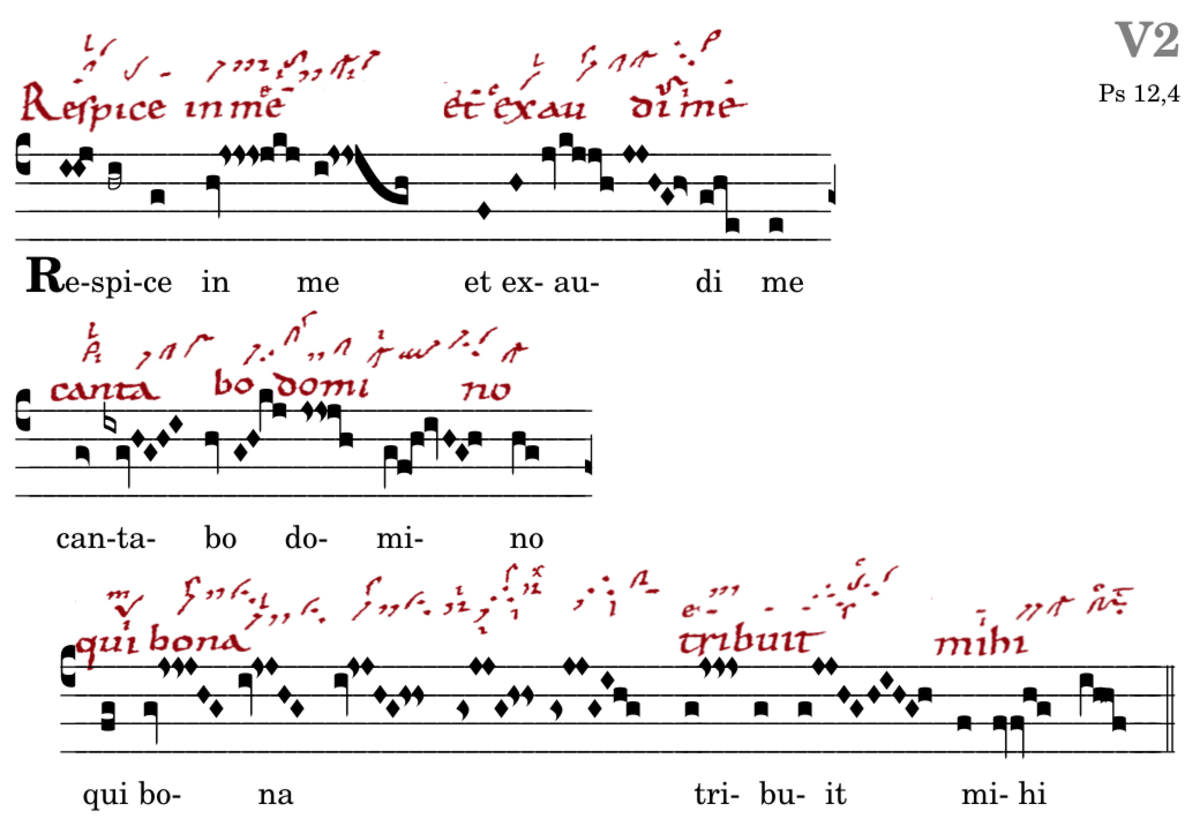
„et exaudi“ Wenn das kleine Häkchen über der Minuskel 'e' von “et“ als 'inferius' zu lesen ist, dann ist die Silbe mit Bv34 ein “fa“; wenn nicht, dann mit A, Y etc. ein „sol“. Die weiteren st. galler Quellen haben kein 'inferius'.
„can-ta-bo“ Abermals, die VStr ist kein Halbtonpes. Mp si naturale (h)!
„tribu-it“ Es gibt keinen Grund hier bereits ein “sa“ einzusetzen. Kl revidiert hier zum “do“, schreibt aber auf der drittletzten Note „mi-hi“ ein „b“ vor.
V2. Wende dich zu mir und erhöre mich.
Singen will ich dem Herrn, der mir Gutes getan hat!

V2. Turn to me and hear me.
I will sing to the Lord, who has done me good!
“et exaudi” If the small check mark above the lowercase ‘e’ in “et” is to be read as ‘inferius’, then the syllable with Bv34 is a ‘fa’; if not, then with A, Y, etc., it is a “sol.” The other St. Gallen sources do not have ‘inferius’.
“can-ta-bo” Once again, the VStr is not a semitone. Mp si naturale (h)!
“tribu-it” There is no reason to insert a “sa” here. Kl revises this to “do”, but writes a “b” before the third-last note “mi-hi”.