🔘 IN GR TR AL OF CO xxxxx 1️⃣ 2️⃣ 3️⃣ ✅ 5️⃣ 6️⃣ 7️⃣ 8️⃣ xxxxx AN RP IV alia
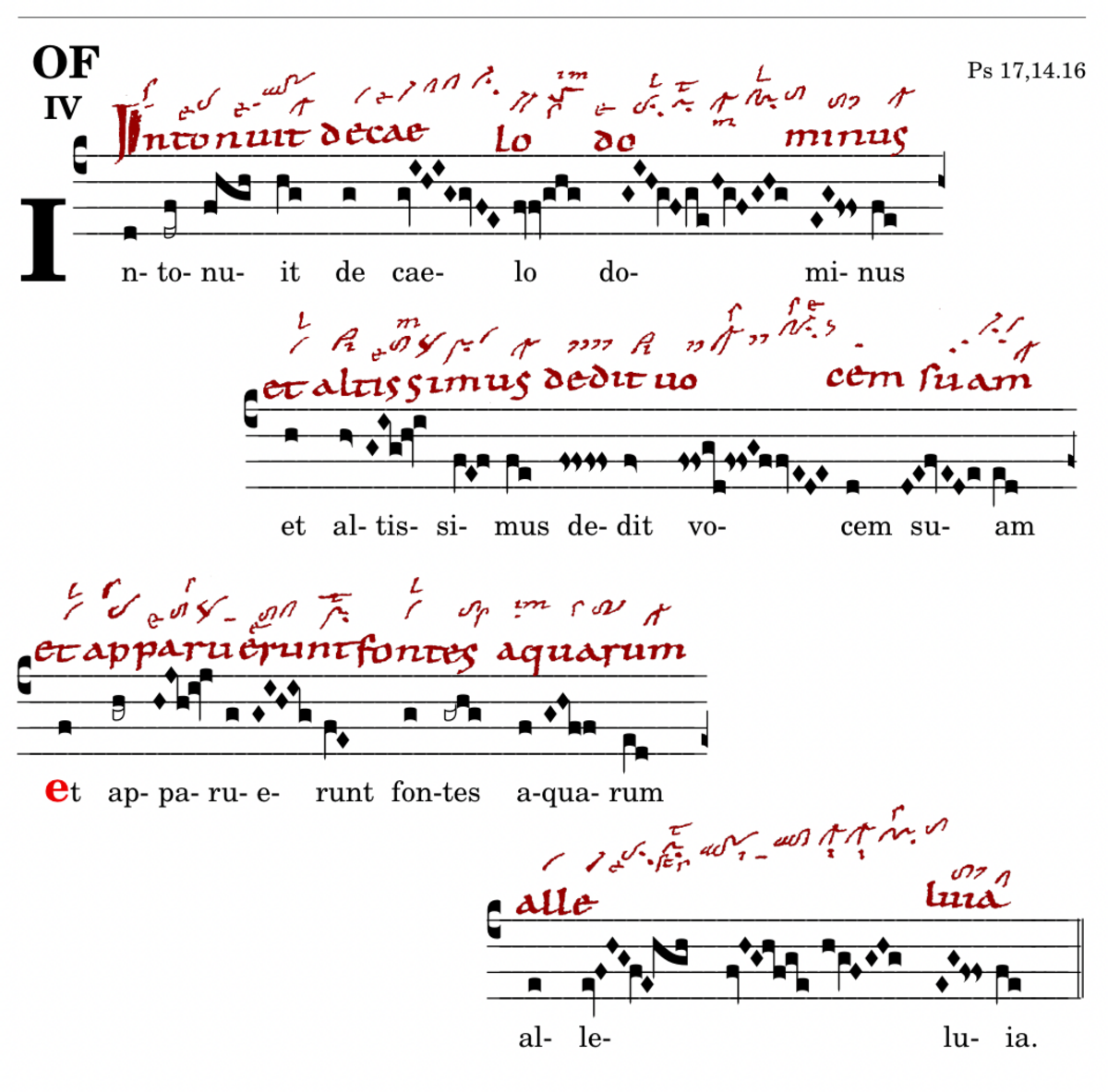
0550 OF Intonuit de caeloModus 4
OF – V1 – V2 xxx ⏹️ xxx GT 204 - GN 1/175 - BzG 48/20
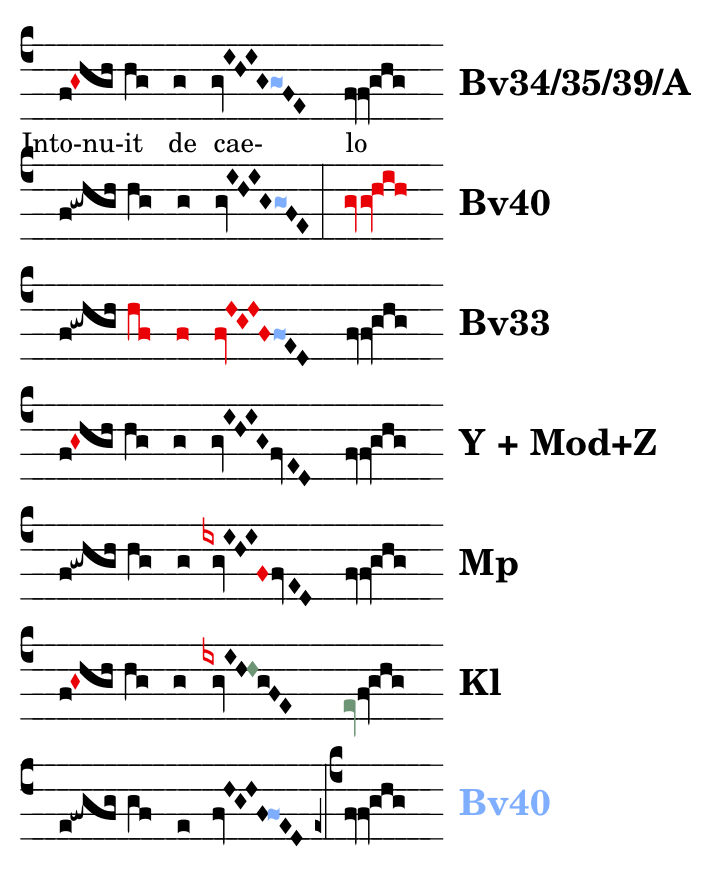 „de cae-lo“ „si“ oder „sa“ hängt ab von der Clm-Graphie am Ende der Neume „cae-lo“. Führt sie zum re, dann ist „sa“ logisch. Führt sie allerdings zum „mi“ (Bv34, 35, 39, A) ist das „si“ nahezu zwingend: reine Quint „si-mi“. Leider ist die Sache nicht so einfach.
Nach Bv40 führt die Melodie „cae-lo“ zum „sol“, das hieße wohl das Incipit des OF müsste einen Ton tiefer stehen (modale Centonisation).
In Bv33 ist die Melodie so verändert, dass „cae-lo“ zum „re“ führt.
A geht mit Bv34 + 35 + 39 (Clm zum „mi“), aber
Y führt die Reihe jener Quellen an, die zum „re gehen“ (Mod + Mp, Zt), die jüngeren schreiben auch das „b“.
Kl ist auch keine Hilfe: „b“ und das zum „mi“. Die beiden „do-Revisionen (Vermeiden des Halbtons, Vermeiden der Tonwiederholung) entsprechen dieser Ideologie.
Bleibt festzustellen: Bv34/35/39/A zwingen uns zum „si“. Bv40 (+33) weisen allerdings auf eine modale Centonisation hin, der wir mangels genügender Quellen nicht entsprechen.
„al-tissimus“ Cephalicus ja!, aber den Nebenton lehnen wir grundsätzlich ab; er ist Ausdruck der Plerosis auf dem Weg zur 2. Gregorianik. Keine der in BzG 48/21 genannten Quellen ist Zeuge eines zweiten Tons. Vor allem das nicht erwähnte Bv34 zeigt eindeutig auf, dass hier kein Nebenton zu singen ist. Das inferius unterhalb der LiqueszenzSchlaufe in E, Bam + G376 ist kein melodischer Hinweis, sondern einer des Ausdrucks („Nimm den Klang der Liqueszenz zurück, übertreibe nicht“). Wohl ist das equaliter nach dem Cephalicus in E ein Hinweis auf einen zweiten Ton, allerdings ist die Quelle E, gegen/ um 1000 geschrieben, selbst schon eine relativ junge Quelle die immer wieder den Einfluss von Plerosis und do-Revision erkennen lässt. Cf.:
„de-dit“ In der ganzen Reihe der beneventanischen Quellen ist ein zweiter Ton des Cephalicus am abschließenden Knoten der Neume abzulesen, allerdings in Bv33 nicht mehr.
„ap-pa-ruerunt“ Kl schreibt kein „sa““, das folgt erst auf der übernächsten Silbe
„apparu-e-runt“ cf.: „de caelo“. Die Clivis zum „mi“ (apparue-runt) spricht für „si-be-durum“: reine Quint.
Es donnerte der Herr vom Himmel / und der Höchste ließ seine Stimme ertönen.
Und es erschienen die Wasserquellen.
 Halleluja.

The Lord thundered from heaven / and the Most High let his voice be heard.
And the springs of water appeared.
 Hallelujah.
“de cae-lo” “si” or ‘sa’ depends on the Clm notation at the end of the neume “cae-lo”. If it leads to re, then “sa” is logical. However, if it leads to “mi” (Bv34, 35, 39, A), then ‘si’ is almost mandatory: pure fifth “si-mi.” Unfortunately, it's not that simple.
According to Bv40, the melody “cae-lo” leads to “sol,” which would mean that the incipit of the OF would have to be one tone lower (modal centonisation).
In Bv33, the melody is changed so that “cae-lo” leads to “re.”
A goes with Bv34 + 35 + 39 (Clm to “mi”), but
Y leads the series of sources that go to “re” (Mod + Mp, Zt), the more recent ones also write the “b”.
Kl is also no help: ‘b’ and that to “mi”. The two “do revisions” (avoiding the semitone, avoiding the repetition of notes) correspond to this ideology.
It remains to be noted: Bv34/35/39/A force us to “si.” However, Bv40 (+33) point to a modal centonisation, which we do not follow due to a lack of sufficient sources.
“al-tissimus” Cephalicus yes!, but we fundamentally reject the secondary tone; it is an expression of plerosis on the way to the 2nd Gregorian chant. None of the sources mentioned in BzG 48/21 bear witness to a second tone. Above all, the unmentioned Bv34 clearly shows that no secondary tone is to be sung here. The inferius below the licqueness loop in E, Bam + G376 is not a melodic indication, but one of expression (“Take back the sound of the licqueness, do not exaggerate”). Admittedly, the equaliter after the cephalicus in E is an indication of a second note, but the source E, written around 1000, is itself a relatively recent source that repeatedly reveals the influence of plerosis and do revision. Cf.:
“de-dit” In the entire series of Beneventan sources, a second tone of the Cephalicus can be read at the final knot of the neume, but not in Bv33.
“ap-pa-ruerunt” Kl does not write “sa,” which only follows on the next but one syllable
“apparu-e-runt” cf.: “de caelo.” The clivis to “mi” (apparue-runt) indicates “si-be-durum”: perfect fifth.