🔘 IN GR TR AL OF CO xxxxx 1️⃣ 2️⃣ 3️⃣ 4️⃣ ✅ 6️⃣ 7️⃣ 8️⃣ xxxxx AN RP IV alia
0747 CO Ultimo festivitatisModus 5
0745 ⟽ CO 5 ⟾ 1730 xxx ⏹️ xxx GT 251 - BzG 52/14 + GN 2/105
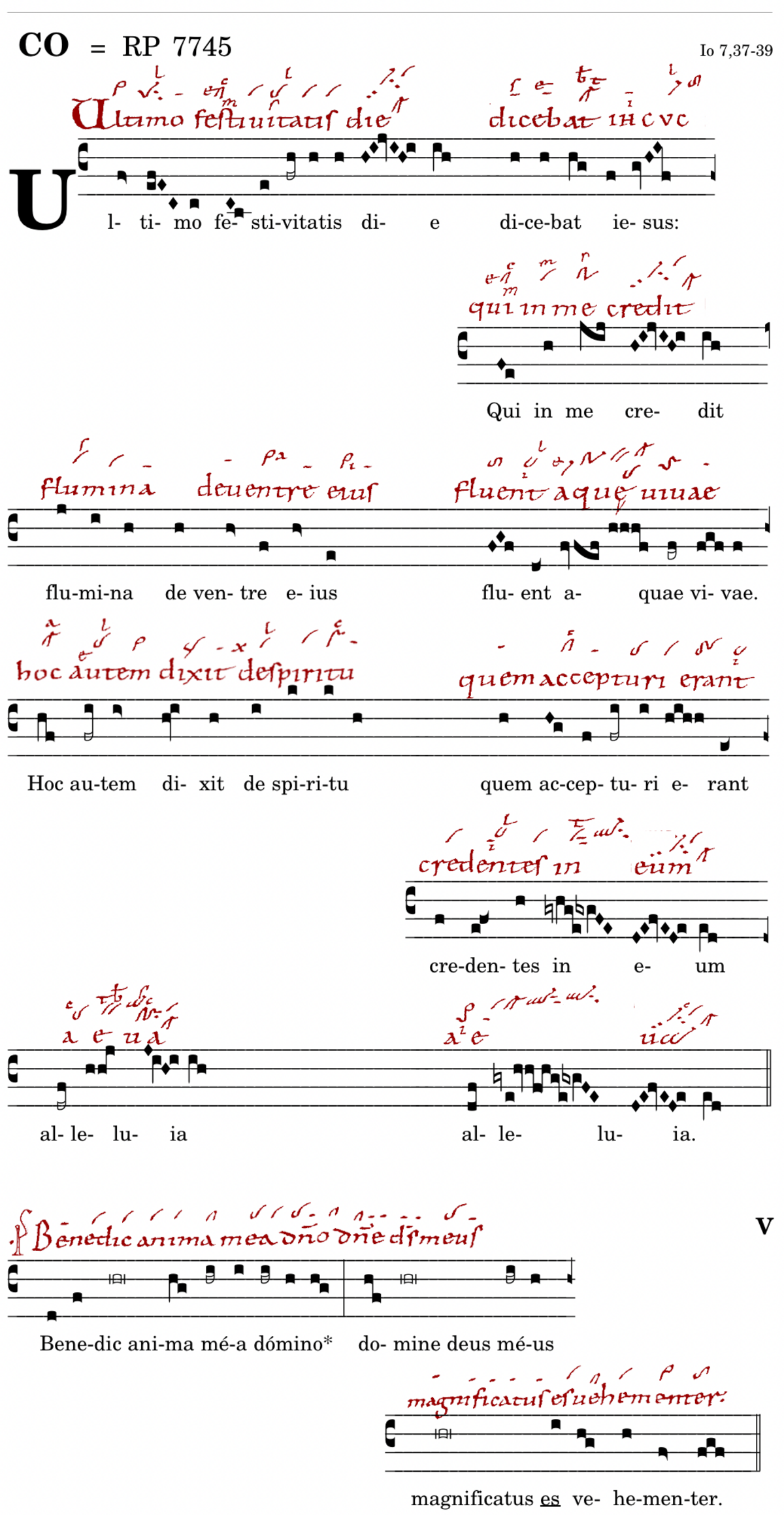
„Ultimo“ Der PesSbp könnte auch mit Quadrata beendet sein (Silbendartikulation, vide L + Ch ). Die Zisterzienser (Zt) ändern die Melodie, um den Ambitus nicht unter das „fa“ gehen zu lassen.
„festivitatis“ Die Clv ist in E, L + Ch als kurrent notiert, alle anderen Hss kennen bei der Clv den Unterschied k - nk nicht. Wir schreiben sie in allen Zeilen nk (Rhomba + Quadrata), denn die anderen Quellen notieren ja nicht eine nkClv, sondern ihre EinheitsClv, sie kennen den Unterschied nicht mehr.
Der kPes auf der mittleren Silbe geht in L über die Quart (unisonisch mit der Silbe vorher), Bv33, E, Ch + MR ( der erste Ton des Pes ist höher als der Ton zuvor: Pes disgregatus. Das hat melodische, aber keine artikulatorische Bedeutung) widersprechen dem.
„die“ Die CAD mega ist in der traditio occidentalis (frOc) leicht anders als in der traditio orientalis (frOr) Siehe dazu Semiologie CAD mega. Entsprechend auch „credit“, „eum“ und „alleluia 2“.
Die Liqueszenz auf der Endsilbe ist adiastematisch nur in MR belegt, diastematisch in allen Quellen außer Kl. Ist sie Zeichen einer traditio occidentalis ? Zw macht eine Clv daraus.
„dicebat“ Die Clv ist nk (Ch, L + E, dort sogar „bene tenete“ + Episem. Der Tonwechsel auf der Binnensilbe in Mod (Ansatz der Plerosis) wird in E durch „equaliter“ verhindert.
„iesús“ Bv33 Acuasta spricht den hebräischen Namen auftaktisch aus, bewusst auf der letzten Silbe betont.
„de ventre eius“ A, Y + Zt führen die absteigende Tonleiter zum „si“; MR + Ch sind hier schlechte Zeugen. Der Akzent „éius“: „do“ oder „si“? Kl + Mp kann man als der do-Revision anheimgefallen betrachten, nicht aber unbedingt Mod. Der nkPes in L spricht eher für „do“. Es bleibt die Frage Benevent „do“ oder Aquitanien „si“. Da die Aquitanier in solchen Fällen sehr oft, auch alleine, die Intervalle verkürzen entscheiden wir uns für „do“.
„flu-ent aquae vivae“ Epiphonus, „fa“ in Benevent, „sol“ in Aquitanien etc. In E hat der Epiphonus offensichtlich bereits einen zweiten, kleinen Ton; das „inferius“ kann „sol“ genauso wie „fa“ bedeuten, das „levare“ allerdings verlangt einen Aufstieg zu diesem Zusatzton der größer ist als eine Sekund. Das folgende „equaliter“ bestätigt indirekt das „fa“ als ersten Ton des Epiphonus. Der Text zu diesem Thema in den „BzG 52,15 Kommentar 5“ kann nur als Druckfehler interpretiert werden.
„fluent a-quae vivae“ Diese 4tonige Neume A-Por (Anfangsartikulation und dann Porrectusbewegung) muss das ganze Repertoire hindurch untersucht werden. Der Melodieverlauf in Mp (+Zt) könnte der Rest eines archaischen Zustands sein. Das Ausfüllen des Terzabsprungs nach dem Strophicus in Bv, A + Mp ist als Plerosis zu verstehen. Trc „vi-vae“ do-Revision in Kl. Das „subjice“ in L steht dagegen.
„hoc au-tem“ QuartPes in Kl. E sichert das durch „equaliter“ und „levare“.
„di-xit“ Pes quassus nur in E. Ist die Neume in Ch ( Tractulus- und OriscusGraphie, die auch für Quilisma stehen kann) auch ein Pes quassus.
„de spi-ri-tu“ Die Virga strata ( OriscusVirga = ~Vrg) in E zeigt an, dass die Melodie nachher abspringt. Sie ist in allen anderen adiastematischen und diastematischen Quellen als kHalbtonPes übertragen. Wir sind der Überzeugung, dass das Oriscus-Zeichen keinen Ton meint, sondern eine Spezifizierung ist, vergleichbar einem Episem oder Buchstaben. Kl weicht dem Halbton aus mit Tristropha.
„cre-den-tes“ Der Epiphonus wie der Cephalicus haben keinen kleinen zweiten Ton, die Liqueszenz, auch die diminutive Liqueszenz, unterdrückt ihn im authentischen Choral. Die meisten unserer Quellen, auch schon im 10.Jh rechnen mit einem solchen zweiten Ton. Wir notieren diesen nur, wenn in der jeweiligen Schreibgestalt ein fixer zweiter Tonort erkennbar ist.
„credentes in eum“ Die klassische große Kadenz des 5. Modus, die den Tonraum „fa-la-(si)-do“ heruntertransformiert zur Tetrachordspannung „sa-la-sol-fa“( wie im 8.Modus „do-si-la-sol“). Das führt oft zur chromatisch fallenden Linie „do-si-sa-la“, oder sagen wir es italienisch „do-si-si(be-molle)-la“ Einige Quellen lösen das Problem indem sie statt des ersten „si“ ein „la“ schreiben und singen (hier Kl, aber das muss gegen der do-Revision ohnehin so handeln), die jüngeren Quellen setzten schon vor das erste „si“ ein b-molle, so Mp + Zt. Das Auffüllen zur Tonleiter (Plerosis) wie in MR, A, Y, Mod, Mp beseitigt das Problem nicht. Für Ch, L + E ist wahrscheinlich, dass sie wie Bv34 kein „la“ meinen, sondern ein „si“. Aus dem Vergleich vieler (aller?) großer Kadenzen des 5.Modus sind wir überzeugt, hier wird die Chromatik bewusst ausgespielt. Dass Chromatik im authentischen Choral verboten ist, nicht vorkommt, ist ein Vorurteil des 19.Jh.
In „alleluia 1+2“ wird der Kontrast Dreiklang f-a-c (mit si) gegen Quartraum „sa-fa“ deutlich sichtbar.
Am letzten Tag des Festes sagte Jesus:
Wer an mich glaubt, aus seinem Leib werden Ströme
von lebendigem Wasser fließen.
Das sagte er aber von dem Geist, den die empfangen sollten,
welche an ihn glauben.
Halleluja, Halleluja.

On the last day of the feast, Jesus said:
He that believeth on me, out of his belly shall flow rivers of living water.
Now he said this about the Spirit, which those who believe in him should receive.
Hallelujah, hallelujah.
‘Ultimo’ The PesSbp could also end with a quadrata (syllabic articulation; see L + Ch). The Cistercians (Zt) alter the melody so that the range does not fall below the ‘F’.
‘festivitatis’ The Clv is notated in E, L + Ch as kurrent; all other manuscripts do not distinguish between k and nk in the Clv. We write it as nk (rhombus + quadrata) in all staves, as the other sources do not notate an nkClv but their standard Clv; they no longer recognise the distinction.
The kPes on the middle syllable crosses the fourth in L (in unison with the preceding syllable); Bv33, E, Ch + MR (the first note of the Pes is higher than the note before: Pes disgregatus. This has melodic, but no articulatory significance) contradict this.
‘die’ The CAD mega is slightly different in the traditio occidentalis (frOc) than in the traditio orientalis (frOr). See Semiology CAD mega. The same applies to ‘credit’, “eum” and ‘alleluia 2’.
Liquefaction on the final syllable is attested adiastematically only in MR, diastematically in all sources except Kl. Is it a sign of a traditio occidentalis? Zw makes a Clv out of it.
‘dicebat’ The Clv is nk (Ch, L + E, there even ‘bene tenete’ + Episem. The change of tone on the internal syllable in Mod (the onset of plerosis) is prevented in E by ‘equaliter’
‘iesús’ Bv33 Acuasta pronounces the Hebrew name with an upbeat intonation, deliberately emphasising the final syllable.
‘de ventre eius’ A, Y + Zt lead the descending scale to ‘si’; MR + Ch are poor witnesses here. The accent ‘éius’: ‘do’ or “si”? Kl + Mp can be regarded as having succumbed to the do revision, but not necessarily Mod. The nkPes in L tends to favour ‘do’. The question remains: Benevento “do” or Aquitaine “si”. Since the Aquitanians very often shorten the intervals in such cases, even on their own, we opt for “do”.
‘flu-ent aquae vivae’ Epiphonus, “fa” in Benevento, “sol” in Aquitaine, etc. In E, the epiphonus evidently already has a second, lower note; the “inferius” can mean “sol” just as well as “fa”, but the “levare” requires an ascent to this additional note that is greater than a second. The following “equaliter” indirectly confirms “fa” as the first note of the epiphonus.
The text on this subject in ‘BzG 52,15 Commentary 5’ can only be interpreted as a misprint.
‘fluent a-quae vivae’ This 4-note neume A-Por (initial articulation followed by a porrectus movement) must be examined throughout the entire repertoire. The melodic progression in Mp (+Zt) could be the remnant of an archaic state. The filling in of the third leap after the Strophicus in Bv, A + Mp is to be understood as plerosis. Trc ‘vi-vae’ do-revision in Kl. The ‘subjice’ in L, however, stands in contrast to this.
‘hoc au-tem’ QuartPes in Kl. E confirms this with “equaliter” and ‘levare’.
‘di-xit’ Pes quassus only in E. Is the neume in Ch (Tractulus and Oriscus notation, which can also stand for Quilisma) also a Pes quassus?
‘de spi-ri-tu’ The virga strata (Oriscus virga = ~Vrg) in E indicates that the melody subsequently jumps down. It is transcribed as a k-semitone pes in all other adiastematic and diastematic sources. We are convinced that the Oriscus sign does not denote a note, but is a specification, comparable to an Episem or letter. Kl avoids the semitone with Tristropha.
‘cre-den-tes’ Neither the Epiphonus nor the Cephalicus have a small second note; the liquefaction, including the diminutive liquefaction, suppresses it in the authentic choral. Most of our sources, even as early as the 10th century, assume the presence of such a second note. We notate this only if a fixed second tone is recognisable in the respective notation.
‘credentes in eum’ The classical major cadence of the 5th mode, which transforms the pitch range ‘fa-la-(si)-do’ downwards into the tetrachordal interval ‘sa-la-sol-fa’ (as in the 8th mode ‘do-si-la-sol’). This often leads to the chromatically descending line ‘do-si-sa-la’, or to put it in Italian ‘do-si-si(B flat)-la’
Some sources resolve the problem by writing and singing an “A” instead of the first “B” (here Kl, but this must be done anyway in the do-revision); the later sources already insert a B-flat before the first “B”, as in Mp + Zt. Filling out to the scale (plerosis) as in MR, A, Y, Mod, Mp does not resolve the issue. For Ch, L + E, it is likely that, like Bv34, they do not mean a “la” but a “si”. From a comparison of many (all?) major cadences in the 5th mode, we are convinced that chromaticism is deliberately employed here. The notion that chromaticism is forbidden in authentic chorale, or does not occur, is a 19th-century prejudice.
In “alleluia 1+2”, the contrast between the triad F–A–C (with B) and the fourth interval “B–F” becomes clearly apparent.