🔘 IN GR TR AL OF CO xxxxx 1️⃣ 2️⃣ 3️⃣ 4️⃣ 5️⃣ 6️⃣ 7️⃣ ✅ xxxxx AN RP IV alia
0889 OF Ave maria V1Modus 8
OF – V1 – V2 xxx ⏹️ xxx OT 13 - GN xx - BzG 67/10
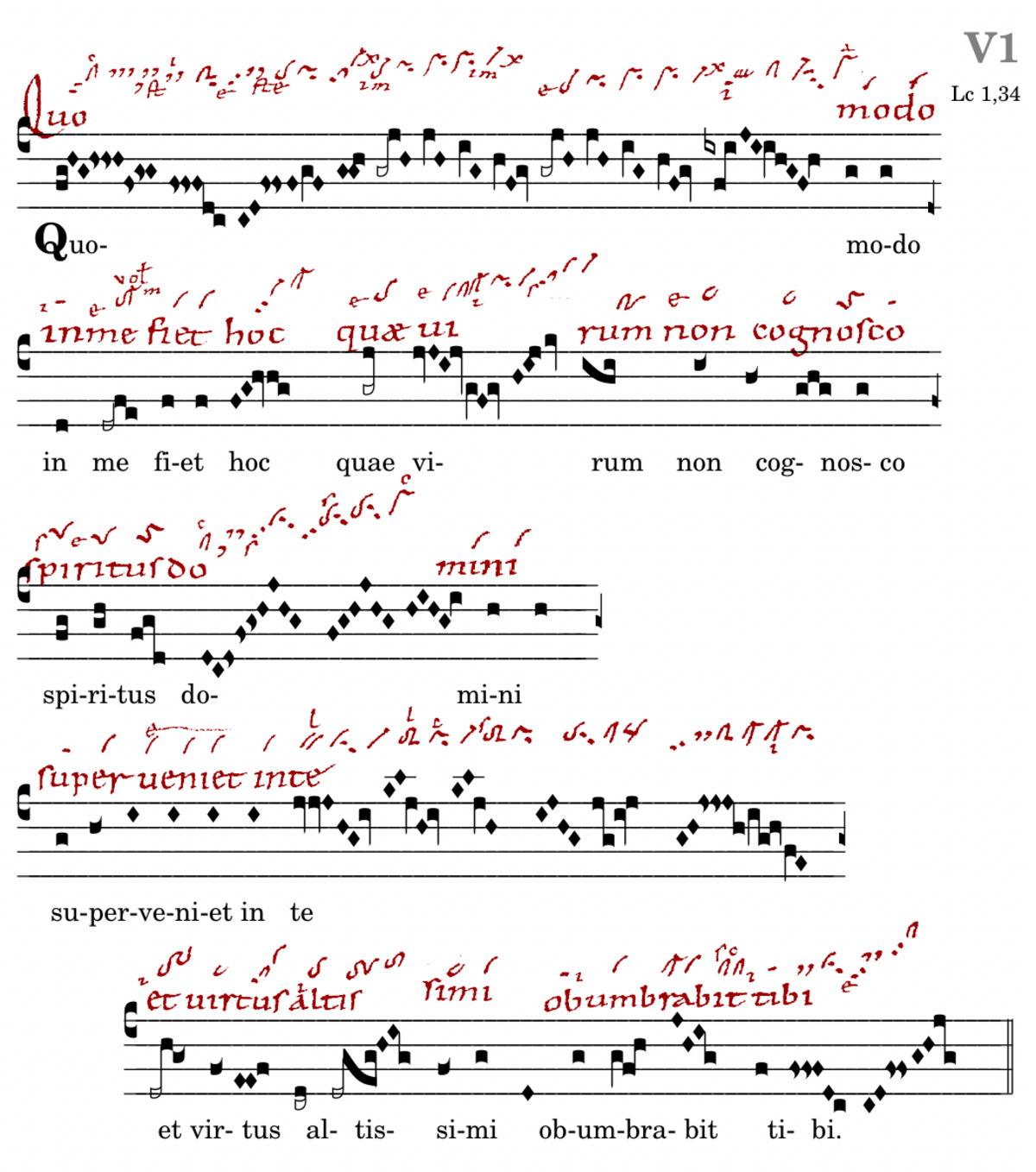
„non cognosco - spiritus“ L und E verweisen auf einen höheren ersten Ton von „spiritus“. Sollte hier tatsächlich die Quarttransposition nach oben von Mp Platz greifen? Die komplexe Fragestellung zu solchen Transpositionen ist nicht Gegenstand dieser Untersuchung.
„superveniet“ Rezitation si (Ch,L?) oder do (E,Bv,A). Beides hat seine Logik: staunen oder triumphieren.
„altissimi“ auf der vorletzen (Binnen)silbe steht ein Epiphonus, kein kPes. Damit ist das Wort endbetont:„altissimí“. Das Wort meint den Unnennbaren: WHWJ.
„in me fiet“ Warum sich hier die BzG auf Kl stützen und „ do verwenden entgegen A, Y, Bv34 und Mp ist nicht nachzuvollziehen.
V1. Wie soll das in mir geschehen / die ich doch keinen Mann erkenne?
Der Geist des Herrn wird über dich kommen / und die Kraft des Höchsten wird dich überschatten.

V1. How shall this happen in me / who recognise no man?
The Spirit of the Lord will come upon you / and the power of the Most High will overshadow you.
„non cognosco - spiritus“ L and E refer to a higher first note of „spiritus“. Should the fourth transposition upwards from Mp really be used here? The complex question of such transpositions is not the subject of this study.
„superveniet“ Recitation si (Ch,L?) or do (E,Bv,A). Both have their logic: marvel or triumph.
„altissimi“ there is an epiphonus on the penultimate syllable, not a kPes. The word is thus finalised: „altissimí“. The word means the unnameable: WHWJ.
“in me fiet„ Why the BzG rely on Kl and use “ do in contrast to A, Y, Bv34 and Mp is incomprehensible.