🔘 IN GR TR AL OF CO xxxxx ✅ 2️⃣ 3️⃣ 4️⃣ 5️⃣ 6️⃣ 7️⃣ 8️⃣ xxxxx AN RP IV alia
0665 CO Illumina faciem tuamModus 1
0658 ⟽ CO 1 ⟾ 0666 xxx ⏹️ xxx GT 271 - GN 1/237 - BzG 38/36 ; 41.42/363️⃣ AB - CD - EF
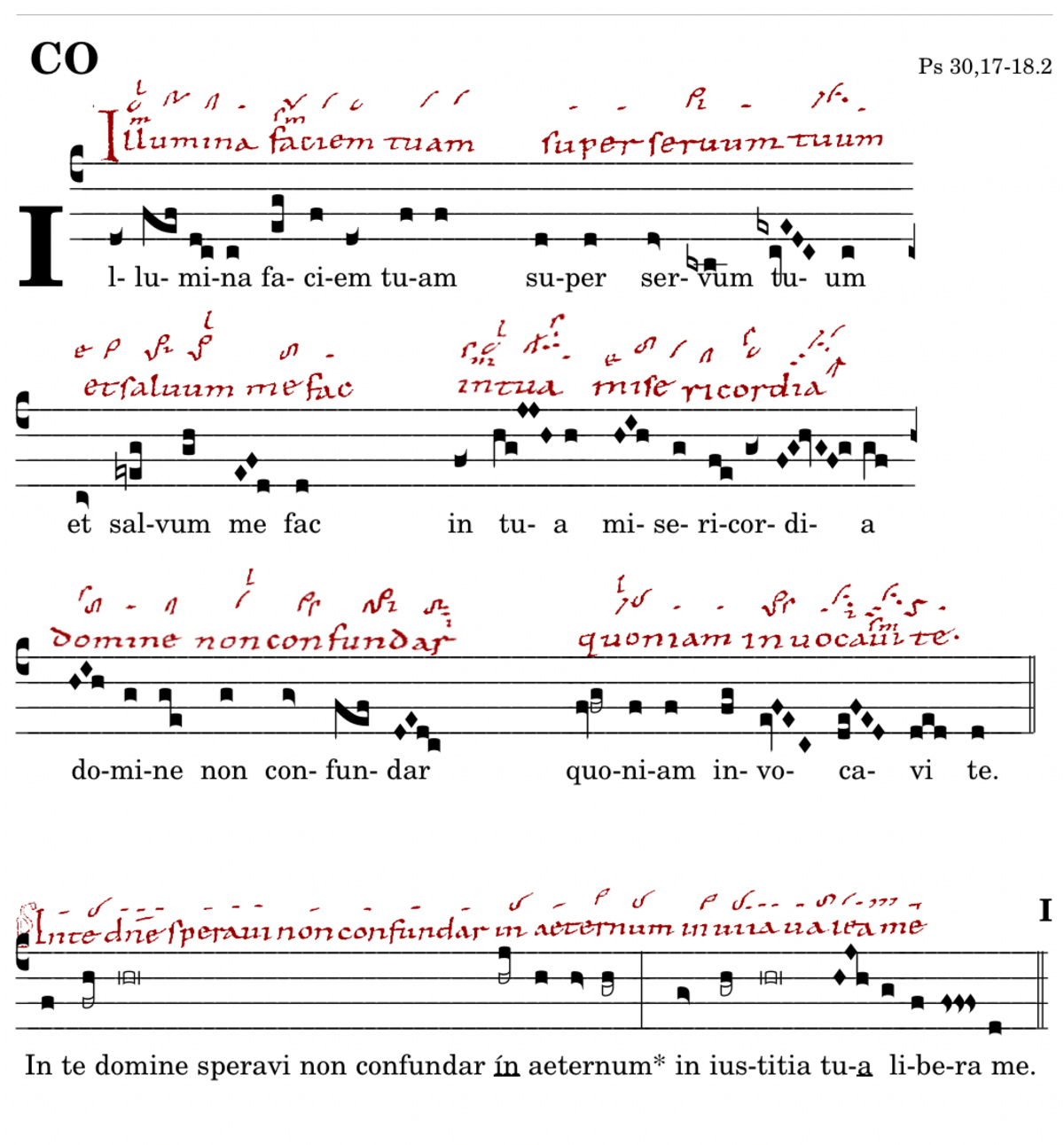
Ein kompliziertes Stück, schon im 10.Jh nicht mehr einheitlich tradiert:
A „fa-ciem“ Der TerzPes ist in Bv34, Mod + Mp bestätigt. Auch die Transposition in Kl (do-Revision) spricht dafür.
B „servum tuum“ T1 zur Komplexität der Transposition in T1 vide: BzG 36,36f. Die Transposition an dieser Stelle ist offensichtlich. Die Frage ist, wie und wo sie rückgängig gemacht wird, denn ein Beginn der Co auf „mi“ (Höhertransposition des ersten Teils „Illumina faciem tuam super“) ist unwahrscheinlich, G381 mit seinem equaliter am Psalmversende spricht dagegen. Noch vor „tua misericordia“ muss die Rücktranspostion gesehen, ab „tua“ ist die Melodie ein in sich geschlossener Protus authenticus.
„tuum et“ in E equaliter, sic!
C „et salvum“ Der Übergang der beiden Silben in L + Bv34 equaliter, aber nicht in Ch.
„et salvum“ nur in BzG Quartaufstieg, in den Quellen überall Terz„!. „et salvum“. In A TerzPes. Unsere Lösung daher TerzPes „mi-sol“ womit die Rücktransposition vollzogen ist.
D “in tua„ Das sursum in E spricht gegen Tol. Die „Taktstriche“ in T1 zeigen an, in welchem Bereich eine Transposition stattfindet.
“mi-sericordia do-mine„ Die beiden TrcAkz gehen zum „si“ (la-si-la). Die Faustregel (einhellige Meinung Agustoni, Joppich, R.Fischer) wenn Kl do schreibt, dann war es „si“. Abgesehen davon steht das „si“ des Torculus zum jeweiligen Finalton „mi“ ( mise-ri-cordia domi-ne) im Abstand der reinen Quint.
E
F
Lass dein Angesicht leuchten / über deinem Knecht,
mache mich heil in deiner Barmherzigkeit.
Herr, lass mich nicht zuschanden werden / denn dich habe ich angerufen.

Let your face shine / upon your servant,
make me whole /in your mercy.
Lord, do not let me be put to shame / for I have called upon you.
A complicated piece, already no longer uniformly transmitted in the 10th century:
“et salvum” The transition of the two syllables in L + Bv34 equaliter, but not in Ch.
“fa-ciem” The third Pes is confirmed in Bv34, Mod + Mp. The transposition in Kl (do revision) also supports this.
“servum tuum” T1 on the complexity of the transposition in T1 vide: BzG 36,36f. The transposition at this point is obvious. The question is how and where it is reversed, because a beginning of the Co on “mi” (higher transposition of the first part “Illumina faciem tuam super”) is unlikely; G381 with its equaliter at the end of the psalm verse argues against this. The retransposition must be seen before “tua misericordia”; from “tua” onwards, the melody is a self-contained protus authenticus.
“tuum et” in E equaliter, sic!
“et salvum” only in BzG quartal ascent, in the sources everywhere third“!.
“et salvum”. In A thirdPes. Our solution therefore thirdPes “mi-sol,” with which the retransposition is complete.
“in tua” The sursum in E argues against Tol.
The “bar lines” in T1 indicate the range in which a transposition takes place.
“mi-sericordia do-mine” The two TrcAkz go to “si” (la-si-la). The rule of thumb (unanimous opinion of Agustoni, Joppich, R. Fischer) is that when Kl writes do, it was “si.” Apart from that, the ‘si’ of the Torculus is at a distance of a perfect fifth from the respective final note “mi” (mise-ri-cordia domi-ne).