🔘 IN GR TR AL OF CO xxxxx 1️⃣ 2️⃣ ✅ 4️⃣ 5️⃣ 6️⃣ 7️⃣ 8️⃣ xxxxx AN RP IV alia
0610 CO Beatus servusModus 3
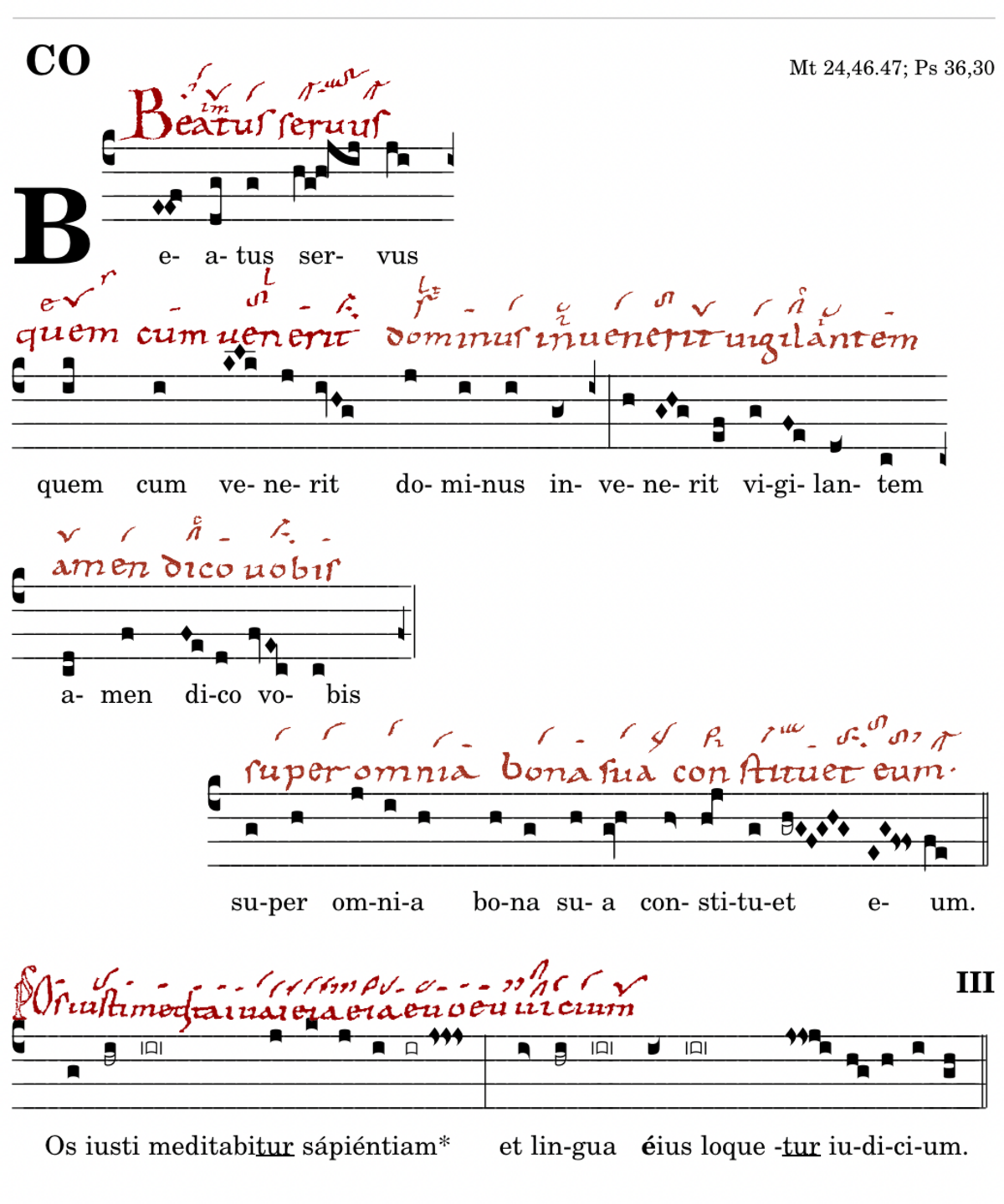
0604 ⟽ CO 3 ⟾ 0612 xxx ⏹️xxx GT 491 - GN 1/309 - BzG 43/35Diese Communio im 3. Modus transponiert im Mittelteil zum Protus (1TER de5 vom „si“ weg): modale Modulation. Wir notieren das nicht durch Vorzeichen, sondern durch Versetzung mittels Custos. ˜˜ Der 3. Modus (DT mysterium fidei) spricht über Glaubenswahrheiten, Gotteserfahrungen etc. Der 'Komponist' dieser CO wendet beim Text „invenerit vigilantem“ die Melodie in den 1.Modus und die 1TER de5. Hier geht es nicht mehr um Transzendenz sondern um handfeste Praxis! Der melodische Höhepunkt, über das „do“ hinaus, liegt allerdings bei „quem cum vénerit“
Glücklich der Knecht,
den der Herr, wenn er kommt, wachend finden wird.
Wahrlich, ich sage euch:
über alle seine Güter wird er ihn einsetzen.

Blessed is that servant whom his master finds awake when he comes.
Truly, I say to you,
he will set him over all his possessions.
This Communio in Mode 3 transposes to Protus in the middle section (1TER de5 away from “si”): modal modulation. We do not notate this with accidentals, but rather with transposition using Custos.
The 3rd mode (DT mysterium fidei) speaks of truths of faith, experiences of God, etc. The ‘composer’ of this CO applies the melody in the 1st mode and the 1TER de5 to the text “invenerit vigilantem.” Here it is no longer a matter of transcendence but of tangible practice! However, the melodic climax, beyond the “do,” lies at “quem cum vénerit.”