🔘 IN GR TR AL OF CO xxxxx 1️⃣ 2️⃣ ✅ 4️⃣ 5️⃣ 6️⃣ 7️⃣ 8️⃣ xxxxx AN RP IV alia
0727 CO Scapulis suisModus 3
0717 ⟽ CO 3 ⟾ 0743 xxx ⏹️xxx GT 77 - BzG 24/26 + GrN 1/69
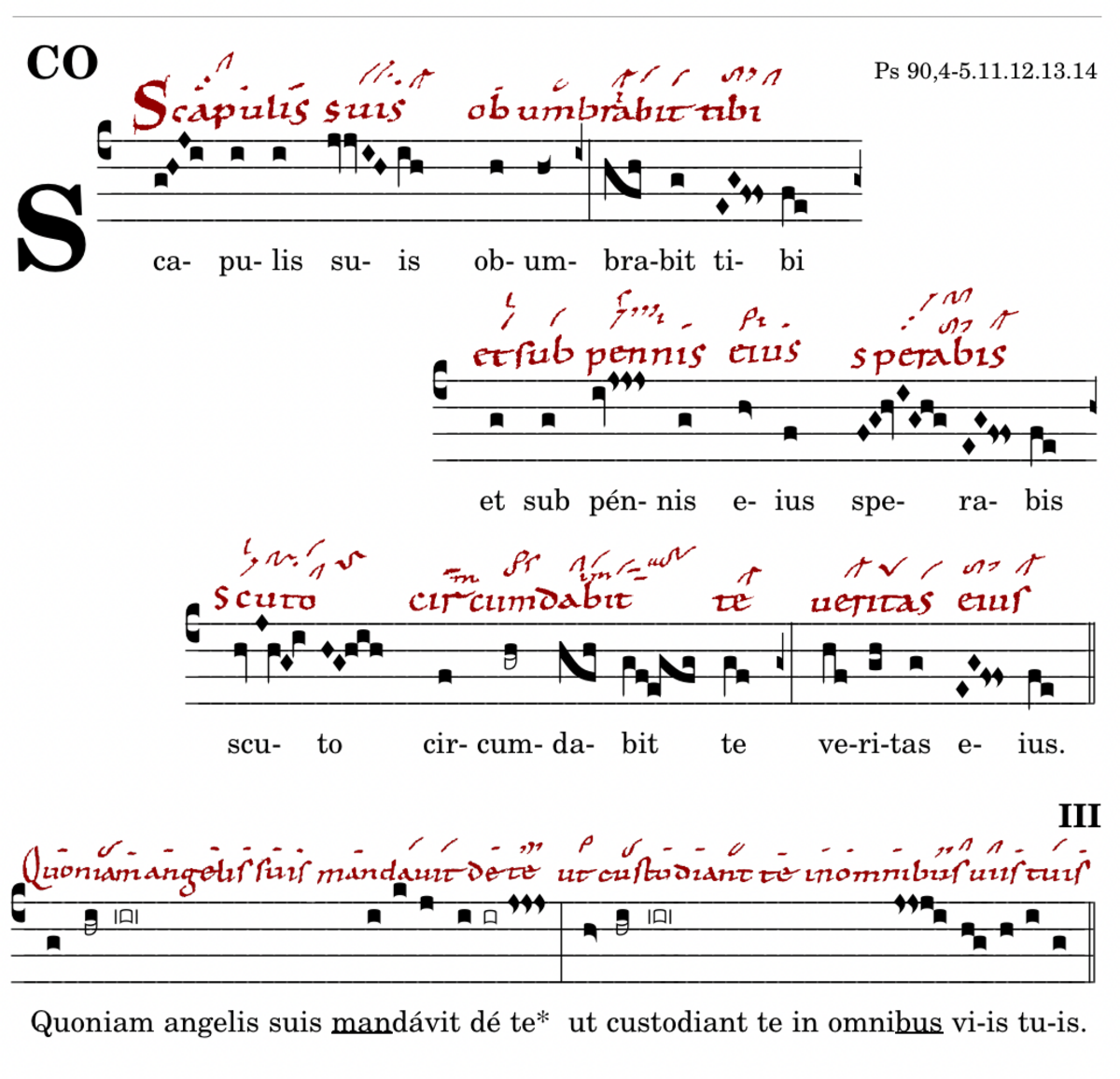
Ein transponierendes Stück (cf.: BzG 24,26). Diese Transposition wird in den unterschiedlichen Handschriften unterschiedlich dargestellt. Ausgangspunkt müssen die Aquitanier A + Y sein. Während A grundsätzlich den Melodieverlauf ohne Rücksicht auf Halbtöne (Vorzeichen) notiert, verschiebt Y Teile der Melodie, um „halbtongerecht“ zu notieren. (cf. Rupert Fischer BzG 23, 90). Daraus ergibt sich für „Scapulis suis“ folgende Situation:
Im Verhältnis zum Anfang „Scapulis suis obum-“ und dem Schluss „veritas eius“ ist das gesamte Stück einen Ton höher zu transponieren, was zu „fis“ und „cis“ führen würde. Wir notieren die Transposition durch „Taktstrich“ und Custos. A und Y sind viceversa zu lesen: Y notiert den Mittelteil tiefer, um die Halbtöne richtig darzustellen, A hat den Melodieverlauf richtig, wir haben ihn tiefer transponiert.
In Bv34 und Kl ist der Teil „circumdabit te“ im Verhältnis zu den anderen Quellen bereits „richtig“ notiert; Bv34 setzt den ersten Teil „Scapulis suis obum-“ tiefer („fa-sa“) und somit in Relation zum Folgenden richtig. Mp notiert im Tonraum „do-fa“ mit konsquenter Anwendung des tiefen „si-be-molle“, hat damit aber den Mittelteil der Communio auch nicht transponiert.
In Bv33 sind die Übergänge zwischen den Perioden nicht adäquat notiert ( „tibi / et“,„sperabis / scuto“ ) !
„et sub pén-nis eius sperabis“ der Cento RP Ω i zeigt das Fehlen jeder Betonung an. Der Akzent liegt zuvor bei „pénnis“.
Er beschirmt dich mit seinen Flügeln,
unter seinen Schwingen findest du Zuflucht,
Schild und Schutz ist seine Treue.

He shields you with his wings,
you find refuge under his wings,
shield and protection is his faithfulness.
A transposed piece (cf.: BzG 24,26). This transposition is represented differently in the various manuscripts. The Aquitanian manuscripts A and Y must be taken as the starting point. Whilst A generally notates the melodic progression without regard to semitones (accidentals), Y shifts parts of the melody in order to notate it ‘in semitones’. (cf. Rupert Fischer BzG 23, 90). This results in the following situation for “Scapulis suis”:
In relation to the beginning “Scapulis suis obum-” and the end “veritas eius”, the entire piece must be transposed up a tone, which would lead to “F#” and “C#”. We notate the transposition using a ‘bar line’ and Custos. A and Y are to be read vice versa: Y notates the middle section lower to represent the semitones correctly; A has the melodic progression correct, but we have transposed it lower.
In Bv34 and Kl, the section ‘circumdabit te’ is already notated ‘correctly’ in relation to the other sources; Bv34 sets the first part “Scapulis suis obum-” lower (“fa-sa”) and thus correctly in relation to what follows. Mp notates in the “do-fa” range with consistent use of the low “si-be-molle”, but has therefore not transposed the middle section of the Communio either.
In Bv33, the transitions between the phrases are not notated correctly ( ‘tibi / et’, ‘sperabis / scuto’ ) !
‘et sub pén-nis eius sperabis’ the Cento RP Ω i indicates the absence of any stress. The accent previously lay on ‘pénnis’.