🔘 IN GR TR AL OF CO xxxxx ✅ 2️⃣ 3️⃣ 4️⃣ 5️⃣ 6️⃣ 7️⃣ 8️⃣ xxxxx AN RP IV alia
0641 CO Ecce virgoModus 1
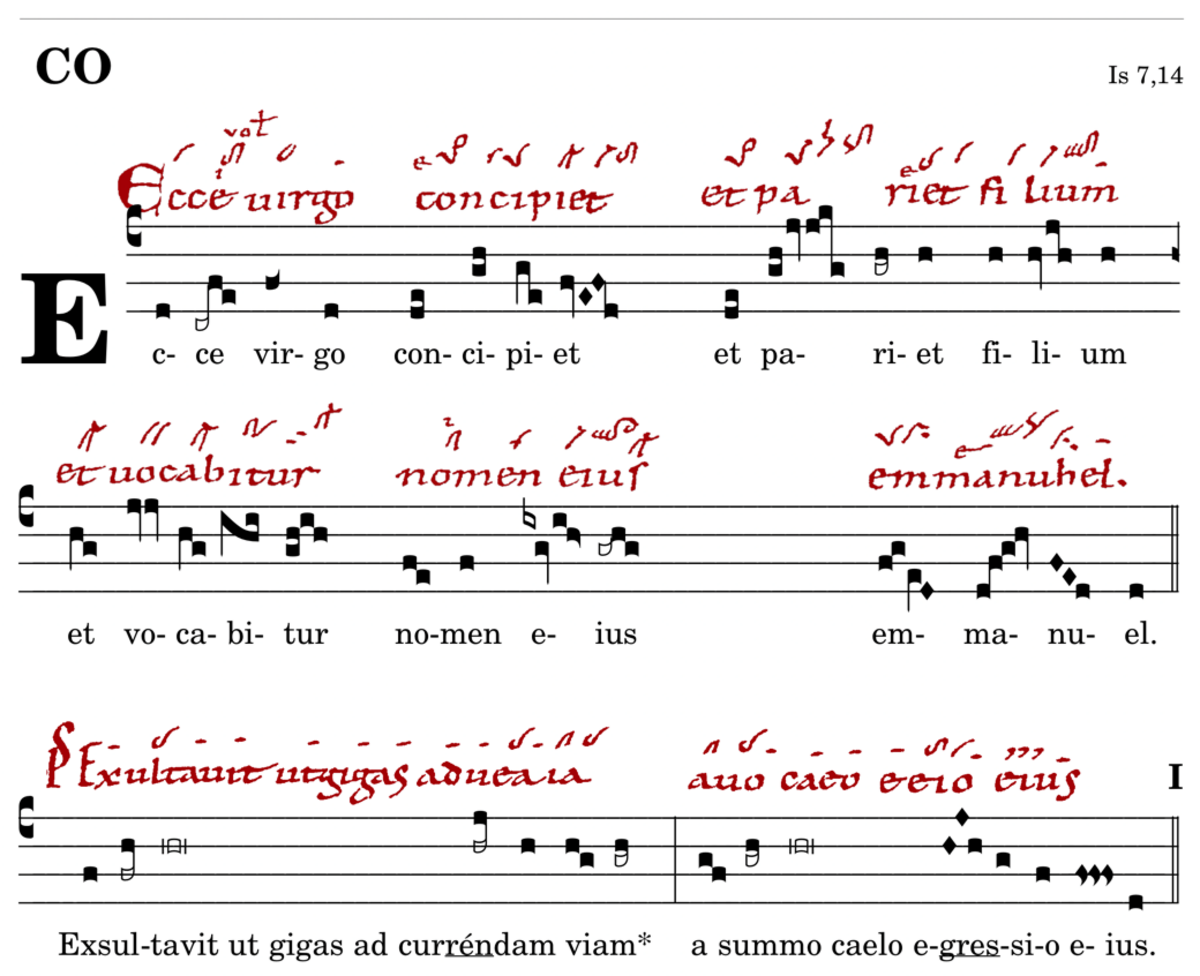
0634 ⟽ CO 1 ⟾ 0645 xxx ⏹️ xxx GT 37 - GN 1/19 - BzG 21/40„Ec-ce virgo“ Ein TrcINT, dessen praetonische Silbe nur eine Terz tiefer steht als der Gipfelton des Trc. Trotzdem ist sein erster Ton, das Portamento, nicht unisonisch, sondern durch 'inferius' einen Ton tiefer gesetzt. Vergleichbar der FML alloquium in der Weihnachts-Antiphon „Hodie“ 0170 wird beim ersten Erscheinen einer neuen Formel der Melodieverlauf durch litterae festgelgt; im Wiederholungsfall ist das nicht mehr nötig. Der Intonationstorculus ist also auf eine Quart festgelegt, egal welcher Ton zuvor steht. Es gibt also keinen TrcINT über die Terz. Ohnehin ist der Trc specialis initio debilis und in nicht schriftlich fixierten und mündlich tradierten Melodien stellt sich die Frage nach unisonisch ohnehin nicht.
Bemerkenswert ist der 'unisonische Anschluss' (?) in L, aber auch der tiefer stehende Binnenpes bei „pariet“.
Seht, die Jungfrau wird empfangen und einen Sohn gebären.
Und genannt wird er: Emmanuel – Gott mit uns.

Behold, the virgin will conceive and bear a son.
And he will be called Emmanuel - God with us.
“Ec-ce virgo” A TrcINT whose praetonic syllable is only a third lower than the peak tone of the Trc. Nevertheless, its first tone, the portamento, is not unison, but is set a tone lower by ‘inferius’. Comparable to the FML alloquium in the Christmas antiphon “Hodie” 0170, the melody is determined by litterae when a new formula appears for the first time; this is no longer necessary in the case of repetition. The intonation torculus is therefore fixed at a fourth, regardless of the preceding tone. There is therefore no TrcINT above the third. In any case, the Trc specialis initio debilis and in melodies that are not fixed in writing and are transmitted orally, the question of unison does not arise anyway.
Noteworthy is the ‘unison connection’ (?) in L, but also the lower internal pes in “pariet.”