🔘 IN GR TR AL OF CO xxxxx ✅ 2️⃣ 3️⃣ 4️⃣ 5️⃣ 6️⃣ 7️⃣ 8️⃣ xxxxx AN RP IV alia
0645 CO Ego vos elegiModus 1
0641 ⟽ CO 1 ⟾ 0648 xxx ⏹️ xxx GT 436 - GN 1/208 - BzG 30/22
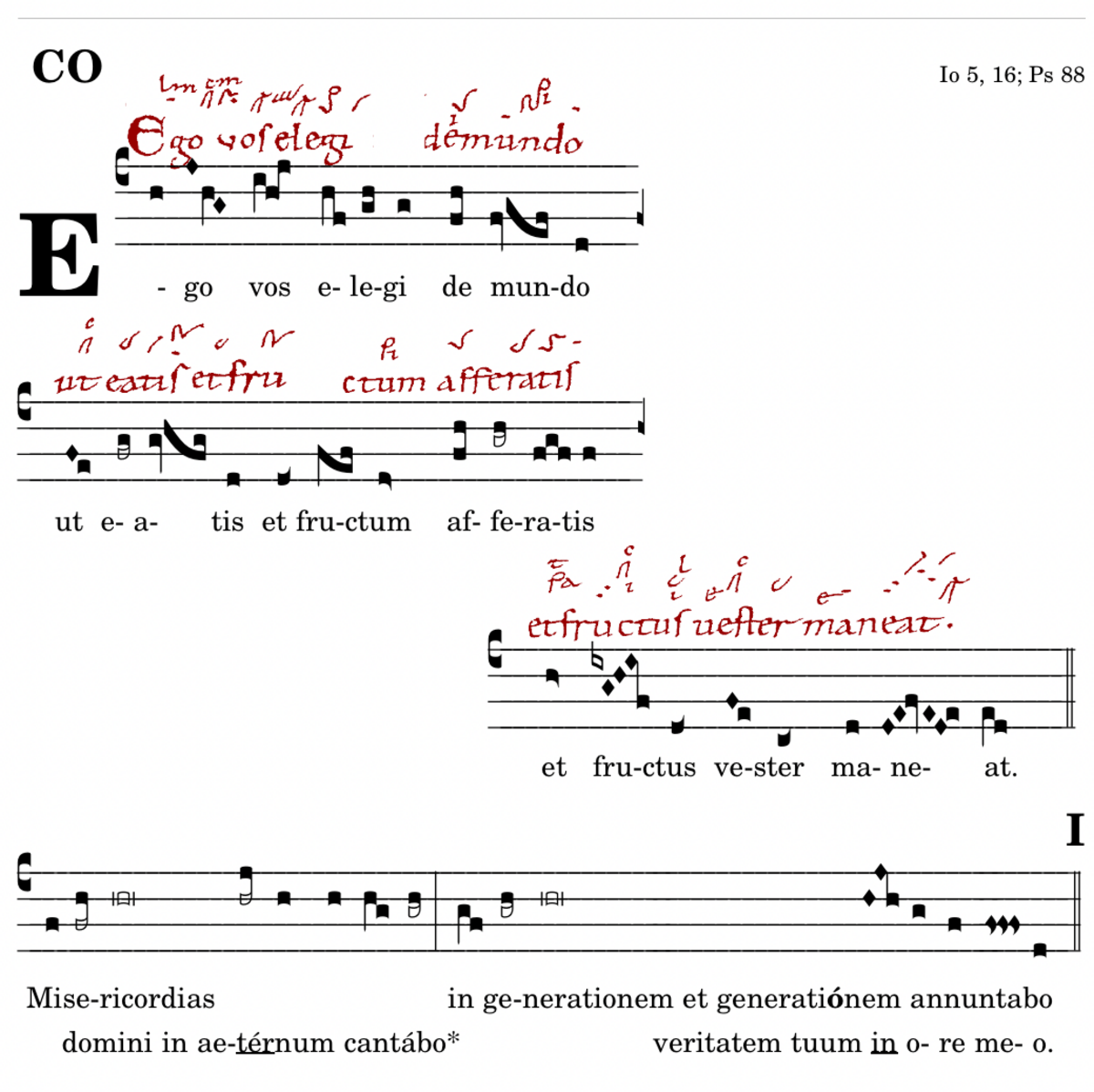
„Ego“ FML rever auf zwei Silben aufgeteilt. Legt Tenor „la“ fest.
„vos“ nkPrr breitet aus und verweist trotzdem weiter.
„mundo“ FML A-Prr auf „fa“.
„ut eátis“ Nach einem rudimentären TrcINT abermals FML A-Prr, nun auf „sol“.
„afferatis“ FML quia und CAD minima.
Die drei Centones sind eher individuell als formal komponiert:
• „Egó vós elegi de mundo“ steigt vom Tenor „la“ ab zur Finals „re“. „Egó“ und „vós“ führen zum höchsten Ton der gesamten CO „do“ und schöpfen so den Tonraum des 1. Modus aus („do-do“).
• „ut eátis et fructum áffératis“ Tenorebenen „sol - la - fa“. Die CAD auf „fa“ gibt dem Satz einen positiven, frohen Charakter, um im letzten Cento wieder zur Ernsthaftigkeit des 1. Modus zurück zu kehren:
• „et fructus vester maneat“. Die CAD mega bestätigt die Wichtigkeit der Aussage „máneat“.
Sehr fragwürdig sind die beiden 'equaliter' bei “fructus 'e' vester 'e' maneat“. Beide können nur als Beweis für einen kleinen Nebenton des Epiphonus verstanden werden (Bv34,Y etc.). Das 'levare' bei „fructus“ kann für sich allein noch als emotional klangliche Verstärkung der Schlusssilbe verstanden werden. Die 'equaliter aber, so sie nicht a.m. sind, wären ein Beweis für die Veränderung der Singgewohnheiten schon in E (um 1000) am Ende des 10. Jahrhunderts. Wir negieren die beiden 'e', anders als GR und GN, und verstehen sie als Fehler.
Ich habe euch aus der Welt erwählt, damit ihr geht, und Frucht bringt,
und damit eure Frucht bleibt.

I have chosen you out of the world so that you may go and bear fruit
and that your fruit may remain.
“Ego” FML rever divided into two syllables. Sets tenor “la.”
“vos” nkPrr spreads out and still refers further.
‘mundo’ FML A-Prr on “fa”.
“ut eátis” After a rudimentary TrcINT, again FML A-Prr, now on ‘sol’.
“afferatis” FML quia and CAD minima.
The three centones are composed individually rather than formally:
• “Egó vós elegi de mundo” descends from the tenor “la” to the final “re”. “Egó” and “vós” lead to the highest note of the entire CO, “do,” thus exploiting the tonal range of the 1st mode (“do-do”).
• “ut eátis et fructum áffératis” tenor levels “sol - la - fa”. The CAD on ‘fa’ gives the movement a positive, joyful character, only to return to the seriousness of the 1st mode in the last cento:
• “et fructus vester maneat”. The CAD mega confirms the importance of the statement “máneat”.
The two ‘equaliter’ in “fructus ‘e’ vester ‘e’ maneat” are highly questionable. Both can only be understood as evidence of a small secondary tone of the epiphonus (Bv34,Y etc.). The ‘levare’ in “fructus” can still be understood on its own as an emotional tonal reinforcement of the final syllable. The ‘equaliter’, however, if they are not a.m., would be evidence of a change in singing habits already in E (around 1000) at the end of the 10th century. We negate the two 'e's, unlike GR and GN, and understand them as mistakes.