🔘 IN GR TR AL OF CO xxxxx ✅ 2️⃣ 3️⃣ 4️⃣ 5️⃣ 6️⃣ 7️⃣ 8️⃣ xxxxx AN RP IV alia
0054 IN Exaudi domine --- tibi dixitModus 1
0050 ⟽ IN 1 ⟾ 0057 xxx ⏹️ xxx GT 241 - GN 1/213 - BzG 33/20
3️⃣ AIB - CD - EYF
↔️ Ab XB - bXB - BXB - F
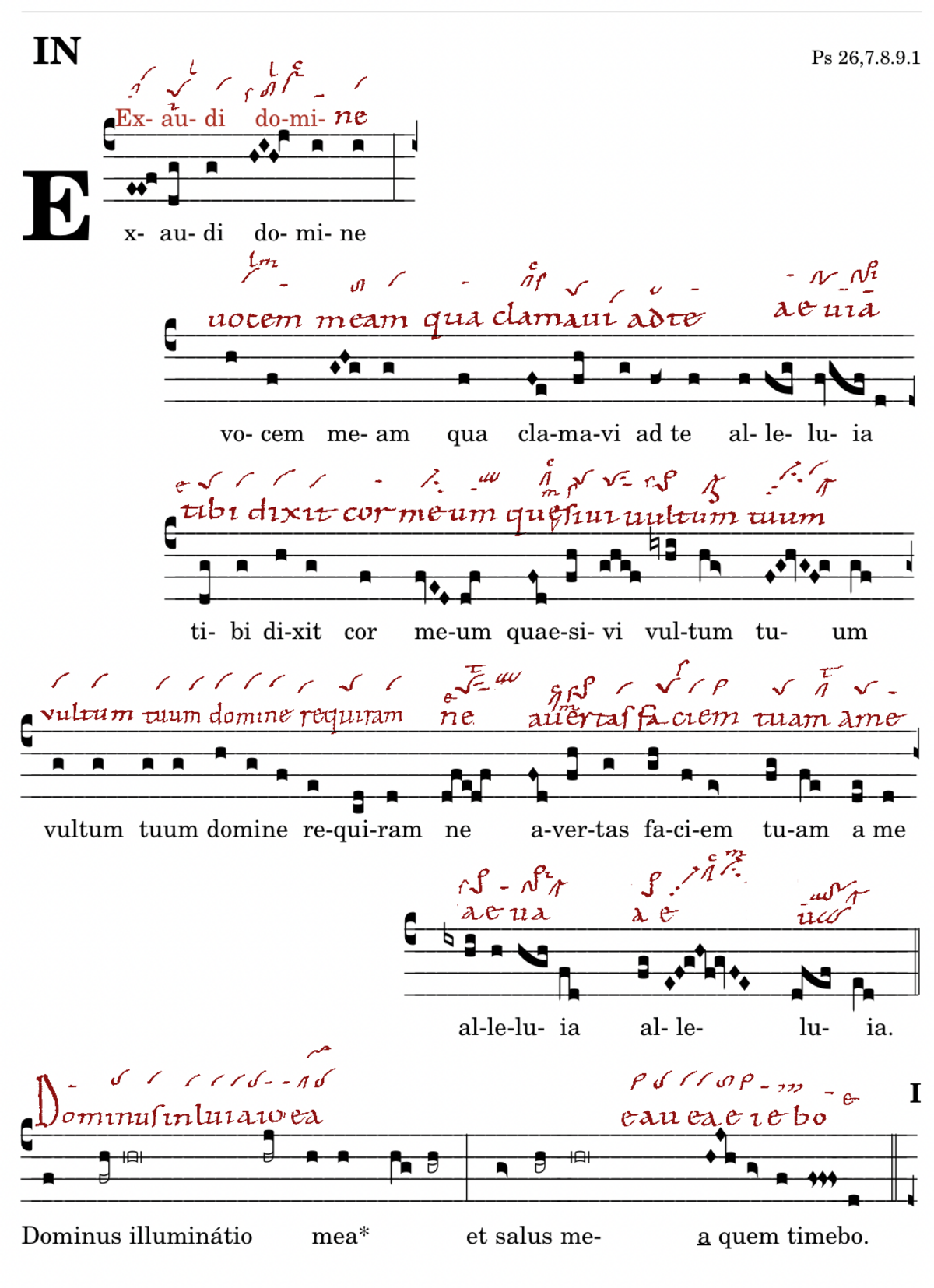
 Centologisch gesehen besteht der IN aus drei Zeilen, denen ein Incipit des 3.Modus vorangestellt ist: „Exaudi domine“ und ein zweifaches „Alleluia“ 1TER de5 nachgestellt ist. Die drei Zeilen:
1 vocem meam / qua clamavi ad te / alleluia
2 tibi dixit cor meum / quaesivi vultum tuum
3 vultum tuum domine requiram / ne avertas faciem tuam a me.
• Sie sind um eine Zentralformel gruppiert, die aus Clv „fa-re“ und Akzentpes „fa-la“ besteht, es folgt der Abstieg „sol-fa“. Die zweite, mittlere Zeile allerdings kadenziert auf „fa“ (CAD mega D).
• Eingeleitet sind die drei Teile mit 1NOV typ einakzentig (gag): Rezitation „sol“, Akzent „la“, von dem die Melodie stufenweise zum „fa“ geht.
• Den Schluss der Zeile bildet 2INC cad, der Abstieg vom „fa“ zum „re“.
ZENTRALFORMEL

A Die kTerz-Clv ist zum Halbton verkürzt (Bv, Kl, Zt und E 'sursum' gegenüber sonst 'mediocriter'. Textausdeutung, der Notschrei. „clamávi“ ist besser mit Halbton eingeleitet, der Epiphonus „ad te“ verhindert einen (Akzent-)Pes.
B nkPesSbp, die Meditationsneume steht auf der Endsilbe des Wortes „quaesivi“. „vultum“ ist mit FML PeCl angereichert. Es gibt keinen Grund hier ein „sa“ zu verwenden. Zt, Mod und Mp schreiben mit ihrer Schlüsselung zwar „mi“, aber Kl schreibt „do“. Das mystische Angesicht des Herrn, „vultum domini“ ist mit einem Tritonus besser umschrieben als mit einem biederen „sa“.
C „fáciem“ führt zum „mi“, der Akzent ist mit nkPes besetzt.
.
1NOV typ
 C Der Cento 1NOV typ ist in der dritten Zeile (C) unverändert verwendet. Akzent „la“ bei „dómine“. Der Abstieg führt weiter bis zum „re“.
B Der Quart-Pes „ti-bi“ sorgt für unisonischen Anschluss. Der Cento schließt klassisch mit „fa“, aber es folgt eine Formula potestatis (FML pot) auf „me-um“. In der Zeile C ist diese FML auf eine Silbe reduziert und nach vorne unisonisch angeschlossen „ne“.
A Abermals modifiziert der unisonsiche Anschluss den Cento, der Akzent „me-am“ trägt den klassischen kurrenten Akzent-Trorculus. Die eigentliche Struktur von 1NOV typ ist kaum mehr ahnen, trotzdem ist sie latent.
.
2INC cad
 C Die fallende Linie „fa-mi-re“ ist mit FML PeCl angereichert, dazu trägt „á me“ einen Akzent-Pes.
A Hier ist die fallende Linie „alleluia“ mit zweimal Porrectus ( Pro + A-Prr ) sozusagen 'gegen den Strich gebürstet'. Das „alleluia“ ist eben kein Abschluss! Die Resupin-Bewegung ist weniger eine Akzentuierung als ein Element der Beschleunigung.
B Die Kadenz mega auf „fa“ hingegen ist ein Abschluss, modern gesprochen auf der parallel Dur-Tonart, sozusagen Halbschluss des Introitus.
Erhöre, Herr,
meine Stimme, mit der ich zu dir rief, Halleluja.
Mein Herz sprach zu dir: Dein Angesicht habe ich gesucht!
Dein Angesicht, Herr, will ich suchen. Wende dein Angesicht nicht von mir,
Halleluja, Halleluja.

Hear, Lord,
my voice with which I called to you, alleluia.
My heart said to you: I have sought your face!
I will seek your face, Lord. Do not turn your face from me,
Hallelujah, Hallelujah.
Centologically speaking, the IN consists of three lines, preceded by an incipit in the 3rd mode: ‘Exaudi domine’ and followed by a double ‘Alleluia’ 1TER de5. The three lines:
1 vocem meam / qua clamavi ad te / alleluia
2 tibi dixit cor meum / quaesivi vultum tuum
3 vultum tuum domine requiram / ne avertas faciem tuam a me.
• They are grouped around a central formula consisting of Clv ‘fa-re’ and accent pes ‘fa-la’, followed by the descent ‘sol-fa’. The second, middle line, however, cadences on ‘fa’ (CAD mega D).
• The three parts are introduced with 1NOV type single accent (gag): Recitation ‘sol’, accent ‘la’, from which the melody gradually descends to ‘fa’.
• The line ends with 2INC cad, the descent from “fa” to ‘re’.
CENTRAL FORMULA
A The kTerz-Clv is shortened by a semitone (Bv, Kl, Zt and E “sursum” as opposed to “mediocriter” elsewhere. Text interpretation, the cry for help. ‘clamávi’ is better introduced with a semitone, the epiphonous ‘ad te’ prevents an (accented) Pes.
B nkPesSbp, the meditation neume is on the final syllable of the word ‘quaesivi’. “vultum” is enriched with FML PeCl. There is no reason to use a ‘sa’ here. Zt, Mod and Mp write ‘mi’ with their notation, but Kl writes ‘do’. The mystical face of the Lord, ‘vultum domini’, is better described with a tritone than with a staid ‘sa’.
C “fáciem” leads to ‘mi’, the accent is occupied by nkPes.
.
1NOV type
C The Cento 1NOV type is used unchanged in the third line (C). Accent ‘la’ at ‘dómine’. The descent continues to ‘re’.
B The quart pes ‘ti-bi’ provides a unison connection. The Cento closes classically with “fa”, but this is followed by a Formula potestatis (FML pot) on ‘me-um’. In line C, this FML is reduced to one syllable and connected unisonically to ‘ne’.
Once again, the unison connection modifies the Cento, with the accent ‘me-am’ carrying the classical cursive accent trorculus. The actual structure of 1NOV type is hardly recognisable, yet it remains latent.
.
2INC cad
C The falling line ‘fa-mi-re’ is enriched with FML PeCl, and ‘á me’ carries an accent Pes.
A Here, the descending line ‘alleluia’ is ‘brushed against the grain’, so to speak, with two porrectus (Pro + A-Prr). The ‘alleluia’ is not a conclusion! The resupine movement is less an accentuation than an element of acceleration.
B The mega cadence on ‘fa’, on the other hand, is a conclusion, in modern terms on the parallel major key, a semi-conclusion of the introit, so to speak.