🔘 IN GR TR AL OF CO xxxxx 1️⃣ 2️⃣ 3️⃣ 4️⃣ ✅ 6️⃣ 7️⃣ 8️⃣ xxxxx AN RP IV alia
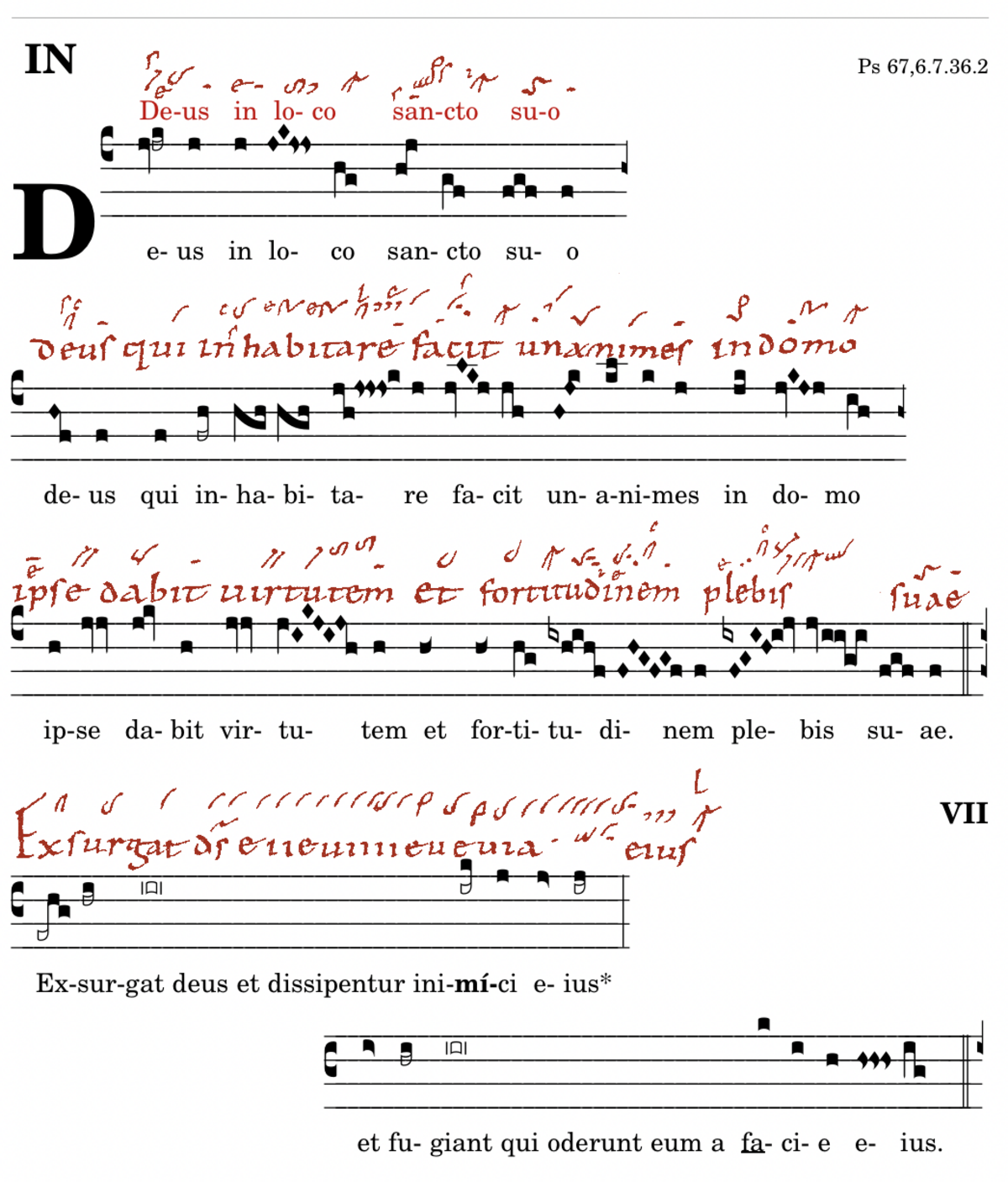
0022 IN Deus in loco sanctoModus 5
0012 ⟽ IN 5 ⟾ 0030 xxx ⏹️ xxx GT 310 - GN 1/32 - BzG 23/7
Ein 5. Modus in Verbindung mit dem 7. Psalmton. Der IN kippt erst am Schluss in den 7.Ton, daher ab dort „b“ (f-g-b entspicht nun g-a-c)
Ps. „facie e-ius“ E Clivis mit langem Abstrich und levare am ersten Ton. Diese Neume führt den 7. tonus wieder zum Anfangston des IN.
„qui in-habitare“ = „quin-habitare“ Ein oder zwei Silben, TerzPes wie in Ang oder Einzeltöne „fa“ und „la“ wie in L, Ch, MR. sollte der zweite Ton ein (kurrenter) Pes sein, so ist der initio debilis unisonisch angeschlossen: Mod. Das sursum in E, ein Durchgangston, ist nicht authentische Gregorianik.
Gott an seinem heiligen Ort / Gott, der Einmütige wohnen lässt in seinem Haus,
er selbst wird geben Macht
und Stärke / seinem Volk.

God in his holy place / God, who dwells in his house, will give power and strength to his people.
The Lord is a refuge for all who seek him, a stronghold for all who fear him.
A fifth mode in conjunction with the seventh psalm tone. The IN only shifts to the seventh tone at the end, hence “b” from that point onwards (f-g-b now corresponds to g-a-c). Ps. “facie e-ius” E Clivis with a long stroke and levare on the first tone. This neume brings the seventh tonus back to the initial tone of the IN.
“qui in-habitare” = ‘quin-habitare’ One or two syllables, TerzPes as in Ang or single tones ‘fa’ and ‘la’ as in L, Ch, MR. If the second tone is a (current) Pes, the initio debilis is connected in unison: Mod. The sursum in E, a passing tone, is not authentic Gregorian chant.