🔘 IN GR TR AL OF CO xxxxx 1️⃣ ✅ 3️⃣ 4️⃣ 5️⃣ 6️⃣ 7️⃣ 8️⃣ xxxxx AN RP IV alia
0589 OF Tollite portasModus 2
OF – V1 – V2 xxx ⏹️ xxx GT 40 - GrN 2/23 - BzG 29/687, 51/26Zu den Transpositionen siehe den grundlegenden Artikel von Rupert Fischer „Die Notation von Stücken mit chromatisch alterierten Tönen - Schwierigkeiten der melodischen Restitution“ BzG 29/43. Im Gegensatz zu GT und GN notieren wir den 2. Modus grundsätzlich mit Do-Schlüssel auf der vierten Linie.
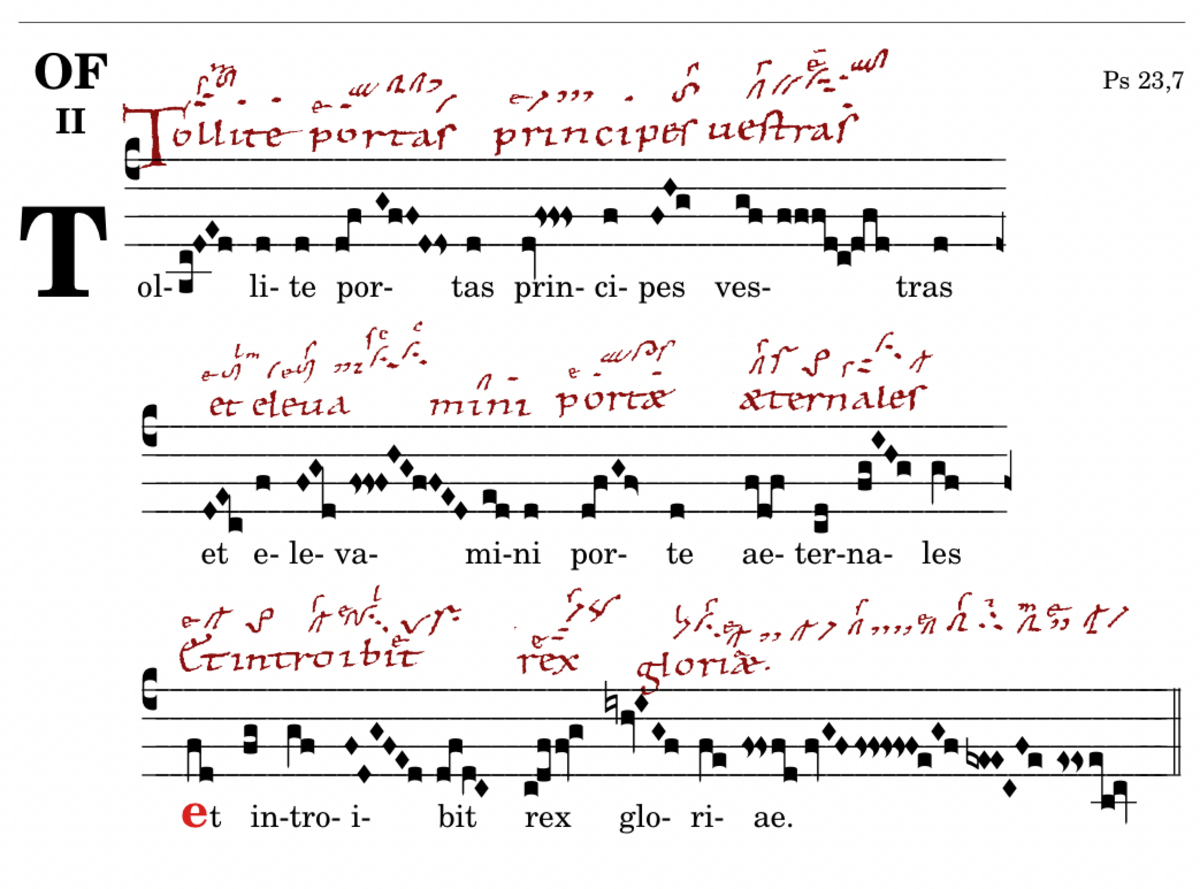
„glo-riae“ Das si-be-molle des GN ist nicht nachzuvollziehen, „do“ in Kl spricht dagegen. Der Gipfelton „si“ steht nicht in Relation zu „fa“ (Tritonus) sondern zum Schlusston „mi“ der nächsten Silbe (reine Quint). cf. Alleluia-Typos des 4.Modus 4*
„glori-ae“ Die modale Transposition (cf.: BzG 29,53) in der Mitte des Melisma ist in Mp eindeutig notiert. Die Tieferstellung des Trigon (sa-sa-sol) ist in E mit inferius angezeigt. L setzt den ersten Ton des Trigon deutlichst tiefer als den Ton davor. Die nachgestellte Wiederholung des Incipit „Tollite portas“ samt nkPes dient als eine Art Custos. Ch ist nicht eindeutig zu lesen, widerspricht aber nicht. A weist auf die Transposition hin, Y verkürzt das Melisma wie Zt und Mod.
Hebt, ihr Tore, eure Häupter / erhebt euch, ewige Pforten,
und es wird eintreten der König der Herrlichkeit.

Lift up your heads, ye gates, ye everlasting gates,
and the King of Glory shall come in.
On transpositions, see the fundamental article by Rupert Fischer „Die Notation von Stücken mit chromatisch alterierten Tönen - Schwierigkeiten der melodischen Restitution“ BzG 29/43. In contrast to GT and GN, we always notate the 2nd mode with Do clef on the fourth line.
„glo-riae“ The GN's si-be-molle is not comprehensible, „do“ in Kl speaks against it. The summit note „si“ is not in relation to „fa“ (tritone) but to the final note „mi“ of the next syllable (pure fifth). cf. alleluia typos of the 4th mode 4*
„glori-ae“ The modal transposition (cf.: BzG 29,53) in the middle of the melisma is clearly notated in Mp. The lower position of the trigon (sa-sa-sol) is indicated in E with inferius. L sets the first note of the trigon clearly lower than the note before it. The subsequent repetition of the incipit „Tollite portas“ together with nkPes serves as a kind of custos. Ch cannot be read clearly, but does not contradict it. A indicates the transposition, Y shortens the melisma like Zt and Mod.