🔘 IN GR TR AL OF CO xxxxx ✅ 2️⃣ 3️⃣ 4️⃣ 5️⃣ 6️⃣ 7️⃣ 8️⃣ xxxxx AN RP IV alia
0712 CO Principes persecutiModus 1
0708 ⟽ CO 1 ⟾ 0713 xxx ⏹️ xxx GT 530 - GrN 2/223 - BzG 61/44
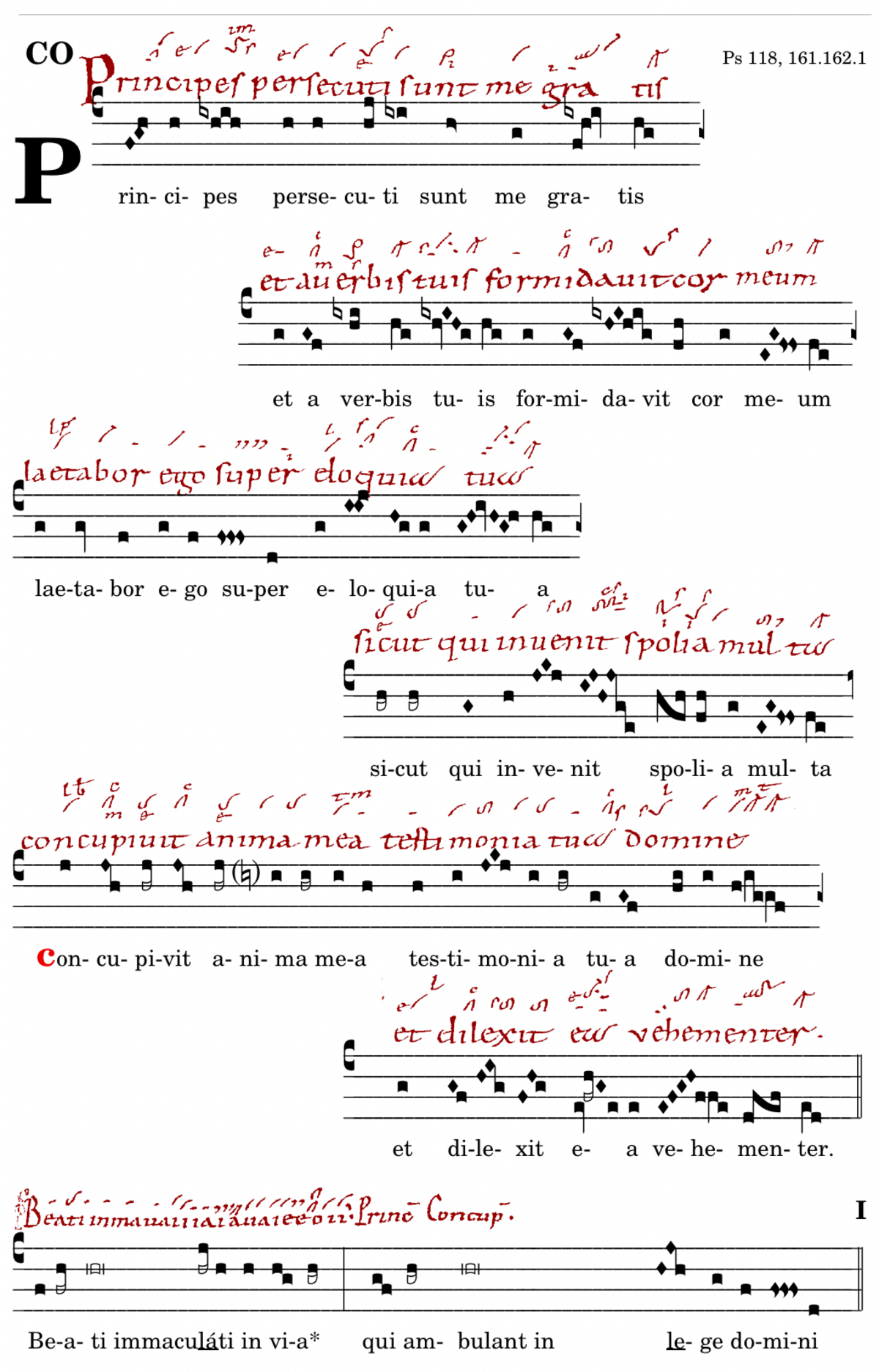
 „verbis“ ad BzG 61/46 4: „Augmentativ liqueszierernder Pes quadratus“ bedeutet dass kein zusätzlicher Ton zum Pes dazukommt.
„inve-nit spo-lia“ E legt durch seine litterae recht deutlich fest: der Abstieg der 6Ton-Neume kann nur „do-sol-mi/fa“ sein, der Por ist durch 'inferius' und 'sursum' eindeutig als „la-fa-la“ festgelegt. Das ergibt eine Melodie, die in keiner anderen Quelle irgendwie abgesichert wäre. Eine verwirrende Lage, die einer ausgiebigen Diskussion würdig ist.
Wir notieren in unserer Restitution die etwas spröde Form, wie sie aus E gelesen werden kann. Sie verlangt ein klares Abfangen bei „invenit“, bevor mit „spolia“ neu begonnen wird ('statim').
„anima mea“ usque ad finem:
Nach dem SaLicus „e-lo-quia“ „si-do“ besteht im weiteren Verlauf kein Grund für ein si-be-molle „sa“.
Hier einmal ein rhetorisch - musikalisches Argument:
„concupivit anima mea“ Die Stelle beginnt mit der kräftigen Terz „la-do“ auf „concupivit“. Das anschließende „anima mea“ und „testimonia tua“ in den resignierenden Semitonus „sa-la“ fallen zu lassen widerspricht jeder Aesthetik. Der Tritonus „si-fa“ kann als Ausdruck einer latenten Transzendenz verstanden werden und ist hier für den Sänger kein Problem.
Für den polyphonen Komponisten mag „tritonus diabolus in musica“ sein, im einstimmigen (unbegleiteten!) Cantus ist er ein Element der Spannung.
Herrscher verfolgten mich ohne Grund, doch mein Herz fürchtete sich nur vor deinen Worten.
Frohlocken will ich über deine Worte
wie einer, der viel Beute findet.

Verlangt hat meine Seele deine Weisungen, Herr,
und hat sie überaus lieb.

Rulers persecuted me without cause, but my heart feared only your words.
I will rejoice at your words like one who finds much spoil.

My soul has longed for your instructions, Lord, and loves them dearly.
“verbis” ad BzG 61/46 4: “Augmentative liquefying Pes quadratus” means that no additional tone is added to the Pes.
“inve-nit spo-lia” E clearly states in its litterae: the descent of the 6-tone neume can only be “do-sol-mi/fa,” and the por is clearly defined as “la-fa-la” by ‘inferius’ and 'sursum.' This results in a melody that is not corroborated in any other source. A confusing situation that is worthy of extensive discussion.
In our restitution, we note the somewhat brittle form as it can be read from E. It requires a clear break at “invenit” before starting again with “spolia” (‘statim’).
“anima mea” usque ad finem:
After the SaLicus “e-lo-quia” “si-do,” there is no reason for a si-be-molle “sa” in the further course.
Here is a rhetorical-musical argument:
“concupivit anima mea” The passage begins with the powerful third “la-do” on “concupivit.” Dropping the subsequent “anima mea” and “testimonia tua” into the resigned semitone “sa-la” contradicts all aesthetics. The tritone “si-fa” can be understood as an expression of latent transcendence and is not a problem for the singer here.
For the polyphonic composer, “tritonus diabolus in musica” may be, but in the monophonic (unaccompanied!) cantus, it is an element of tension.