🔘 IN GR TR AL OF CO xxxxx 1️⃣ 2️⃣ 3️⃣ ✅ 5️⃣ 6️⃣ 7️⃣ 8️⃣ xxxxx AN RP IV alia
0044 IN Eduxit eosModus 4
0025 ⟽ IN 4 ⟾ 0053 xxx ⏹️ xxx GT 211 - GrN 1/183 - BzG 49/9
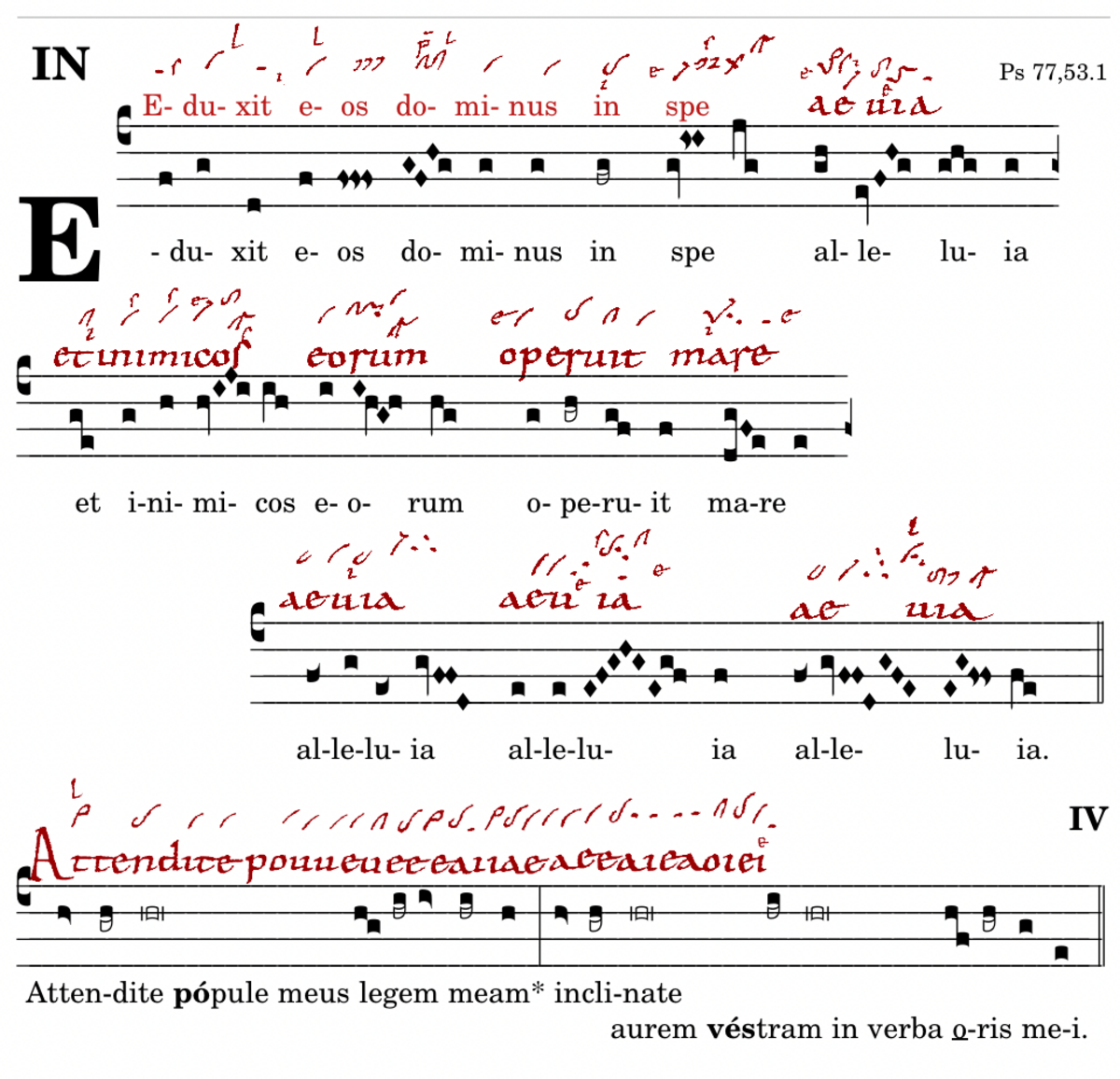
„spe“ nach Nach der Bistropha ('supra' spricht gegen „sa“) beginnt die forgende Clv auf „do“. E, L + Ch sind eindeutig. Schon Bv, S + Y allerdings interpretieren das und das Folgende als 6.Modus „fa-sa“. Das „mi“ in „al-le-luja“ und „et inimicos“ spricht dagegen (vide: EIGC, Bd.1 S.51). Es gibt also im ganzen Introitus keinen Grund für ein si-be-molle.
„alleluia 2“ cf.: 0001 „alleluia 2“ Entweder ist das 'equaliter' falsch, oder das 'inferius' sinnlos. In der Parallelstelle 0001 könnte das 'equaliter' auf ein „mi“ am Ende des Wortes „vocavit“ hinweisen (vide Mod), bleibt die Diskrepanz zwischen den beiden Epiphonus auf „alleluia“ 'sursum' - 'inferius'.
Herausgeführt hat sie der Herr in Hoffnung,
Halleluja,
und für ihre Feinde öffnete er das Meer,
Halleluja, Halleluja, Halleluja.

The Lord brought them out in hope, alleluia,
and for their enemies he opened the sea, alleluia, alleluia, alleluia.
“spe” after After the bistropha ('supra' speaks against “sa”) the forging Clv begins on “do”. E, L + Ch are unambiguous. However, Bv, S + Y already interpret this and the following as 6th mode “fa-sa”. The “mi” in “al-/le-luja” and “et inimicos” speaks against this (vide: EIGC, vol.1 p.51). There is therefore no reason for a si-be-molle in the entire Introitus.
“alleluia 2” cf.: 0001 “alleluia 2” Either the 'equaliter' is wrong, or the 'inferius' is meaningless. In the parallel passage 0001, the 'equaliter' could refer to a “mi” at the end of the word “vocavit” (vide Mod), the discrepancy between the two epiphonuses remains on “alleluia” 'sursum' - 'inferius'.