🔘 IN GR TR AL OF CO xxxxx 1️⃣ ✅ 3️⃣ 4️⃣ 5️⃣ 6️⃣ 7️⃣ 8️⃣ xxxxx AN RP IV alia
0164 IN Vultum tuumModus 2
0157 ⟽ IN 2 ⟾ 0011 / 1251xxx ⏹️ xxx GT 404 - GrN 1/382 - BzG 37/11 xxx cf. didym: 01563️⃣ AB - CD - EF
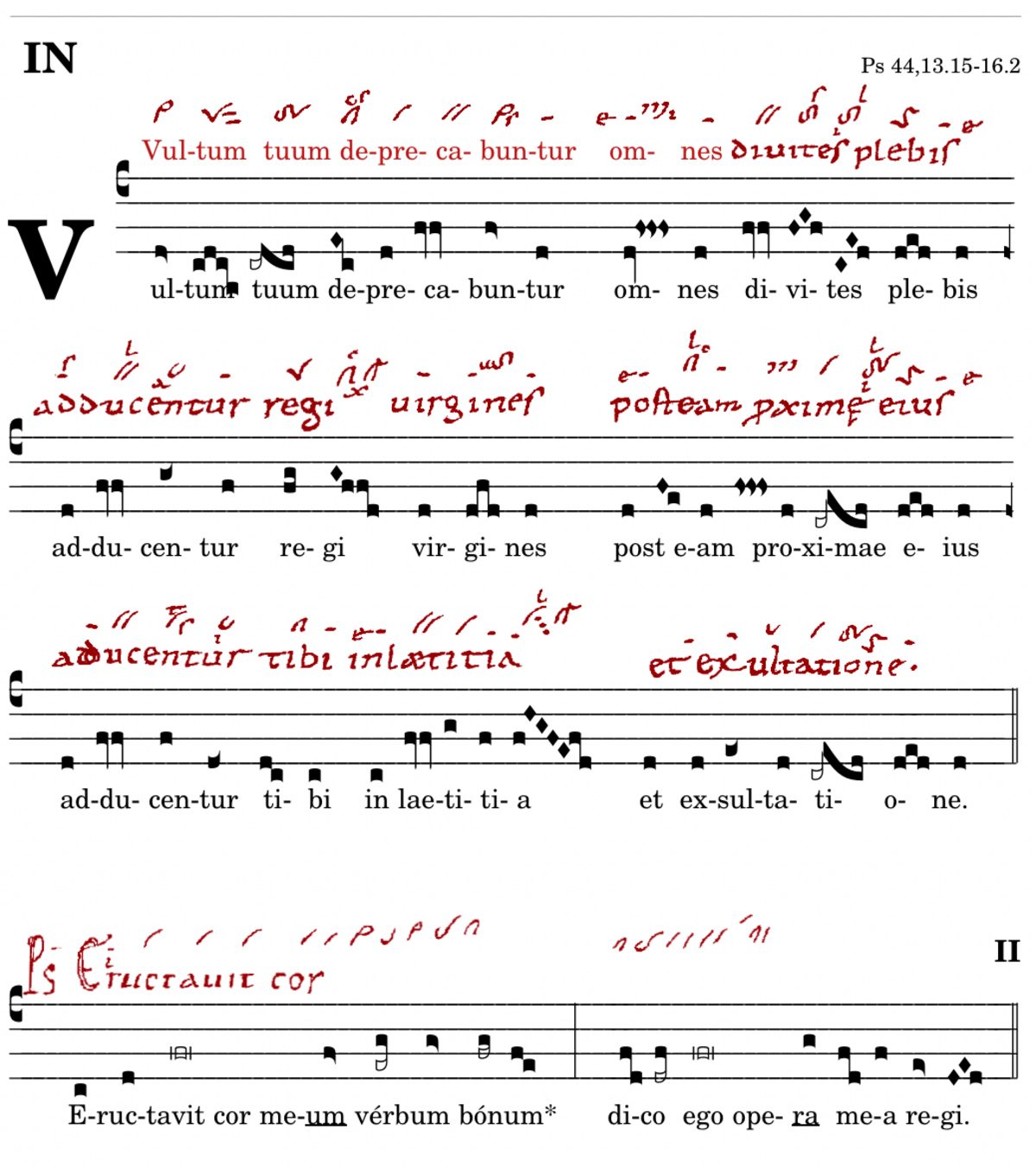
„divi-tes“ Das GrN führt den Trc zum„do“ wie Bv33/34, die anderen zum „si“.
Kl mit seiner do-Revision zählt nicht. MR + Ch geben keinen Hinweis. Das 'levare' in E kann so oder so gelesen werden: Nach dem Trc „do-re-do“ und dem 'inferius' zum „sol“ läge für den Neumenleser eine CAD TrcTrc nahe. Diese durch 'levare' zu verhindern ist logisch.
Zur Bewertung der aquitanischen Quellen: sie verkürzen gerne Intervalle.
Zur Bewertung Benevents: Erweiterungen, zusätzliche Schnörksel aber auch melodische Erweiterungen kommen vor.
Eine klassische 50:50-Situation.
Zusätzliches Argument: Bei sprechend flüssiger Interpretation dieser Stelle mit einer beweglichen Kleinschola ist das „do“ nicht zu treffen, wohl aber mit einer Kathedralschola die auf Grund der Akustik die einzelnen Töne klopfen muss.
Der Introitus ist klar in drei Perioden zu je zwei Centones gegliedert:
A Vultum tuum deprecabuntur - B omnes divites plebis 1. Periode
C adducentur regi virgines - D post eam proximae eius 2. Periode
E adducentur tibi in laetitia - F et exsultatione. 3. Periode
 Die Schlüsse B-D-F wiederholen den Satzende-Torculus (TrcFSE), der mit einem TrcGRAV auf der praetonischen Silbe eingeleitet ist (Der ‹gewichtige Torculus› wird in B mit ‹inferius› zum ersten Ton und ‹levare› zum Gipfelton eindeutig festgelegt: «do-mi-re»). In D und F ist der TrcGRAV mit einer Resupin-Bewegung zur FML A-Por erweitert («do-mi-do-re»). In D wird der Melodieverlauf abermals mit ‹inferius› und ‹levare› gesichert, bei der Wiederholung der FML in F nicht mehr.
Das Corpus dieses Schlusscento bildet die Rezitation «re». In F hebt sich nur der eintonige Pes auf dem Morphem „et ex-súl-tatione“ aus der Rezitation und macht den Text eindeutig zum 'cursus planus' ( / . . / .). Der Epiphonus verhindert einen Pes «mi-fa». Cento D hebt beide Akzente zum «fa», schwächt sie aber beide ab; „post éam“ durch die weiterführende und verbindende Clv «fa-mi», „próximae“ durch die Tristropha. Sie dehnt zwar die Silbe, gibt ihr aber keinerlei Gewicht. Cento B ist aufwändiger komponiert: „ómnes“ ist ein Pes «re-fa», der zweite Ton ist strophisch erweitert, „dívi-tes“ verstärkt den Akzent mit Bivirga und fängt diese zusätzlich auf der Binnensilbe mit kTrc «fa-sol-fa» ab, das einzige Mal, dass die 1. Periode den Ténor «fa» übersteigt. Alle drei Perioden enden mit cursus planus.
Auch die ersten Centones rezitieren auf «re», aber steigen grundsätzlich zum «fa» auf. Kern ist die Bivirga-Formel «re- fafa- fa-re», die viermal verwendet wird.
So in A am Schluss des Cento. der Cephalicus verhindert eine Duirchgans-Clv.
In C und beim zweitenmal in E hebt sich die Akzentsilbe aus der Rezitationsebene «fa» mit eintonigem Pes zum «sol». Der Cephalicus auf „addu-cén-tur 1“ verhindert ein weiteres Aufsteigen bis zum «la». Das ‹altius› darunter sichert aber den Aufstieg zum «sol» ab.
„addu-cen-tur 2“ betont seinen Akzent nicht mehr durch Pes sondern durch bloßes ‹tenete›. Das ‹sursum› unter der Virga verhindert den Durchgangston «mi». Eigentlich wäre der Terz-Absprung eine Aufgabe für die Virga strata (die kein Halbton-Pes ist!). Ebenso verhindert das ‹inferius› auf dem Wortende „adducen-tur 2“ ein «mi». Der Abstieg unter die Finalis („tibi“) bewirkt 'Colon' - Doppelpunkt, bevor die Bivirga-Formel «re- fafa- fa-re» unmittelbar wiederholt wird. „adducentur tibi : in laetítia“. Auf der Endsilbe des Wortes „laetíti-a“ kommt der Höhepunkt des gesamten Introitus, das einzige «la» in einer kurrenten 8-Ton-Neume mit Anfangs- und vorbereiteter Schlussartikulation «fa-la-sol-fa-mi-re-fa-re». Das ist die einzige 'individuelle' Stelle des Introitus (?).

Der Terz-Trc «re-fa-re» bei „virgines“ ist ein TrcFSE, aber die Terz hält die Spannung offen, beruhigt nicht. „régi“ ist im Kern Rezitation «fa», nk Akzenpes «fa-sol» mitabschließendem Clm «sol-fafa-re» amplifiziert auf dem Ténor. Diese Neume ist sehr häufig als Teil einer Kadenz-Bildung.
Bleibt als letztes das Incipit von Cento A zu besprechen. Die FML katab, der Abstieg unter die Finalis zur Quart «re-do-La», ist wesentlicher Bestandteil des 2. Modus. Er vertont wichtige Texte, die aber nicht laut auszusprechen sind, sondern ihre Wichtigkeit durch besondere Ruhe erzielen.
Verkündet die Stimme des Jauchzens / damit man es hört, Halleluja.
Ruft es hinaus bis ans Ende der Erde / Der Herr hat sein Volk erlöst.
Halleluja, Halleluja.

Proclaim the voice of shouting / that it may be heard, alleluia.
Shout it out to the ends of the earth / The Lord has redeemed his people.
Alleluia, alleluia.
“divi-tes” The GrN leads the Trc to “do” like Bv33/34, the others to “si”.
Kl with its do revision does not count. MR + Ch give no indication. The 'levare' in E can be read either way: After the Trc “do-re-do” and the 'inferius' to the “sol”, a CAD TrcTrc would be obvious to the neume reader. Preventing this with 'levare' is logical.
To evaluate the Aquitanian sources: they like to shorten intervals.
To evaluate Beneventus: extensions, additional flourishes but also melodic extensions occur.
A classic 50:50 situation.
Additional argument: the “do” cannot be hit with a fluent interpretation of this passage with a movable small schola, but it can be hit with a cathedral schola that has to tap the individual notes due to the acoustics.
The Introit is clearly divided into three sections, each consisting of two centones:
A Vultum tuum deprecabuntur - B omnes divites plebis 1st section
C virgines shall be brought before the king - D those next to her 2nd period
E shall be brought before thee in joy - F and exultation. 3rd period
The cadences B-D-F repeat the sentence-ending torculus (TrcFSE), which is introduced by a TrcGRAV on the praetonic syllable (The ‘weighty torculus’ is clearly defined in B with ‘inferius’ as the first note and ‘levare’ as the peak note: ‘do-mi-re’). In D and F, the TrcGRAV is extended to the FML A-Por with a resupin movement (“do-mi-do-re”). In D, the melodic progression is once again secured with ‘inferius’ and ‘levare’, but not so in the repetition of the FML in F.
The corpus of this concluding cento forms the recitation “re”.
In F, only the monosyllabic pes on the morpheme ‘et ex-súl-tatione’ stands out from the recitation, making the text clearly a ‘cursus planus’ ( / . . / .). The epiphonus prevents a pes ‘mi-fa’. Cento D raises both accents to ‘fa’, but weakens them both; ‘post éam’ through the continuing and connecting Clv ‘fa-mi’, ‘próximae’ through the Tristropha. Although it lengthens the syllable, it gives it no weight whatsoever. Cento B is more elaborately composed: ‘ómnes’ is a ‘re-fa’ pes, the second note is strophically extended, ‘dívi-tes’ reinforces the accent with a bivirga and additionally catches this on the internal syllable with a kTrc ‘fa-sol-fa’, the only time the first period exceeds the tenor ‘fa’. All three periods end with cursus planus.
The first centones also recite on ‘re’, but generally rise to ‘fa’. The core is the Bivirga formula ‘re- fafa- fa-re’, which is used four times. Thus in A at the end of the Cento, the Cephalicus prevents a passing-through Clv. In C and the second time in E, the stressed syllable rises from the recitation level ‘fa’ with a monosyllabic pes to ‘sol’. The Cephalicus on ‘addu-cén-tur 1’ prevents a further ascent to ‘la’. However, the ‘altius’ below secures the ascent to ‘sol’. ‘addu-cen-tur 2’ no longer emphasises its accent through a pes but through a mere ‘tenete’. The ‘sursum’ beneath the virga prevents the passing tone ‘mi’. Strictly speaking, the third-degree leap would be a task for the virga strata (which is not a semitone pes!). Similarly, the ‘inferius’ at the end of the word “adducen-tur 2” prevents a “mi”. The descent below the finalis (“tibi”) produces a ‘Colon’ – a colon – before the bivirga formula “re- fafa- fa-re” is immediately repeated. “adducentur tibi : in laetítia”. The climax of the entire Introit occurs on the final syllable of the word ‘laetíti-a’, the sole ‘la’ in a current 8-note neume with an initial and prepared final articulation ‘fa-la-sol-fa-mi-re-fa-re’. This is the only ‘individual’ passage in the Introit (?).
The third-based Trc ‘re-fa-re’ at ‘virgines’ is a TrcFSE, but the third keeps the tension open; it does not resolve. ‘régi’ is essentially a recitative ‘fa’, with an accented ‘fa-sol’ and a concluding clm ‘sol-fafa-re’ amplified on the tenor. This neume is very frequently found as part of a cadence formation.
Finally, the incipit of Cento A remains to be discussed. The FML katab, the descent below the finalis to the fourth ‘re-do-La’, is an essential component of the 2nd mode. It sets important texts to music, which are not to be spoken aloud, but achieve their significance through a particular stillness.