🔘 IN GR TR AL OF CO xxxxx 1️⃣ 2️⃣ ✅ 4️⃣ 5️⃣ 6️⃣ 7️⃣ 8️⃣ xxxxx AN RP IV alia
0010 IN Caritas deiModus 3
0006 ⟽ IN 3 ⟾ 0015 xxx ⏹️xxx GT 248 - GN 1/361 - BzG 50/29 - SX ..BCKS knapp vor 900Struktur: AB - CE - F
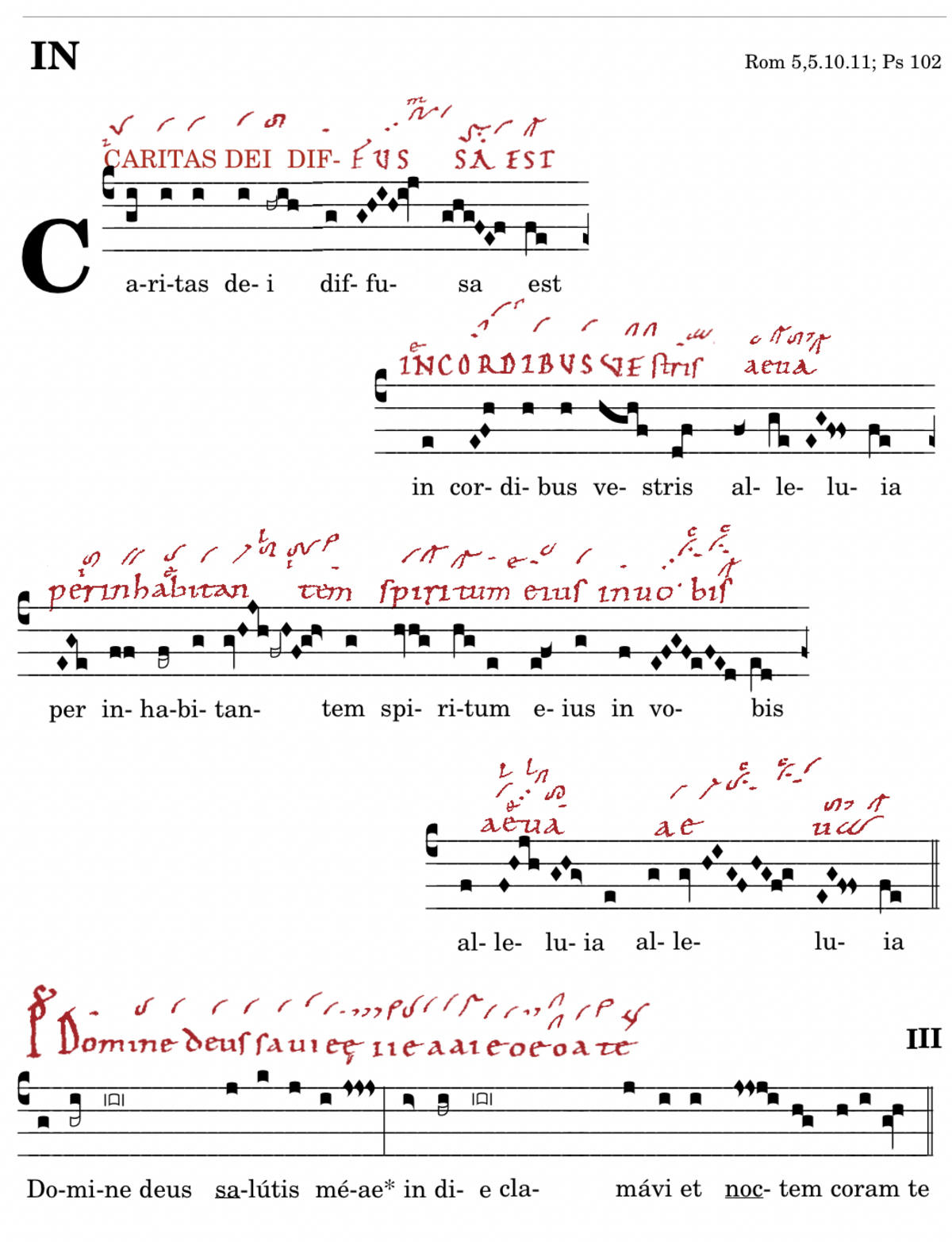
 A 3INC i „Caritas de-i“ L, Ch, MR und Y schreiben kein „do“. Die jüngeren diastematischen Quellen rezitieren bereits auf „do“ (do-Revision). Nur Bv34 und A bringen einen Akzentpes (eintonig, Halbtonpes?) auf der Silbe „dé-i“. Bei E kann man darüber diskutieren, aber die weit abgesetzte Neumen-Notation wegen der Majuskeln des Textes lässt kein eindeutiges Urteil zu. Die weiteren St.Galler Quellen bestätigen ebenfalls keinen Akzent „do“.
Bleibt zuletzt die Beurteilung des Textes:
„Cáritas dei diffúsa est“ Hauptakzent ist „Cá-ritas“ (4INC i). Die Silbe „dif-fú-sa est“ ist ebenfalls ein Akzent. Ein zusätzlicher Akzent würde die Logik dieser Aussage stören. Nicht immer muss „Gott“ betont sein.
B DT TER
C 4INC i „in-ha-bitantem“ Hier muss der Argumentation der BzG 50/31 widersprochen werden. Der kPes muss „fa-sol“ sein wie es L, Ch, auch E belegen ( und sogar MR wenn man so will. Die Virga „-ha-bitabit“ ist deutlich länger als der zweite Ton der Bivirga zuvor). Das Fehlen einer „eindeutigen Entsprechung in den adiast. Hss“ wäre nur dann ein Argument, wenn Gregorianischer Chorall allzeit ein und das selbe, ohne historische Verwandlung gewesen wäre. Es handelt sich hier auch nicht um eine geographische Frage, denn frOr (E) und frOc (L, Ch) sind sich einig. Hier argumentieren die BzG mit dem 11., 12. Jahrhundert gegen das 9., 10 Jahrhundert. „Die relative Diastemie in L und Ch widerspricht dem (Pes „mi-fa“ nicht) „scheinbar“, sondern wirklich (vide et Zt)! Darüber hinaus weist auch der Formelvergleich 4INC i in keiner Weise auf ein „mi“ hin: 0023 A+C.
 D 1TER de5
Die 2. Periode endet mit einer 1TER de5 ausgebreitet und am Ende um die Clm-Folge erweitert, die typisch ist für den Cento 4TER f, Hauptakzent auf der Finalis: „Spiritus eius in vóbis“.
D 1TER de5
Die 2. Periode endet mit einer 1TER de5 ausgebreitet und am Ende um die Clm-Folge erweitert, die typisch ist für den Cento 4TER f, Hauptakzent auf der Finalis: „Spiritus eius in vóbis“.
F DT TER = 0056 +0108 „alleluia“
Die Líebe Gottes, áusgegossen wurde sie in unsere Herzen,
Halleluja,
durch den Heiligen Geist, der úns innewohnt.
Halleluja, Halleluja.

The love of God has been poured into our hearts, Hallelujah,
through the Holy Spirit who dwells in ús. Hallelujah, Hallelujah.
‘Caritas de-i’ L, Ch, MR and Y do not include a “do”. The later diastematic sources already recite on ‘do’ (do revision). Only Bv34 and A feature an accent mark (monophonic, semitone accent?) on the syllable ‘dé-i’. In the case of E, this is open to debate, but the widely spaced neume notation, due to the capital letters in the text, does not allow for a clear judgement. The other St. Gallen sources likewise do not confirm a ‘do’ accent.
Finally, there remains the assessment of the text:
‘Cáritas dei diffúsa est’ The main accent is on ‘Cá-ritas’ (4INC i). The syllable ‘dif-fú-sa est’ is also accented. An additional accent would disrupt the logic of this statement. “God” does not always have to be stressed.
‘in-ha-bitantem’ Here, the argumentation of BzG 50/31 must be contradicted. The kPes must be “fa-sol” as evidenced by L, Ch, and also E (and even MR, if you will. The virga ‘-ha-bitabit’ is significantly longer than the second note of the preceding bivirga). The absence of a ‘clear equivalent in the adiastatic manuscripts’ would only be an argument if Gregorian chant had always been one and the same, without historical transformation. Nor is this a geographical issue, for frOr (E) and frOc (L, Ch) are in agreement here. Here, the BzG are arguing with the 11th and 12th centuries against the 9th and 10th centuries. ‘The relative diasteme in L and Ch contradicts this (Pes ’mi-fa‘ not “apparently” but actually (vide et Zt)! Furthermore, the comparison of the formula 4INC i in no way points to a ’mi“: 0023 A+C.
The second period ends with a 1TER de5 spread out and, at the end, extended by the Clm sequence, which is typical of the Cento 4TER f, with the main accent on the finalis: ‘Spiritus eius in vóbis’.