Dies ist eine alte Version des Dokuments!
🔘 IN GR TR AL OF CO xxxxx 1️⃣ 2️⃣ 3️⃣ ✅ 5️⃣ 6️⃣ 7️⃣ 8️⃣ xxxxx AN RP IV alia
1070 OF Lauda anima mea V2Modus 4
OF – V1 – V2 xxx ⏹️ xxx OT 68 - ON xx - BzG xx/xx
FML alloq 3x
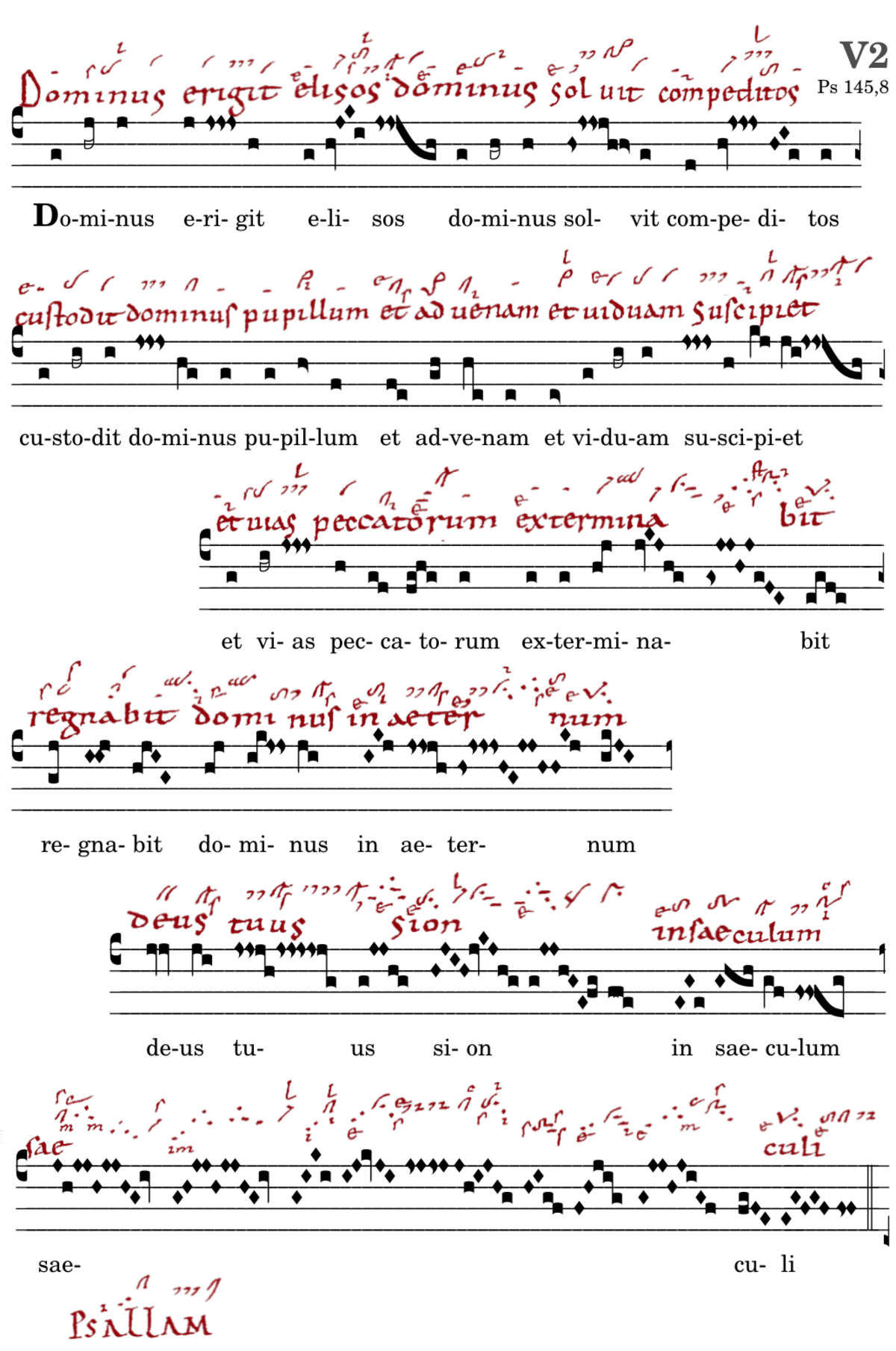
„Dominus“ Das 'sursum' zum kPes ist als Schritt zur plerosis zu verstehen.
„custodit“ L Der erste Ton des kPes steht zur Silbe davor unisonisch; sie auch Y + Mp.
„et viduam“ L unisonisch. Silbe „et“ in E 'levare' und zum nächsten Ton 'equaliter', daher entgegen allen diastematischen Quellen: Cephalicus „sol“.
V2. Der Herr richtet die Gestürzten auf / der Herr macht die Gefesselten los,\\
der Herr behütet die Fremden / Waise und Witwe nimmt er auf,\\
doch den Weg der Sünder macht er zunichte.\\
König ist der Herr in Ewigkeit / dein Gott, Zion, von Geschlecht
zu Geschlecht.

V2. The Lord lifts up the fallen / the Lord loosens those who are bound,\\
the Lord protects the stranger / he takes in the orphan and the widow,\\
but he destroys the way of sinners.\\
The Lord is king forever / your God, Zion, from generation to generation.
FML alloq 3x
“Dominus” The ‘sursum’ to the kPes is to be understood as a step towards plerosis.
“custodit” L The first note of the kPes is in unison with the syllable before it; it is also Y + Mp.
“et viduam” L unison. Syllable ‘et’ in E ‘levare’ and to the next note ‘equaliter’, therefore contrary to all diastematic sources: Cephalicus “sol”.