🔘 IN GR TR AL OF CO xxxxx 1️⃣ 2️⃣ 3️⃣ 4️⃣ ✅ 6️⃣ 7️⃣ 8️⃣ xxxxx AN RP IV alia
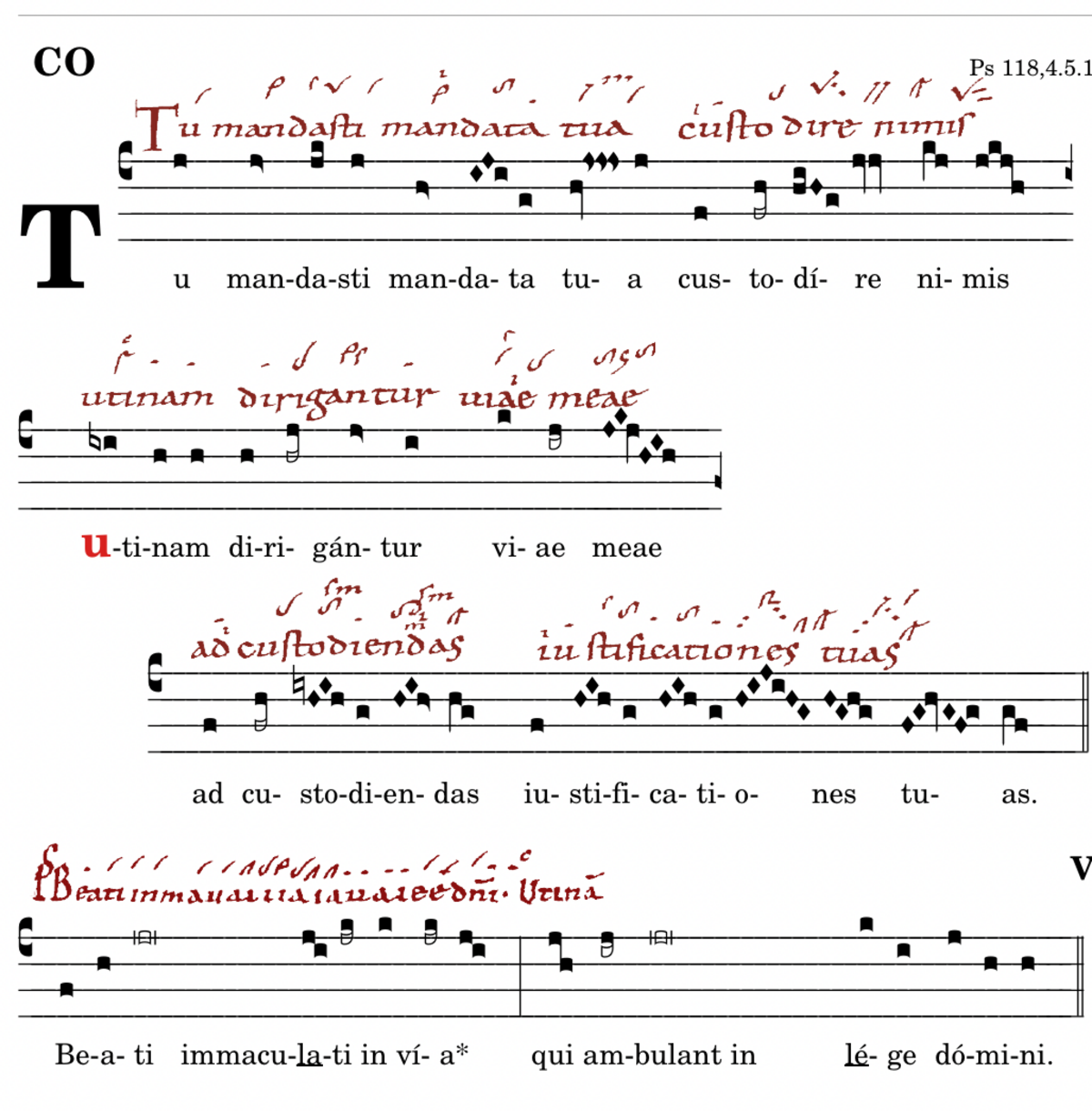
0745 CO Tu mandastiModus 5
0730 ⟽ CO 5 ⟾ 0747 xxx ⏹️ xxx GT 342 - BzG 44/28 + GN 1/331Der 5.Modus (F-Dur mit si!) wird schon ab dem 11.Jahrhundert Richtung modernes F-Dur (mit b) verändert. Der Versuch des GN, den Vorzeichen später Handschriften gerecht zu werden, führt zu keiner befriedigenden Lösung. Wir notieren schlicht „F-Dur mit si“. Die Oriscusvirga „u-tinam“ ist kein Halbtonpes. Die kurrenten Binnenpedes „cus-to-díre“, di-ri-gántur„, ad cus-todiéndas“ schreiben wir, den Erkenntnissen zur Formel 1 AN vocatio entsprechend, unisonisch anschließend; L spricht dafür, Ch dagegen.
„ad cus-to-di-en-das“ Trc vom „la“ aus: was kann 'sursum mediocriter' heißen? Es verhindert „do“, was eine bloßes 'sursum' bedeuten würde. Für ein „sa“ ist 'sursum' überflüssig, als Trc „la-si-la“.
Du hast deine Befehle gegeben, dass man sie genau beachte.
O dass doch meine Wege dahin gerichtet,
deine Anweisungen zu befolgen!

You have given your commands to be carefully observed.
O that my ways were directed to this,
to follow your instructions!
The 5th mode (F major with B!) began to evolve towards the modern F major (with B flat) as early as the 11th century. The GN’s attempt to align the key signatures with those of later manuscripts does not yield a satisfactory solution. We simply notate it as “F major with B”. The Oriscusvirga “u-tinam” is not a semitone pes. We write the currente internal pes “cus-to-díre”, “di-ri-gántur”, “ad cus-todiéndas” in unison, in accordance with the findings regarding the formula 1 AN vocatio; L is in favour of this, Ch against it.
‘ad cus-to-di-en-das’ Trc from “la”: what might “sursum mediocriter” mean? It precludes ‘do’, which would simply mean “sursum”. For an ‘sa’, “sursum” is superfluous, as Trc ‘la-si-la’.