🔘 IN GR TR AL OF CO xxxxx ✅ 2️⃣ 3️⃣ 4️⃣ 5️⃣ 6️⃣ 7️⃣ 8️⃣ xxxxx AN RP IV alia
0603 CO Amen dico vobis quicquidModus 1
3551 / 0754 ⟽ CO 1 ⟾ 0605 xxx ⏹️ xxx GT 368 - GrN 1/261 - BzG 40/172️⃣ AB - EF xxx vel xxx 1️⃣ AI - YF
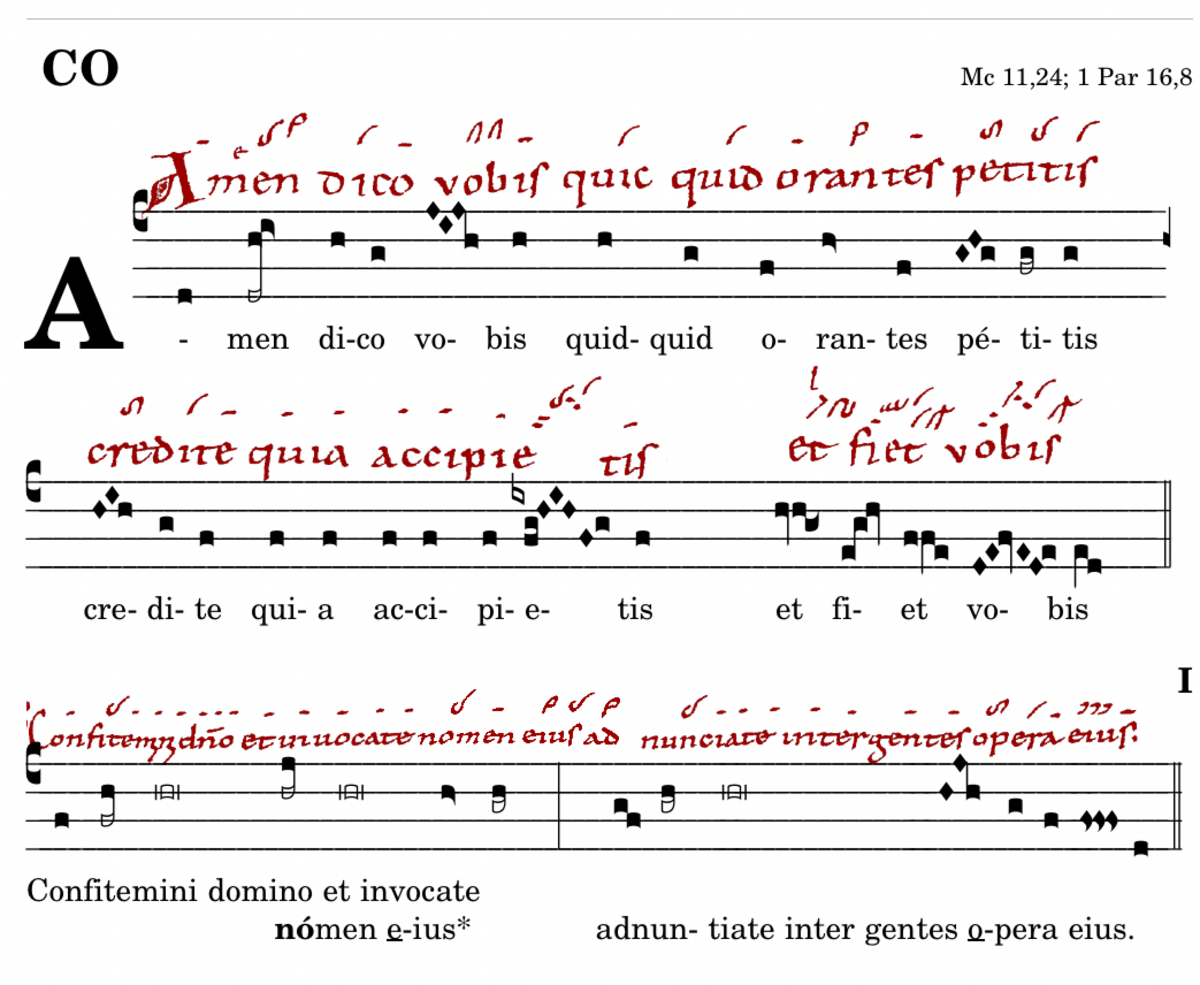
 Oberflächlich betrachtet ist die CO zweiperiodisch AB-EF.
A ist ein klassisches 1INC 5Pes: Hauptakzent am Beginn („Amén dico vóbis“). „vóbis“ Der PrrFlx treibt den Akzent weiter zum nächsten Cento.
F Die Terminatio ist eine Erweiterung des 1TER de5 + FML supra. Die Centones
B + E passen nicht in das Schema, sie verwenden Material des 1INC triv. Die CO ist deshalb eher als einperiodisch AI-YF zu verstehen.
„A-mén“ Pes oder Punctum.
Punctum „re“: E,Kl, L
Pes „do-re“: MR, Bv, A+Y, alle jüngeren
„A-mén“ „sa“ nur in Mp + Zt, Kl „do“ !
„cré-dite“ Kl „do“ ! Nur Mod+Mp schreiben „sa“ Der Imperativ „crédite“ verträgt durchaus einen scharfen Akzent.
„accipi-é-tis“ Nach einem akzentuierenden Pes „fa-sol“ folgt eine Art circulatio.
„fí-et“
🍎 Sca quilismaticus „mi-sol-la“ E, L, A, Bv33
🍏 Sca quilismaticus „re-mi-sol-la“ MR, Y, Bv34,
Bv39 !
Ch Lacune. Die jüngeren Quellen vermeiden das Problem indem sie einfach dreitonigen Sca „fa-sol-la“ schreiben und damit das „mi“ umgehen (do-Revision). Das ist auch ein Indiz, dass das Quilisma kein Ton ist.
Hier wirkt einerseits der Unterschied frOc - frOr (MR - E) aber andererseits noch stärker die Veränderung im Ablauf der Zeit: Bv33 (Beginn 11.Jh, auch Bv40, Bv39, Bv35) 3tonig - Bv34 (spätes 12.Jh) 4tonig
A (11.Jh eher früher) 3tonig - Y (11.Jh eher später) 4tonig.
Bemerkenswert ist, dass L nicht in der traditio frOc steht, sondern die ältere Form bewahrt.
Amen, das sage ich euch: Um was immer ihr betet und bittet,
glaubt nur, dass ihr es schon erhalten habt,und es wird euch zuteil werden.

Amen, I say to you: whatever you pray for and ask for,
believe that you have already received it, and it will be yours.
At first glance, the CO is a two-period AB-EF.
A is a classic 1INC 5Pes: the main stress is at the beginning (‘Amén dico vóbis’). ‘vóbis’ The PrrFlx carries the stress on to the next Cento.
F The terminatio is an extension of 1TER de5 + FML supra. The centones
B + E do not fit the pattern; they use material from 1INC triv. The CO should therefore be understood as a single-periodic AI-YF.
“A-mén” Pes or Punctum.
Punctum “re”: E, Kl, L
Pes “do-re”: MR, Bv, A+Y, all younger
“A-mén” “sa” only in Mp + Zt, Kl “do” !
“cré-dite” Kl “do” ! Write only Mod+Mp “sa” The imperative “crédite” can certainly take a sharp accent.
“accipi-é-tis” An accenting Pes “fa-sol” is followed by a kind of circulatio.
“fí-et”
🍎 Sca quilismaticus “mi-sol-la” E, L, A, Bv33
🍏 Sca quilismaticus “re-mi-sol-la” MR, Y, Bv34,
Ch Lacune. More recent sources avoid the problem by simply writing the three-tone Sca “fa-sol-la” and thus bypassing the “mi” (do revision). This is also an indication that the quilisma is not a tone.
Here, on the one hand, the difference between frOc and frOr (MR - E) is apparent, but on the other hand, the change over time is even more striking: Bv33 (beginning of the 11th century, also Bv40, Bv39, Bv35) 3-tone - Bv34 (late 12th century) 4-tone
A (11th century, earlier) 3-tone - Y (11th century, later) 4-tone.