🔘 IN GR TR AL OF CO xxxxx 1️⃣ ✅ 3️⃣ 4️⃣ 5️⃣ 6️⃣ 7️⃣ 8️⃣ xxxxx AN RP IV alia
0649 CO Exiit sermoModus 2
0636 ⟽ CO 2 ⟾ 0664 xxx ⏹️ xxx GT 637 - GN 2/316 - BzG 63/294️⃣ AB - CD - CD - EF
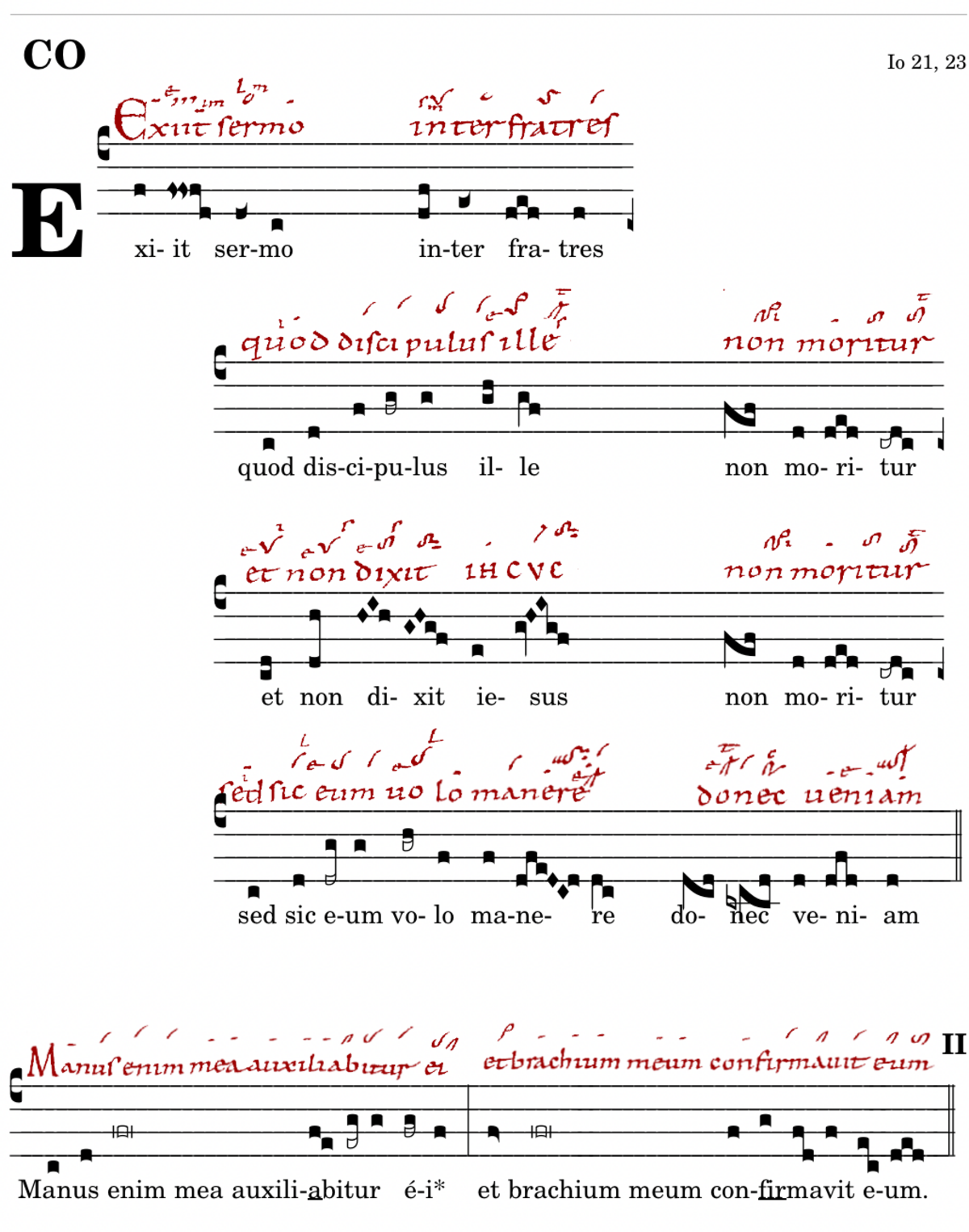
 Der Text ist in 4 kurze Sätze unterteilt, die jeder einzelne mit dem üblichen Satzende-Trc (TrcFSE) endet.
Die 2. und 3. Zeile setzt aber auf die letzte Silbe einen zusätzlichen Wortende-Trc (TrcFIN) zum „do“: Colon. In der 2.3. und 4. Zeile ist das letzte Wort (PPO “moritur“, bzw. „veniam“ mit dem beschleunigenden Prr eingeleitet. Interessant „donec veniam“ beginnt mit nkPrr und kPrr. „dónec“ erhält eine gewisse Betonung (Dehnung), trotzdem zielt alles auf das Wort „véniam“, dessen Trc zur Terz führt ( im 2. Modus nicht selten).
Der Text ist in 4 kurze Sätze unterteilt, die jeder einzelne mit dem üblichen Satzende-Trc (TrcFSE) endet.
Die 2. und 3. Zeile setzt aber auf die letzte Silbe einen zusätzlichen Wortende-Trc (TrcFIN) zum „do“: Colon. In der 2.3. und 4. Zeile ist das letzte Wort (PPO “moritur“, bzw. „veniam“ mit dem beschleunigenden Prr eingeleitet. Interessant „donec veniam“ beginnt mit nkPrr und kPrr. „dónec“ erhält eine gewisse Betonung (Dehnung), trotzdem zielt alles auf das Wort „véniam“, dessen Trc zur Terz führt ( im 2. Modus nicht selten).
Die erste Zeile leitet ihren Schluss mit gewöhnlichem nkPes „re-fa“ (sursum mediocriter zum ersten Ton, „re“ ist ein bisschen höher als das „do“ zuvor) und Cephalicus “mi“ ein. Der Cephalicus staut vor dem Trc „frátres“. Der Cephalicus „sérmo“ gibt sich selbst etwas Mehrwert.
Die Infinites der 4 Sätze sind wie folgt komponiert:
Die 3 Ténorebene des Protus werden konsequent ausgespielt
 1) „Exiit sermo“ von der Terz, niedrige Emotionalität. Das 'equaliter' verhindert ein “mi“ oder “re“, denn de Strophicus steht immer über dem Halbton, auf „fa“ oder „do“. 'inferius mediocriter' ist ein Hinweis auf den Terzfall „fa-re“. Das 'levare mediocriter' ist kein Hinweis auf einen zweiten kleinen Ton (vgl.: Mod „ser-mo in-ter“) Es ist entweder emotional gedacht, oder Hinweis, das der Ton nicht wie üblich tiefer ist als zuvor (vide: 0019 „De ventre“, 0102 „Memento“).
2+4) 1INC ad4, mittlere Emotionalität. Der Aufstieg „do-re-fa-sol“ ist der Psalmodie entsprechend, aber auch dem antiphonalen 1INC ad4 (dort „re-fa-sol“ oder „re-mi-fa-sol“). Der Aufstieg führt weiter zur Ebene „sol“, bei 4) „sed sic éum“ direkter Aufsprung von Re„ zu „sol“. Höhepunkt dieser beiden Centones ist das „la“ - „discipulus ílle“ bzw. „sic eum vólo“. Während der Schluss des Cento bei 2) bloß mit FML PeCl angereichert ist, ist er bei 4) mit CAD 8C vertont, der Formel, die in den RP2 als 'christologon' steht. Die Bibelstelle Io 21,23 spricht von enttäuschter Endzeiterwartung: Johannes ist gestorben, obwohl Jesus doch versprochen hätte, er werde nicht sterben bis er wiederkommt. „sic…volo manere“ - Nein, nur wenn ich will, dass er bleibt“.
3) Höhepunkt der CO ist der Beginn der 3. Zeile: Tenor „la“. „et nón“ 1INC 5Pes. 1.Akzent ist Hauptaussage, aber “dí-xit ie-sús„ steigt höher zum „si“. Das GN erzwingt von vornherein durch die Schlüsseln ein „sa“. Kl aber führt beide Höhepunkte zum “do“, Mp und auch Zt hat die Melodie verschoben und spricht nicht für „sa“. Ebenso liegt kein Tritonus vor, das „si“ bezieht sich auf „la“ bzw. „sol“. Entscheidend ist aber E: Auf dem Gipfel des Trc „dí-xit“ steht ein 'sursum'. Trc und PesSbp (Neume bedenkenswerter Texte) und der ScaSbp 1–45 (abermals ein PesSbp, aber 'praepunctis') machen „dixit iesús“ zur Hauptaussage, die mit „manere“ korreliert.
Es kam dieses Wort auf unter den Brüdern,
dass dieser Jünger nicht sterbe!
Und doch hat Jesus nicht zu ihm gesagt,
er sterbe nicht.
Sondern: Wenn ich will, dass er bleibe,
bis ich komme.

This word arose among the brethren,
that this disciple should not die!
And yet Jesus did not say to him,
he would not die.
 But rather: If I will that he tarry till I come.
The text is divided into four short sentences, each ending with the usual sentence-ending Trc (TrcFSE).
However, the 2nd and 3rd lines add an additional word-end Trc (TrcFIN) to the last syllable of “do”: colon. In the 2nd, 3rd, and 4th lines, the last word (PPO ‘moritur’ or “veniam”) is introduced with the accelerating Prr. Interestingly, “donec veniam” begins with nkPrr and kPrr. ‘dónec’ is given a certain emphasis (elongation), but everything still points to the word “véniam,” whose Trc leads to the third (not uncommon in the 2nd mode).
The first line introduces its conclusion with the usual nkPes “re-fa” (sursum mediocriter to the first note, “re” is a little higher than the “do” before) and Cephalicus ‘mi’. The Cephalicus accumulates before the Trc “frátres”. The Cephalicus “sérmo” gives itself some added value.
The infinites of the 4 phrases are composed as follows:
The 3 tenor levels of the Protus are played out consistently
1) “Exiit sermo” from the third, low emotionality. The ‘equaliter’ prevents a “mi” or “re,” because the Strophicus always stands above the semitone, on ‘fa’ or “do.” ‘inferius mediocriter’ is a reference to the third fall “fa-re.” The ‘levare mediocriter’ is not a reference to a second minor tone (cf.: Mod “ser-mo in-ter”). It is either intended to be emotional or a reference to the tone not being lower than before, as is usually the case (see: 0019 “De ventre,” 0102 “Memento”).
2+4) 1INC ad4, medium emotionality. The ascent “do-re-fa-sol” corresponds to the psalmody, but also to the antiphonal 1INC ad4 (there “re-fa-sol” or “re-mi-fa-sol”). The ascent continues to the level ‘sol’, at 4) “sed sic éum” direct jump from Re“ to ”sol„. The climax of these two centones is the “la” - “discipulus ílle” or “sic eum vólo”. While the end of the cento at 2) is merely enriched with FML PeCl, at 4) it is set to music with CAD 8C, the formula that appears in the RP2 as ‘christologon’.
The Bible passage Io 21:23 speaks of disappointed expectations of the end times: John has died, even though Jesus had promised that he would not die until he returned. “sic…volo manere” – No, only if I want him to stay.“
3) The climax of the CO is the beginning of the third line: tenor “la.” “et nón” 1INC 5Pes. The first accent is the main statement, but “dí-xit ie-sús” rises higher to “si.” The GN forces a “sa” from the outset through the keys. However, Kl leads both climaxes to “do,” Mp and Zt have also shifted the melody and do not speak for “sa.” Likewise, there is no tritone; the “si” refers to ‘la’ or “sol.” However, E is decisive: at the peak of the Trc “dí-xit” there is a ‘sursum’. Trc and PesSbp (neumes of noteworthy texts) and ScaSbp 1–45 (again a PesSbp, but ‘praepunctis’) make “dixit iesús” the main statement, which correlates with “manere.”