🔘 IN GR TR AL OF CO xxxxx 1️⃣ 2️⃣ 3️⃣ ✅ 5️⃣ 6️⃣ 7️⃣ 8️⃣ xxxxx AN RP IV alia
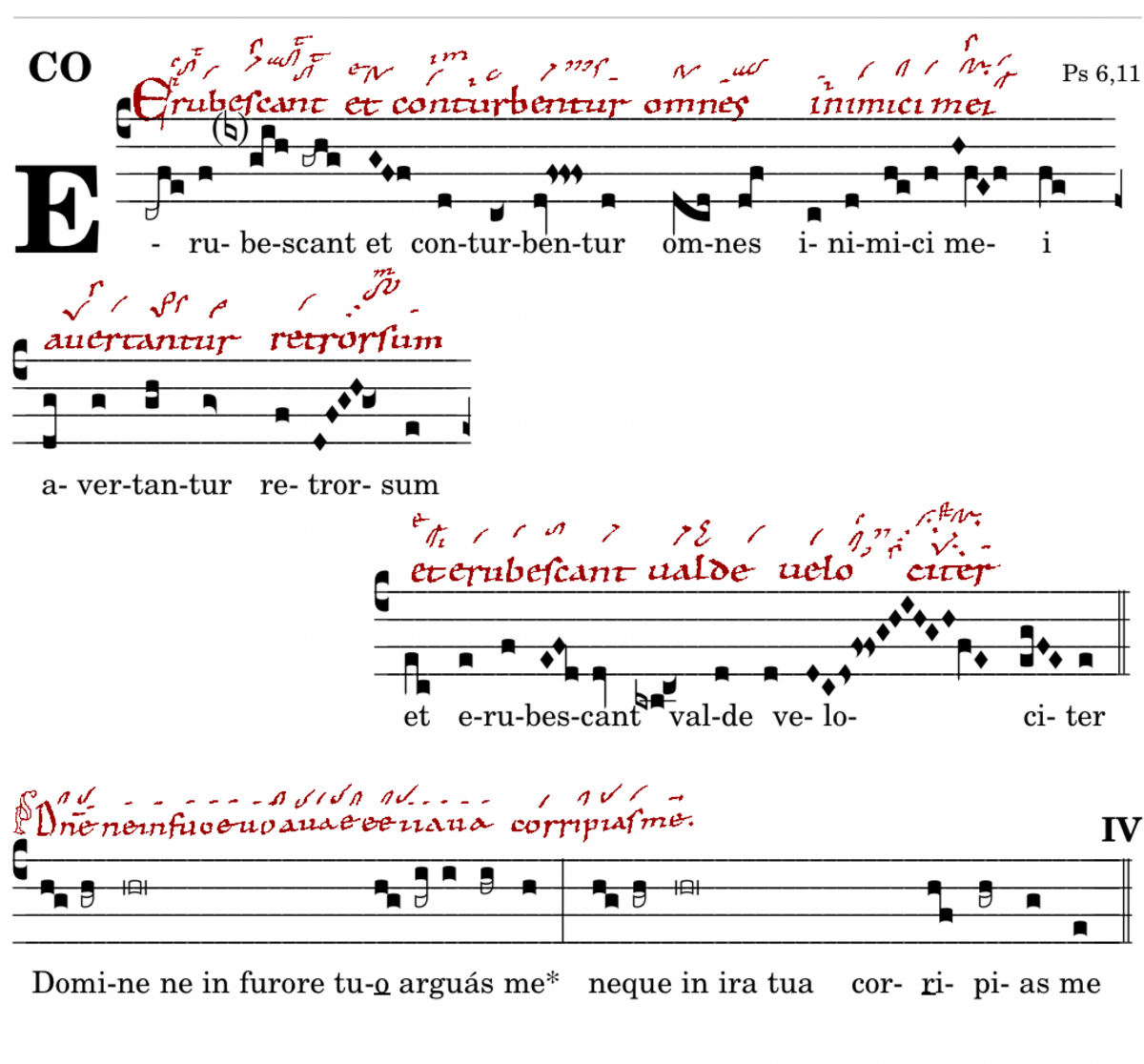
0646 CO Erubescant et conturbenturModus 4
0628 ⟽ CO 4 ⟾ 0650 xxx ⏹️ xxx GT 85 - BzG 54/32 + GrN 2/41„E-rubescant“ Der Intonationstorculus wird grundsätzlich mit QuartEinstieg notiert. Der erste Ton ist so leicht, dass er auch verschwinden kann, er ist ein Portamento, dessen Einstieg keine definierbare Tonhöhe hat.
„Eru-be-scant“ Die Frage ist, ob das „si“ in Bezug zum „fa“ steht (= reine Quart), dann si-be-molle („sa“), oder sich auf das Wortende bezieht: „sol“, dann si-naturale („si“). Als Textausdeutung hat die Tritonusspannung hier durchaus einen Sinn.
„val-de“ Die Neume besteht aus einer episemierten Virga und einem Epiphonus, der durch Oriscus näher definiert ist. Mit Blick auf die adiastematischen Quellen sind es nur zwei Töne. Nach MR ist es eine Pes-Bewegung (aufsteigend), das kann aber nur die Lösung von Kl sein: „B-do“. Aufschlussreich hierzu EIGC 1, S.51f Fußnote 15:
(Luigi Agustoni) „do - untere Grenzstufe des modalen Tontraumes. Die mittelalterlichen Theoretiker geben für den Deuterus plagalis den Tonraum si↑ Mi↑ si an. Dass diese abstrakte Theorie, ja sogar falsch ist, zeigt die Tatsache, dass das tiefe si in Gesängen des IV.Modus nicht vorkommt. Man ersieht daraus, dass es wenig Sinn hat, sich in Fragen der Modalität - dies gilt umso mehr in Bezug auf Fragen des Rhythmus - auf die Aussagen der Theoretiker zu stützen.“
Agustoni geht unhinterfragt vom GR aus. Vielleicht haben hier die Theoretiker doch recht?
Dieses tiefe „si“, das immer ein si-be-molle ist, wird hier der Theorie entsprechend mit dem Großbuchstaben „B“ bezeichnet (Γ-A-B-do-re-mi…).
„ve-lo-citer“ Die Bestätigung des si-be-molle durch Kl + Mp ist etwas schwach. Es stünde zur Terminatio „mi“ in der Distanz von drei Ganztönen (Tritonus), wenn es auch als verminderte Quint notiert wird.
Schämen sollen sich und verstört werden
all meine Feinde,
sie sollen zurückweichen und schnellstens beschämt werden.

Let all my enemies be ashamed and disturbed,
let them retreat and be put to shame as quickly as possible.
‘E-rubescant’ The intonation torculus is generally notated with a fourth entry. The first note is so faint that it might as well disappear; it is a portamento whose entry has no definable pitch.
“Eru-be-scant” The question is whether the “si” relates to the “fa” (= perfect fourth), in which case it is si-be-moll (“sa”), or whether it relates to the end of the word: “sol”, in which case it is si-naturale (“si”). In terms of textual interpretation, the tritone tension certainly makes sense here.
‘val-de’ The neume consists of an episemised virga and an epiphonus, which is further defined by an oriscus. According to the adiastematic sources, there are only two notes. According to MR, it is a Pes movement (ascending), but this can only be the solution from Kl: ‘B-do’. For further insight, see EIGC 1, p.51f footnote 15:
(Luigi Agustoni) “do – lower limit of the modal tone range. Medieval theorists specify the tone range si↑ Mi↑ si for the Deuterus plagalis. The fact that this abstract theory is, indeed, incorrect is demonstrated by the fact that the low si does not occur in chants of the IVth mode. It follows from this that it makes little sense to rely on the statements of theorists in matters of modality – this applies all the more to questions of rhythm.” Agustoni unquestioningly takes the GR as his starting point. Perhaps the theorists are right after all? This low ‘si’, which is always a si-be-molle, is here designated with the capital letter ‘B’ in accordance with the theory (Γ-A-B-do-re-mi…).
‘ve-lo-citer’ The confirmation of B flat by Kl + Mp is somewhat weak. It would stand at a distance of three whole tones (tritone) from the terminatio ‘mi’, even though it is notated as a diminished fifth.
——-