🔘 IN GR TR AL OF CO xxxxx ✅ 2️⃣ 3️⃣ 4️⃣ 5️⃣ 6️⃣ 7️⃣ 8️⃣ xxxxx AN RP IV alia
0620 CO Data est mihiModus 1
0618 ⟽ CO 1 ⟾ 0634 xxx ⏹️ xxx GT 213 - GN 1/186 - BzG 33/15; 49/133️⃣ AB - xCD - xxxEF
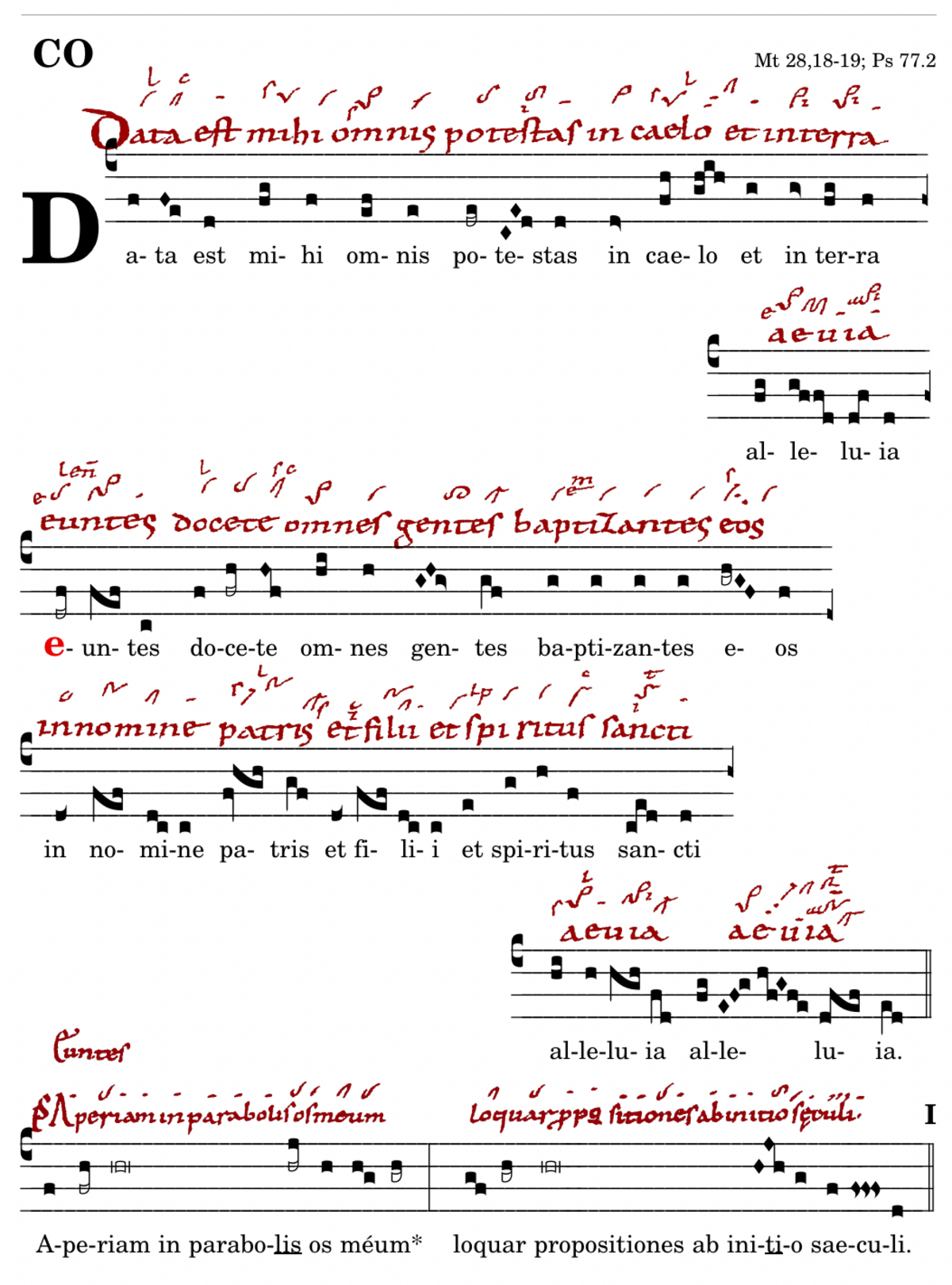
 Die CO ist grundsätzlich wie ein RP gebaut, drei Perioden mit je Incipit und Terminatio folgen aufeinander:
A-B C-D E-F.
Das Melodie-Material ist teilweise den AN entnommen (A,D), den Schluss (F) bildet ein Standard-Alleluia das noch weitere zweimal verwendet wird (CO 0614, IN 0054).
Eine Besonderheit dieser CO ist der Einsatz einer eigenen
FML „euntes“, die, sich verwandelnd, fünfmal eingesetzt wird.
Bei „in nomine“ und “et filii„ nur leicht abgewandelt, ist auch die CAD PrrPp auf „patris“ und die FML quia + Colon bei „caelo“ daraus entwickelt.
Die größte Kadenz der CO ist CAD mikro am Ende. Die selbe CAD steht aber auch bei “patris“, hier auf fa. Das hebt “patris“ gegenüber „et filii et spitirus sancti“ hervor.
Die CAD minima wird dreimal eingesetzt, alle dreimal in auffälliger Variante: „Data est mini potestas“ mit kTrcGRAV, bei „spiritus sancti“ mit nkTrcGRAV. „in terra alleluia“ reduziert den Terz-Trc mit Liqueszeznz um den letzten Ton. Möglicherweise hat das mit der Endbetonung des hebräischen Wortes „allelu-ia“ zu tun .
Die 2. Periode ist von der 3. Periode kaum abgesetzt, denn die 2. Periode endet mit 1NOV typ gag (einakzentig).
Die 1. und 3. Periode hingegen ist durch den TrcGRAV als Satzende-Torculus TrcFSE deutlich gegliedert.
A Beginnt mit 2INC cad, der weitere Verlauf ist ebenfalls die fallende Linie fa-mi-re. Das ist die melodische Ausdeutung des „data est mihi“: 'es kommt mir zu'.
B Die FML quia ist hier als “ergo“ zu verstehen. Das Colon betont „in terra“ im Sinn von „non solum.. sed etiam (in terra)“, oder anders ausgedrückt:
FML quia „quia in caelo ergo et in terra“
C „dó-cé-te“ der kPes ist in L + Ch unisonisch zu lesen. Bv, A+Y schreiben einen eintonigen Pes la. Der Durchgang sol-la ist zweifelsfrei plerosis des Hochmittelalters.
Wenn die Melodie bei „docete“ eine FML alloq ist, so ist das Morphem zu betonen, ohne den grammatikalischen Akzent zu vernachlässigen:
„dó-cé-te“.
“om-nes„ Pes la-si. Das si bezieht sich nicht auf das fa zuvor, sondern auf das sol danach.
D ist ein schlichtes 1NOV typ gag, ein Weiterführen nach der Mediatio, ohne selbst abzuschließen.
E „spiri-tus“ Die Virga strata (celeriter) bestätigt im Nachhinein den Ténor fa und markiert den melodischen Absprung zum do.
F “ál-leluia„ Das levare am oberen Ton des Pes spricht eindeutig gegen si-be-molle! Auch wenn Zw und Mp b schreiben, schreibt Kl do. Somit war der Ton authentisch ein si. Das gilt auch für den Pes bei “óm-nes„.
Gegeben ist mir alle Macht /
im Himmel und auf Erden, Halleluja /
Geht / lehrt alle Völker / tauft sie /
im Namen / des Vaters / und des Sohnes / und des Heiligen Geistes / Halleluja, Halleluja.

All power is given to me / in heaven and on earth, alleluia /
Go / teach all nations / baptize them /
in the name / of the Father / and of the Son / and of the Holy Spirit / Alleluia, alleluia.
The CO is essentially structured like an RP, with three periods, each comprising an incipit and a terminatio, following one another:
A-B C-D E-F.
The melodic material is partly taken from the AN (A, D); the conclusion (F) consists of a standard 'Alleluia' which is used twice more (CO 0614, IN 0054).
A distinctive feature of this CO is the use of its own
FML ‘euntes’, which, undergoing variations, is employed five times.
Only slightly modified in ‘in nomine’ and “et filii‘, the CAD PrrPp on 'patris' and the FML quia + Colon at ’caelo“ are also derived from it.
The largest cadence in the CO is CAD micro at the end. However, the same CAD also appears at “patris”, here on fa. This emphasises 'patris' in contrast to 'et filii et spiritus sancti'.
The CAD minima is used three times, all three times in a striking variant: 'Data est mini potestas' with kTrcGRAV, and ‘spiritus sancti’ with nkTrcGRAV. 'in terra alleluia' reduces the third-Trc with Liqueszeznz by the final note. This may have something to do with the final stress of the Hebrew word 'allelu-ia'.
A begins with 2INC cad, and the subsequent progression is also the descending scale fa-mi-re. This is the melodic interpretation of ‘data est mihi’: “it is given to me”.
B The FML quia is to be understood here as 'ergo'. The colon emphasises 'in terra' in the sense of 'non solum.. sed etiam (in terra)' or, to put it another way:
FML quia 'quia in caelo ergo et in terra'
C 'do-cé-te' the pes-c is to be read in unison in L + Ch. Bv, A+Y write a monophonic pes la.
The passage sol-la is unquestionably plerosis of the High Middle Ages.
'om-nes' pes la-si. The si refers to sol. Even though Zw and Mp notate sa, Kl writes do.
If this FML is an FML alloq, the morpheme must be stressed without neglecting the grammatical accent 'dó-cé-te'
D is a simple 1NOV typ gag, a continuation following the Mediatio, without coming to a conclusion itself.
E 'spiri-tus' The virga strata (celeriter) confirms the tenor fa retrospectively and marks the melodic leap to do.
F 'ál-leluia' (see also 'óm-nes gentes') The levare on the high note of the Pes clearly rules out is-be-molle! Even though Zw and Mp write b, Kl writes do.