🔘 IN GR TR AL OF CO xxxxx 1️⃣ 2️⃣ 3️⃣ 4️⃣ 5️⃣ ✅ 7️⃣ 8️⃣ xxxxx AN RP IV alia
1082 OF Domine deus in simplicitate V1Modus 6
OF – V1 – V2 xxx ⏹️ xxx OT 159 - ON xx - BzG xx/xx
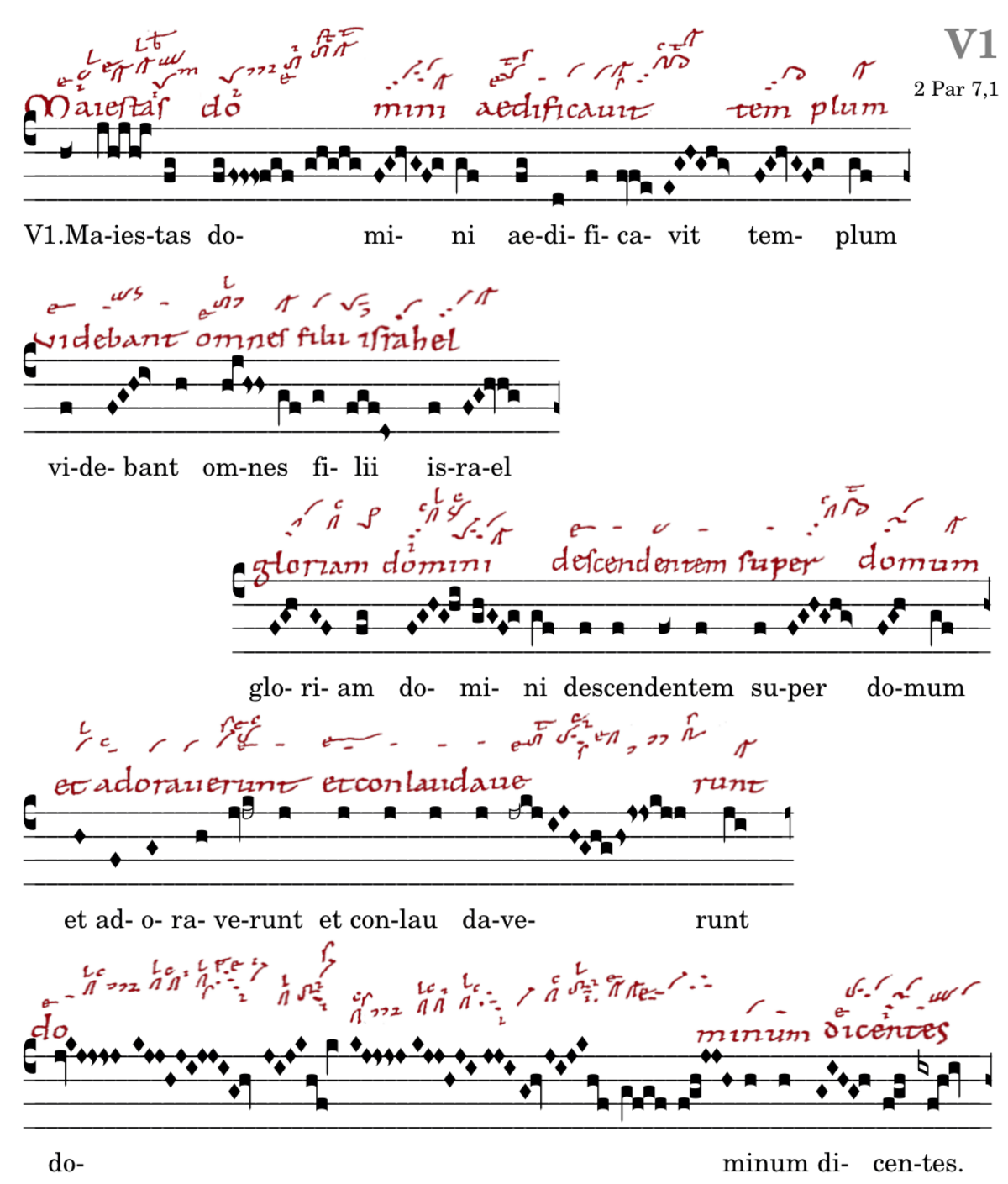
„Maiestas“ Die litterae in E sprechen für die Melodie von A+y gegen Bv.
 Der Vers spielt mit der CAD mega D und ihrem INCCAD, indem sie sie dreimal variiert. Schon im OF selbst seht am Beginn, bei der Anrede Gottes „Domine deus“, die größtmögliche Kadenz, die CAD mega. Diese schließt nun im Vers 1 viermal Kleinstsätze ab uns stellt sie so in einen Zusammenhang: domini - templum - domini - domum. Die ungewöhnliche Neume bei „Maiestas“ zitiert aus dem OF die Stelle „simplicitate“.
domini1 Die letzten zwei Töne der INCCAD sind durch 'statim' abgetrennt.
templum Die CAD mega ist variiert, die vorletzte Silbe ist um zwei Töne verkürzt, die Liqueszenz zeigt die Auslassung an.
domini2 Die Verkürzung des Beginn sie vorletzten Silbe macht die CAD zum „colon“, ebenso der Aufstieg durch Pes quassus beim INCCAD, also doppeltes Colon.
domum Die vorletzte Silbe hat sich zum bloßen Salicus reduziert, das INCCAD ist abermals verkürzt.
„filii israel“ Die doppelte Krasis (Liaison) wird in den Quellen unterschiedlich behandelt. In E sind alle drei Vokale 'i' zu einem Ton reduziert. Allerdings hat eine a.m. bei „is-rah-el“ ein Punktum dazugesetzt.
„vi-de-bant“ und „dicen-tes“ In diesem Vers stehen der Quart-Pes mit Oriscus und die Quart-Clivis gegenüber.
V1. Die Herrlichkeit des Herrn erbaute den Tempel.
Und es sahen alle Kinder Israels / wie die Herrlichkeit des Herrn herabstieg über das Haus,
und sie beteten / an und priesen den Herrn zusammen, sie sagten:

V1. The glory of the Lord built the temple.
And all the children of Israel saw / how the glory of the Lord descended upon the house,
and they worshipped / and praised the Lord together, they said:
“Maiestas” The litterae in E speak for the melody of A+y against Bv.
The verse plays with the CAD mega D and its INCCAD by varying it three times. Already in the OF itself, at the beginning, in the address to God “Domine deus,” we see the greatest possible cadence, the CAD mega. This now concludes four small phrases in verse 1, placing them in context: domini - templum - domini - domum. The unusual neume at “Maiestas” quotes the passage “simplicitate” from the OF.
domini1 The last two notes of the INCCAD are separated by ‘statim’.
templum The CAD mega is varied, the penultimate syllable is shortened by two notes, the liquescence indicates the omission.
domini2 The shortening of the beginning of the penultimate syllable makes the CAD a “colon,” as does the rise through Pes quassus in the INCCAD, i.e., a double colon.
domum The penultimate syllable has been reduced to a mere Salicus, but the INCCAD is shortened again.
“filii israel” The double krasis (liaison) is treated differently in the sources. In E, all three vowels ‘i’ are reduced to one tone. However, an a.m. has added a punctum to “is-rah-el”.
“vi-de-bant” and “dicen-tes” In this verse, the fourth pes with oriscus and the fourth clivis are juxtaposed.