🔘 IN GR TR AL OF CO xxxxx 1️⃣ 2️⃣ 3️⃣ 4️⃣ ✅ 6️⃣ 7️⃣ 8️⃣ xxxxx AN RP IV alia
0697 CO Pacem meamModus 5
0691 ⟽ CO 5 ⟾ 0698 xxx⏹️xxx GT 228 - BzG 56/26 + GN 2/97
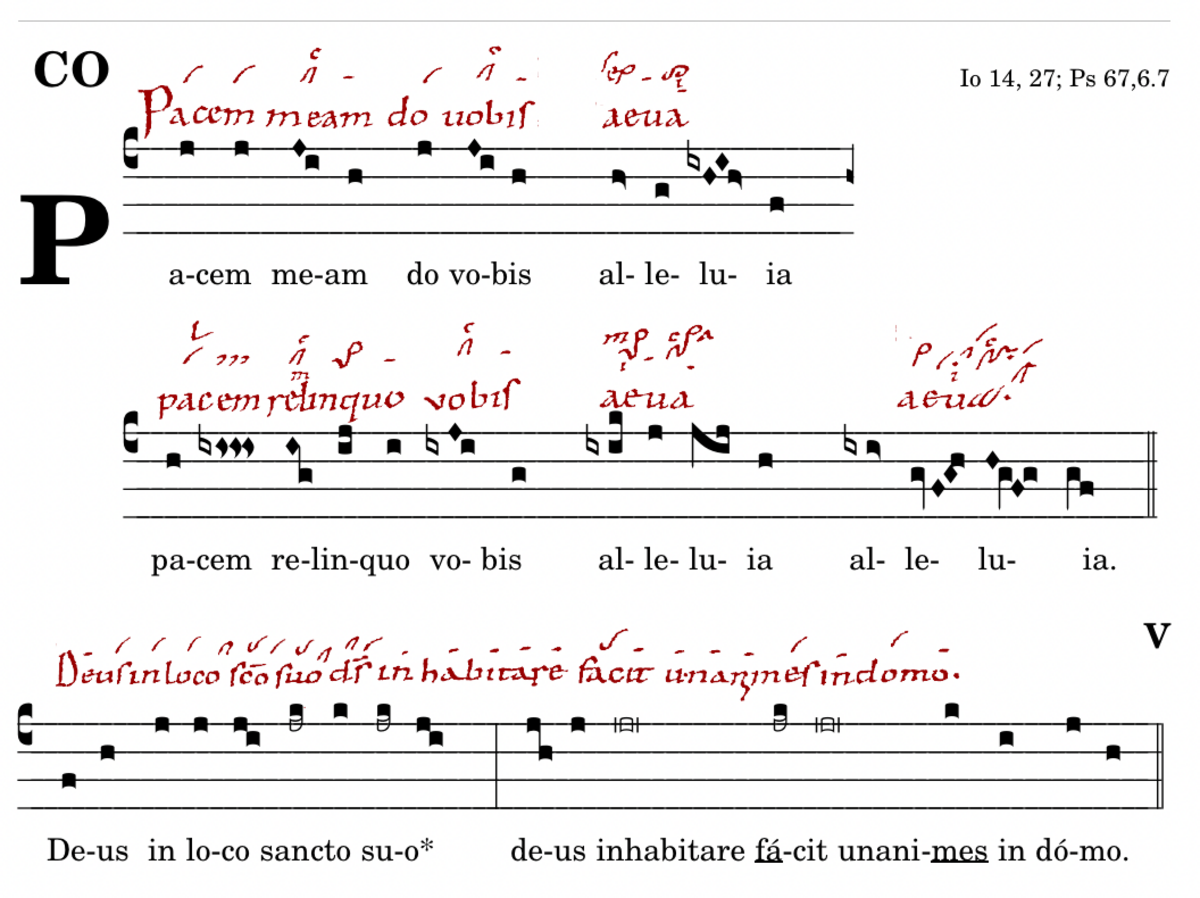
„Pacem meam do vobis“ Protus von der Terz: 2INC cad.
Typisch für den 5.Modus ist das Spannungsverhältnis zwischen dem „Dreiklamg mit si“ (fa-la-do-si 5.Modus) und dem Quartraum „fa-sa“, der als 6. Modus, oder als 8.Modus transponiert verstanden werden kann.
„alle-luia 1“ Die CO centonisiert zum Quartraum „fa-sa“ und verlässt ihn bis zum Schluss nicht wirklich.
Neomaphaga in Aqu, Bv + MR.
„pa-cem“Die Tristropha zieht üblicherweise (nicht im Tritus!) die Rezitation „si“ zum „do“ (hier das „la“ zum „sa“). So notieren Aqu + Bv. L könnte so gelesen werden, ist aber nicht eindeutig. MR + Ch schließen zur Tristropha hin unisonisch an! Auch das levare über der Virga in E ist so zu verstehen. Eine bisher nicht zu entscheidende Frage.
„al-leluia 2“ Das inferius bei der unteren Note, obwohl eine Terz höher, deshalb mit mediocriter korrigiert, sichert das „sa“ und verhindert einen chromatischen Abstieg zur Terminatio.
Meinen Frieden gebe ich euch,
Halleluja,
Frieden hinterlasse ich euch, Halleluja, Halleluja.

My peace I give unto you, alleluia, alleluia
Peace I leave with you, alleluia, alleluia.
‘Pacem meam do vobis’ Protus from the third: 2INC cad.
Typical of the 5th mode is the tension between the ‘triad with B’ (F-A-C-B, 5th mode) and the fourth interval ‘F-G’, which can be understood as the 6th mode, or as the 8th mode when transposed.
‘alle-luia 1’ The CO centonises to the fourth interval ‘fa-sa’ and does not really leave it until the end.
Neomaphaga in Aqu, Bv + MR.
‘pa-cem’The Tristropha usually (not in the Tritus!) draws the recitation ‘si’ to ‘do’ (here the “la” to ‘sa’). This is how Aqu + Bv notate it. L could be read this way, but it is not unambiguous. MR + Ch join in unison towards the Tristropha! The levare above the virga in E is to be understood in the same way. A question that has not yet been resolved.
‘al-leluia 2’ The inferius on the lower note, although a third higher, is therefore corrected with mediocriter; this secures the ‘sa’ and prevents a chromatic descent to the terminatio.