Dies ist eine alte Version des Dokuments!
🔘 IN GR TR AL OF CO xxxxx 1️⃣ 2️⃣ 3️⃣ 4️⃣ 5️⃣ 6️⃣ ✅ 8️⃣ xxxxx AN RP IV alia
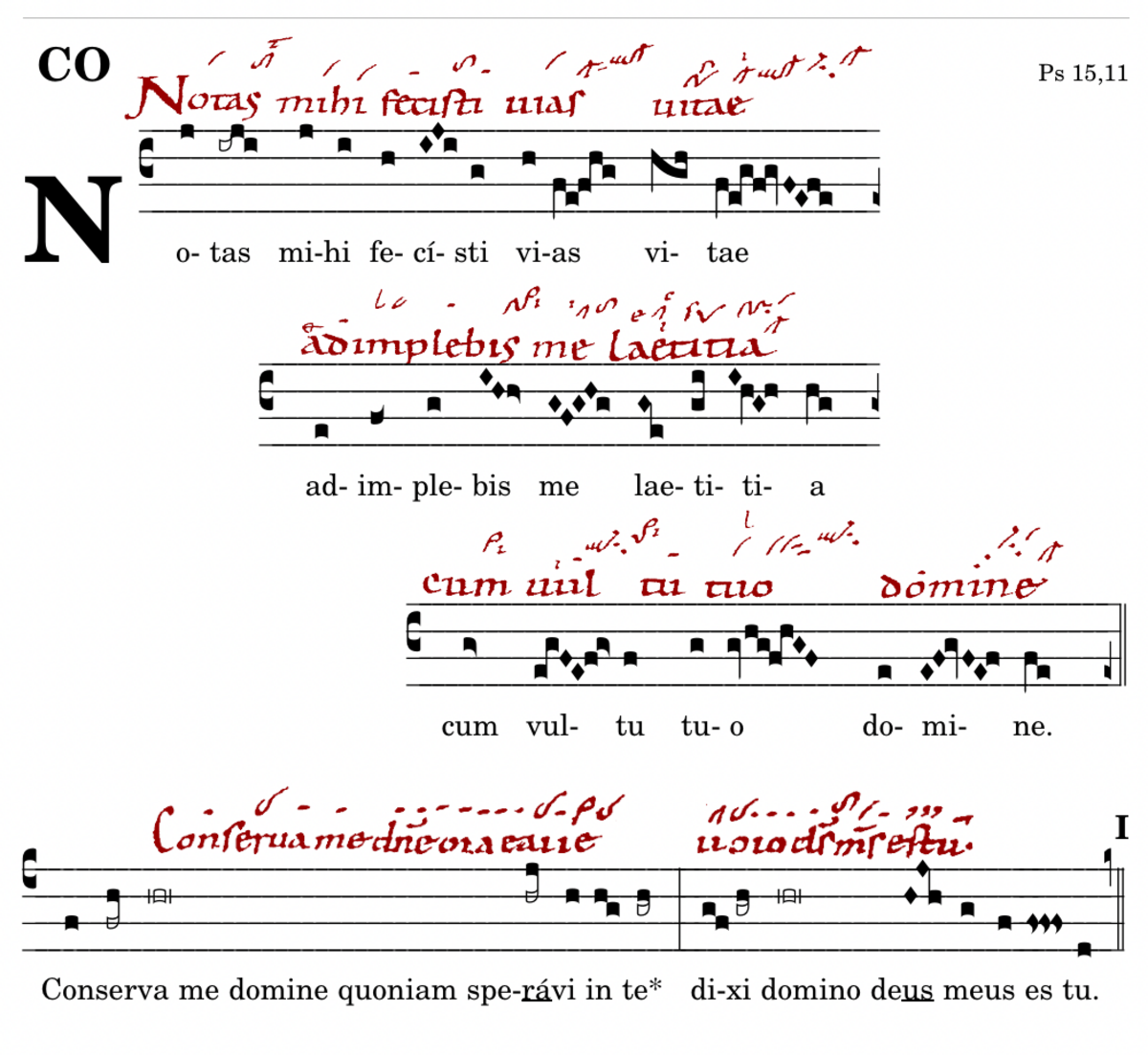
0692 CO Notas mihi fecistiModus 7
0690 ⟽ CO 7 ⟾ 0707 xxx ⏹️ xxx GT 260 - BzG 38,16 - GN 1,223
 „vul-tu tuo domine“ Die BzG haben sich für Bv+A entschieden, dem widersprechen sowohl E+Y als auch Ch+MR+L. Die Kernfrage ist hier die Silbe „tu-o“ alle adiastematischen Quellen außer E schreiben „si-do“. Auch der Blick auf die CAD des RP8 Ω v bringt keine endgültige Entscheidungshilfe.
Von L über Ch,MR und A,Bv zur offensichtlich letzten Stufe E, Y scheint sich eine Entwicklung vollzogen zu haben. Dabei bestätigen die St.Galler Codices G342, G374, G376 das Ergebnis von E nicht(!), sondern sind im Sinne von Ch,MR oder gar wie L zu lesen.
Das Prinzip der repetitio varians (RV) ist auch hier zu finden in der Wiederholung der Circulatio ('me' + 'vultu') und dem Aufstieg sol-la-si, ('adimple-' + 'vultu tu-') die in eine Neume(Neumengruppe) mündet ('-bis me laetitia' + 'tuo') die von der Halbtonspannung si-do lebt. .
Du zeigtest mir / die Wege zum Leben.
Erfüllen wirst du mich / it Freude
mit deinem Angesicht / Herr.

You have shown me t/ he paths to life.
You will fill me / with joy
with your face / Lord.
‘vul-tu tuo domine’ The BzG have opted for Bv+A, a view contradicted by both E+Y and Ch+MR+L. The key issue here is the syllable ‘tu-o’; all adiastematic sources except E write ‘si-do’. Even a look at the CAD of RP8 Ω v does not provide definitive guidance.
It seems that a development has taken place from L via Ch, MR and A, Bv to the final stage, E, Y. The St. Gallen codices G342, G374 and G376 confirm the result of E not (!), but are to be read in the sense of Ch, MR or even L.
The principle of repetitio varians (RV) can also be found here in the repetition of the circulatio ('me' + 'vultu') and the ascent sol-la-si ('adimple-' + 'vultu tu-'), which culminates in a neume (neume group) ('-bis me laetitia' + 'tuo'), which lives off the half-tone tension si-do.