🔘 IN GR TR AL OF CO xxxxx 1️⃣ 2️⃣ 3️⃣ 4️⃣ 5️⃣ 6️⃣ 7️⃣ ✅ xxxxx AN RP IV alia
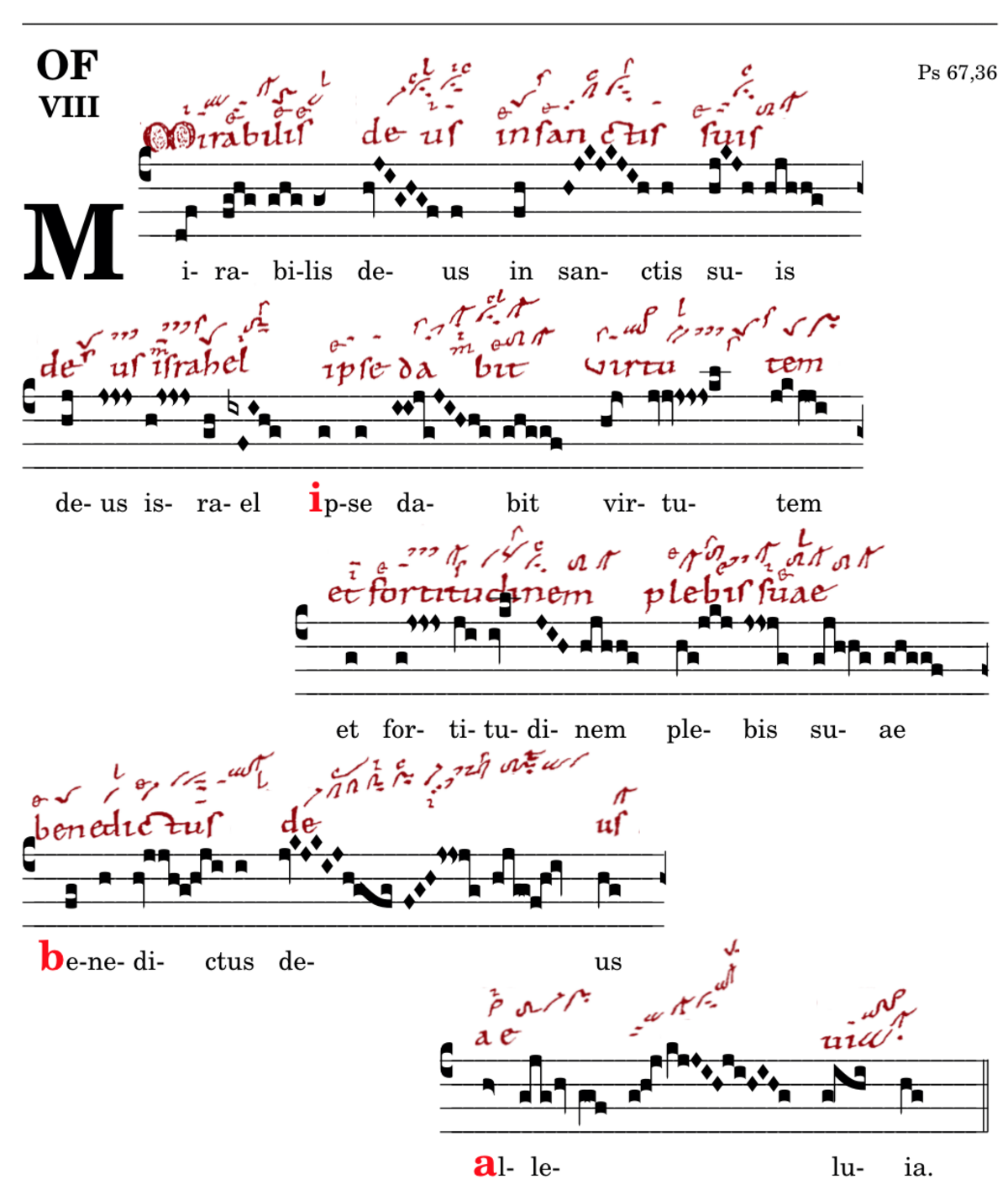
0566 OF Mirabilis deusModus 8
OF – V1 – V2 xxx ⏹️ xxx GT 469 - GN 2/181 - BzG 58/62, 51/43
„isra-el“ Die Quellenlage weist eindeutig auf “si“ hin: E 'mit „i“ zum ersten und „s“ zum zweiten Ton' (BzG 58,63), Kl “do“. Der melodische Kontext ist „do-la-fa“ mit zusätzlicher Tendenz zum „sol“. Wird die Incise „deus israél“ als Einheit gesungen, ist das „si“ bloß eine Umspielung des „la“, das der Zielton ist und deshalb nicht zufällig in den diastematischen Quellen verdoppelt ist. Die auf diese Weise nur wenig vortretende Tritonus-Spannung gibt dem Namen „israhél“ ein kleines Bisschen Gewürz, lässt ihn 'cum grano salis' erklingen.
„vir-tu-tem“ Hier steht Ost gegen West. Ähnlich bei
“ple-bis“ Das 'sursum' in E spricht für “do“, darüber hinaus A+Y „do“ gegen Bv „sol“.
Wunderbar ist Gott in seinen Heiligen / der Gott Israels:
Er selbst wird Macht
und Stärke geben seinem Volk / Gesegnet sei Gott! Halleluja.

Wonderful is God in his saints / The God of Israel:
He himself will give power and strength to his people / Blessed be God! Hallelujah.
“isra-el” The sources clearly point to “si”: E ‘with “i” as the first note and ‘s’ as the second note’ (BzG 58,63), Kl “do.” The melodic context is “do-la-fa” with an additional tendency towards “sol.” If the incise “deus israél” is sung as a unit, the ‘si’ is merely a variation of the “la,” which is the target tone and therefore not coincidentally doubled in the diastematic sources. The tritone tension, which is only slightly pronounced in this way, gives the name “israhél” a little bit of spice, making it sound ‘cum grano salis’.
„vir-tu-tem“ Hier steht Ost gegen West. Ähnlich bei
„ple-bis“ Das 'sursum' in E spricht für “do“, darüber hinaus A+Y „do“ gegen Bv „sol“.