🔘 IN GR TR AL OF CO xxxxx ✅ 2️⃣ 3️⃣ 4️⃣ 5️⃣ 6️⃣ 7️⃣ 8️⃣ xxxxx AN RP IV alia
0503 OF Confitebor tibi domineModus 1
OF – V1 – V2 – V3 – V4 xxx ⏹️xxx GT 123 - GN 1/93 - Bz G76/18
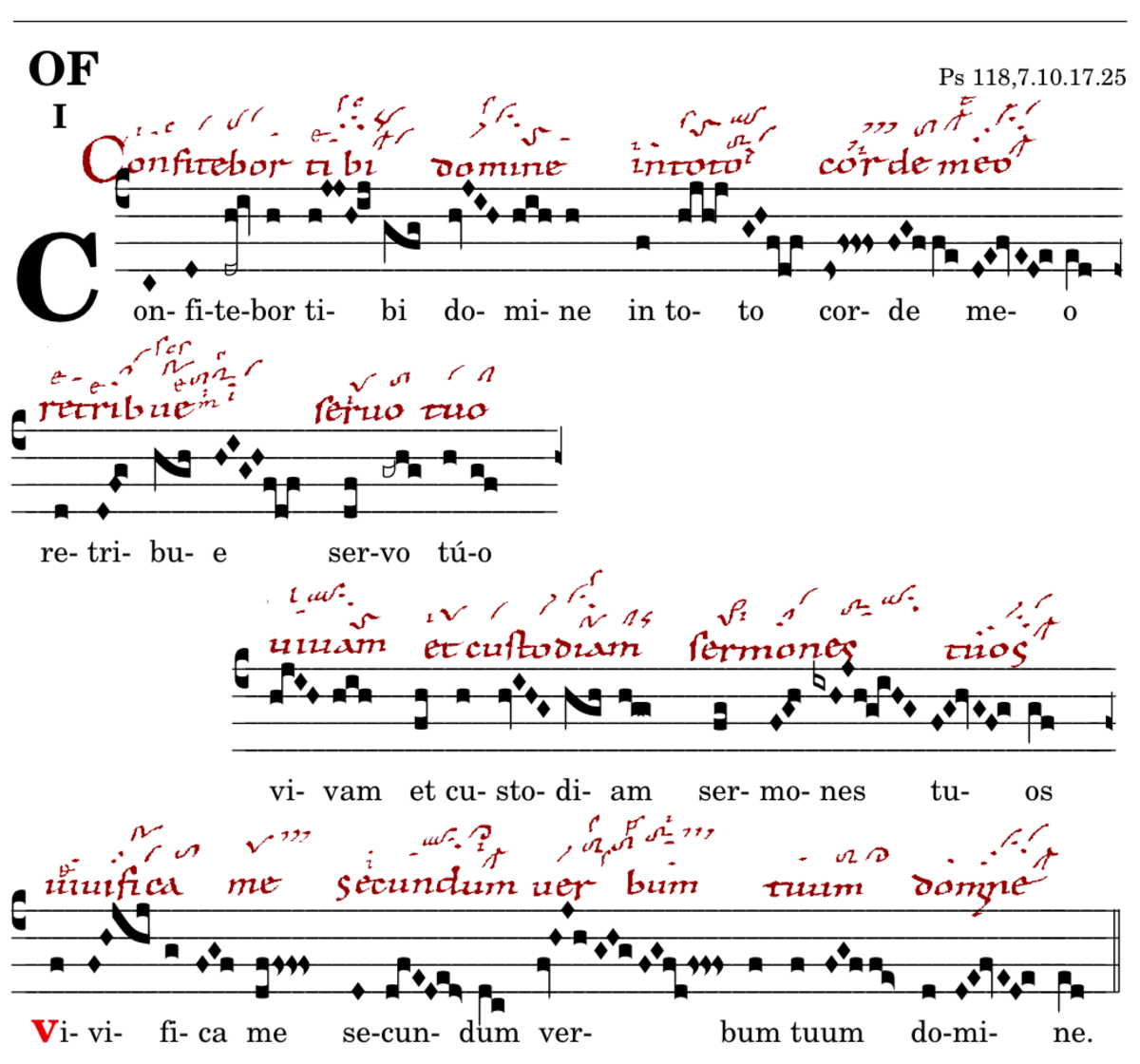
„Confitébor tíbi dómine“ Quintintonation, die Hauptaussage des Offertoriums steht am Beginn. Praetonische Silben in L Punctum.
Der Akzent „confi-té-bor“ ist ein si, nur Mp+Zt schreiben „sa“, Kl gehz zum „do“! Im Kontext des folgenden „do“ bei „tíbi dómine“ kann das „si“ auf „confitébor“ nur ein si-be-durum sein. Die 'virga cornue' in Y (siehe Rupert Fischer, BzG 25, S.108) ist nur eine zusätzliche Bestätigung.
Die Neume „ti-bi“ ist in frOc (L, Ch, MR) und Y nur „la-do-do-la-do“, in E schließt die Neume mit einem nachdrücklichen Pes quassus „si-do“. Es gibt keinen Zeugen für „sa“ außer Mp! Vide Zt, das trotz „sa“ zuvor durch Auflöser hier ein „dsi“ notiert.
„ti-bi“ nkPrr in L, Ch + E.
„ser-vo túo“ TrcPAR, in frOc,A+Y ist der erste Ton entfallen.
„vi-vam“ Das Quilisma ist nur in Bv34 (+Mod) als Ton notiert.
„sermo-nes tuos“ Das si-be-molle gehört in den Kontext der 5.Modus-Kadenz.
Die Kadenz mega am Ende aller drei Perioden ist in MR nk, beginnt mit nkTerz.
Alle „si“ sind „si-be-durum“ außer bei „sermo-nes tuos“: Kadenzgruppe des 5.Modus.
Ich will dich preisen, Herr, von ganzem Herzen.
Vergilt deinem Knecht, ich werde leben und deine Worte beachten!
Belebe mich nach deinem Wort, Herr.

I will praise you, Lord, with all my heart.
Forgive your servant, I will live and heed your words!
Revive me according to your word, Lord.
„Confitébor tíbi dómine“ Quintintonation, the main statement of the offertory is at the beginning. Praetonic syllables in L punctum.
The accent „confi-té-bor“ is an si, only Mp+Zt write „sa“, Kl goes to „do“! In the context of the following „do“ in „tíbi dómine“, the „si“ on „confitébor“ can only be a si-be-durum. The 'virga cornue' in Y (see Rupert Fischer, BzG 25, p.108) is only an additional confirmation.
The neume „ti-bi“ is in frOc (L, Ch, MR) and Y only „la-do-do-la-do“, in E the neume closes with an emphatic pes quassus „si-do“. There is no witness for „sa“ except Mp! Vide Zt, which despite „sa“ previously notates a „dsi“ here by dissolver.
„ti-bi/“ nkPrr in L, Ch + E.
„ser-vo túo“ TrcPAR, in frOc,A+Y the first note is omitted.
„vi-vam“ The quilisma is only notated as a tone in Bv34 (+Mod).
„sermo-nes tuos“ The si-be-molle belongs in the context of the 5th mode cadence.
The cadence mega at the end of all three periods is nk in MR, beginning with nkTerz.
All “si” are “si-be-durum” except for “sermo-nes tuos”: cadential group of the 5th mode.