🔘 IN GR TR AL OF CO xxxxx ✅ 2️⃣ 3️⃣ 4️⃣ 5️⃣ 6️⃣ 7️⃣ 8️⃣ xxxxx AN RP IV alia
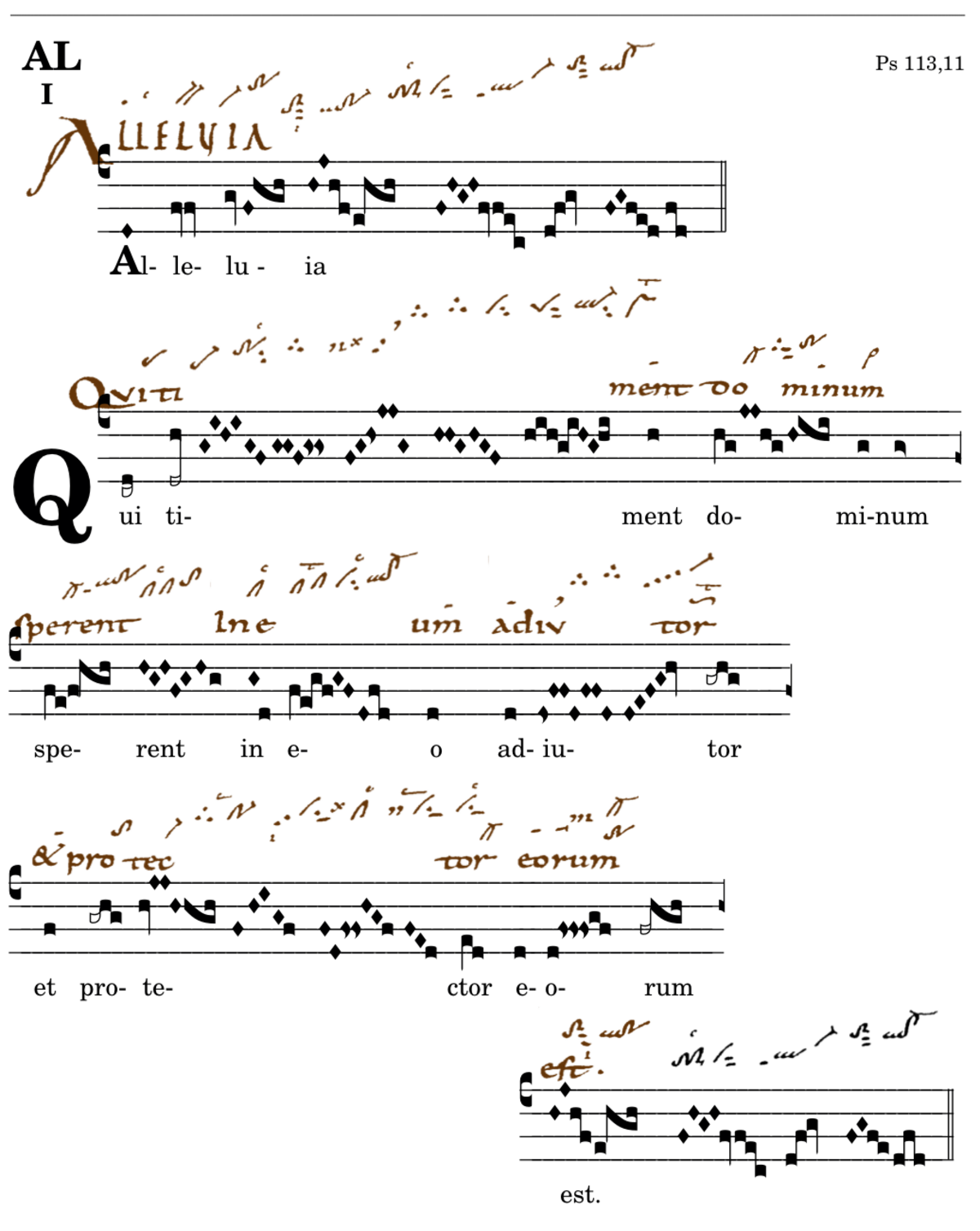
0406 AL Qui timent dominumModus 1b
0399 ⟽ AL 1 ⟾ 04261347 ⟽ AL 1b ⟾ 1586xxx ⏹️xxx GT 352 - GN 1/340 - BzG 43/53 - SX …CKS
Das AL 1b muss in der ersten Hälfte des 9. Jahrhunderts komponiert sein ( vor 853) und ist älter als die AL 1* und AL 1a.Abgesehen von der Referenda, die den gesamten Iubilus umfasst, gibt es keine plumpen Wiederholungen. Bemerkenswert ist die dem jeweiligen Text entsprechende Umformung des Einstieges „re-fa-sol“: Al-le-lú-„ gegen „e-o-rum“.
„Allelu-ia“ Die ersten fünf Töne Melisma-Incipits lauten „la-do-la-fa-mi“, siehe Bv40, aber auch E mit einem 'inferius' auf der 4. und auf der 5.Note.
Bei der Wiederholung am Ende des Verses hat allerdings eine a.m. ein 'altius' dazugesetzt (!?).
SI - SA „Qui ti-ment“ Das „si“ ab der 4.Note des Melismas muss kein „si-be-molle (sa)“ sein, die Melodie bezieht sich auf das „sol“ (Strophicus), vielleicht noch auf das „la“, nicht aber auf „fa“. Darüber hinaus stehen die „si“ im Schatten des zweimaligen Trigon „do-do-sol“ bzw. „do-do-la“.
Leider fehlt codex Kl, das hier vielleicht eine Bestätigung geben könnte.
Auch am Ende dieses Melismas bezieht sich das „si“ auf das „sol (Mp) oder „la“. Das spricht für „si-be-durum“ (si) im Kontext des Quartraumes „do-si-la-sol“. Beim folgenden Wort “do-minum“ „do-sa-la-sol“ zu singen, passt weder zum Text, noch zur Gregorianik überhaupt, vor allem wenn man den Liqueszenzton „mi“ folgen lässt (Mp). Zu beachten ist die VStr am Ende der Silbe „Qui ti-ment“. Etabliert sie eine Ténorebene „sa“, oder ist sie ein eintoniger Akzent-Pes über die Ténorebene „la“ hinaus?
Grundsätzlich geht es hier um eine historisch-ästhetische Frage, die nicht mit dem bloßen Hinweis auf Quellen aus dem 12. Jahrhundert zu beantworten ist.
V. Die den Herrn fürchten, sollen auf ihn vertrauen / Er ist ihr Helfer und Schützer.

V. Who gives peace to your borders / and fills you with the best wheat.
AL 1b must have been composed in the first half of the 9th century (before 853) and is older than AL 1* and AL 1a. Apart from the repetenda, which spans the entire Iubilus, there are no clumsy repetitions. Noteworthy is the adaptation of the opening ‘re-fa-sol’ to suit the respective text: ‘Al-le-lú-’ versus ‘e-o-rum’.
‘Allelu-ia’ The first five notes of the melismatic incipit are ‘la-do-la-fa-mi’, see Bv40, but also E with an “inferius” on the 4th and on the 5th note.
However, in the repetition at the end of the verse, an a.m. has added an “altius” (!?).
SI - SA ‘Qui ti-ment’ The ‘si’ from the 4th note of the melisma need not be a ‘si-be-molle (sa)’; the melody refers to the ‘sol’ (Strophicus), perhaps also to the “la”, but not to ‘fa’. Furthermore, the ‘si’ notes are overshadowed by the double trine ‘do-do-sol’ and ‘do-do-la’.
Unfortunately, Codex Kl is missing, which might have provided confirmation here.
At the end of this melisma, too, the ‘si’ refers to the ‘sol (Mp)’ or “la”. This suggests ‘si-be-durum’ (si) in the context of the fourth interval ‘do-si-la-sol’. Singing “do-sa-la-sol” for the following word “do-minum” fits neither the text nor Gregorian chant in general, especially if one follows the liquefied tone “mi” (Mp). Note the VStr at the end of the syllable ‘Qui ti-ment’. Does it establish a tenor level of “sa”, or is it a monosyllabic accent-pes extending beyond the tenor level of ‘la’?
Fundamentally, this is a historical-aesthetic question that cannot be answered by merely referring to sources from the 12th century.