🔘 IN GR TR AL OF CO xxxxx ✅ 2️⃣ 3️⃣ 4️⃣ 5️⃣ 6️⃣ 7️⃣ 8️⃣ xxxxx AN RP IV alia
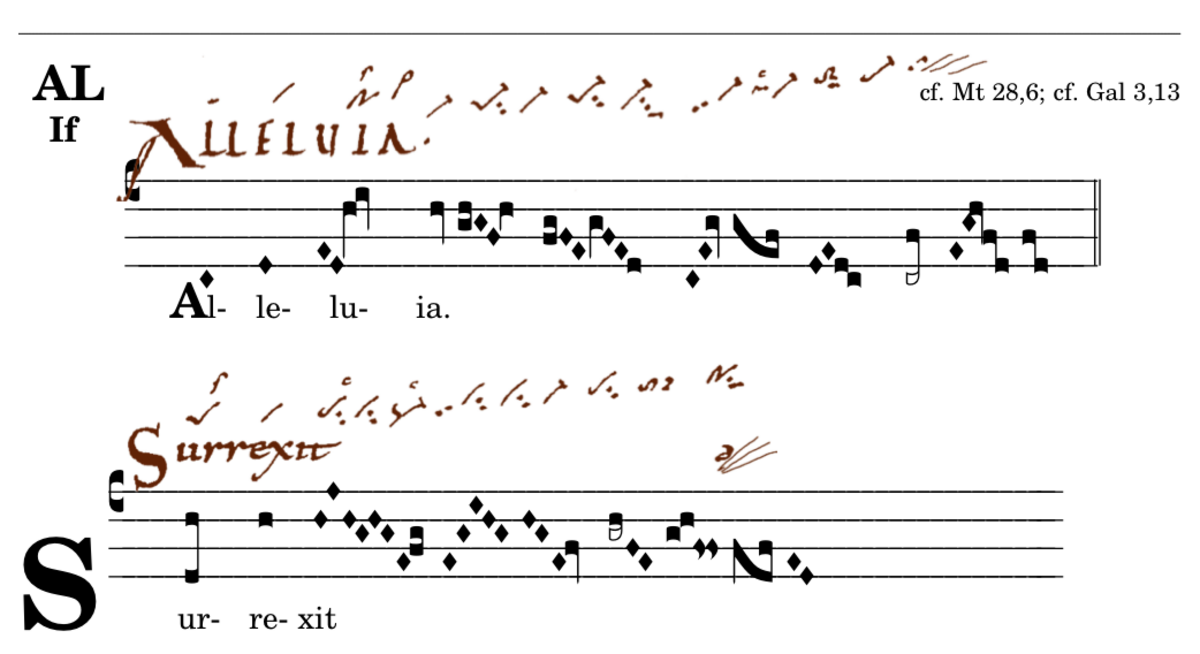
0426 AL Surrexit dominus de sepulcroModus 1f
0406 ⟽ AL 1 ⟾ 0439a1778 ⟽ AL 1f ⟾ 0865 xxx ⏹️ xxx GT 203 - GN - BzG 48/19;49/35 - SX M..C..
Um 0850 entstanden, die Repetenda ist der volle Iubilus. Im
Versus gibt es eine dreisilbige Wiederholung: sepulchro = pependit. Tod und Leiden werden parallel gestellt.
Iubilus und Versus beginnen mit dem 1INC ad5 der AN, der 1. Akzent ist der Hauptakzent. „Allelúia“mit der verstärkenden Prr-Graphie,
„Súrrexít“ mit der zweiakzentigen Form zum „do“, die aber auf dem ersten Akzent die Quint nicht übersteigt und das „do“ auf der Schlusssilbe bringt.
Zweimal wird eine kleine Formel wiederholt und variiert; im Iubilus eine Stufe tiefer und weitergeführt, im Vers gleichhoch aber statt zum „mi“ zum „do“ weitergeführt.
Als Eigenart dieses AL werden Quint-Räume gegeneinander gestellt:
Iubilus: „re-la“ gegen „do-sol“
Versus: „re-la“ gegen „mi-si“ und wieder „la-re“.
„Jubilus“ : Pressus„sol-mi“: Eine der wenigen Stellen. wo nach dem Pressus ein höherer Ton folgt! In der Repetenda fehlt dieser Resupinton. Die Wahrscheinlickeit eines Schreibfehlers in E ist sehr gering. Die Resupinbewegung ist als Signal für das Ende des Jubilus zu interpretieren. Die Repetenda endet hier nicht, sie führt zur Wiederholung des Jubilus.
„Surre-xit“ Das „si“ ist er obere Ton des Dreiklangs „mi-sol-si“, in diesem Kontext schwer zu treffen, aber nicht schwerer als „sa“. Auch der Text „surrexit“ spricht für „si“. Die diastematischen Quellen ändern diese Stelle völlig.
V. Auferstanden ist der Höchste aus dem Grab / der für uns am Kreuz gehangen.

V. Risen from the grave is the Most High / who hung on the cross for us.
Composed around 850, the Repetenda is the full Iubilus. In the
Versus there is a three-syllable repetition: sepulchro = pependit. Death and suffering are juxtaposed.
The Iubilus and Versus begin with the 1INC ad5 of the AN; the first accent is the primary accent. ‘Allelúia’ with the reinforcing Prr-graphic,
‘Súrrexít’ with the two-accented form to “do”, which, however, does not exceed the fifth on the first accent and brings the ‘do’ to the final syllable.
A short phrase is repeated and varied twice; in the Iubilus it is lowered by a step and continued, in the Versus it remains at the same pitch but continues to ‘do’ instead of ‘mi’.
A distinctive feature of this AL is the juxtaposition of fifth intervals:
Jubilus: ‘re-la’ against ‘do-sol’
Versus: ‘re-la’ against ‘mi-si’ and again ‘la-re’.
“Jubilus” : Pressus ‘sol-mi’: One of the few places where a higher note follows the Pressus! This resupinton is missing in the Repetenda. The likelihood of a copying error in E is very low. The resupin movement is to be interpreted as a signal for the end of the Jubilus. The Repetenda does not end here; it leads to a repetition of the Jubilus.
‘Surre-xit’ The ‘si’ is the upper note of the triad ‘mi-sol-si’, difficult to hit in this context, but no more so than ‘sa’. The text “surrexit” also points to ‘si’. The diastematic sources alter this passage completely.