🔘 IN GR TR AL OF CO xxxxx 1️⃣ ✅ 3️⃣ 4️⃣ 5️⃣ 6️⃣ 7️⃣ 8️⃣ xxxxx AN RP IV alia
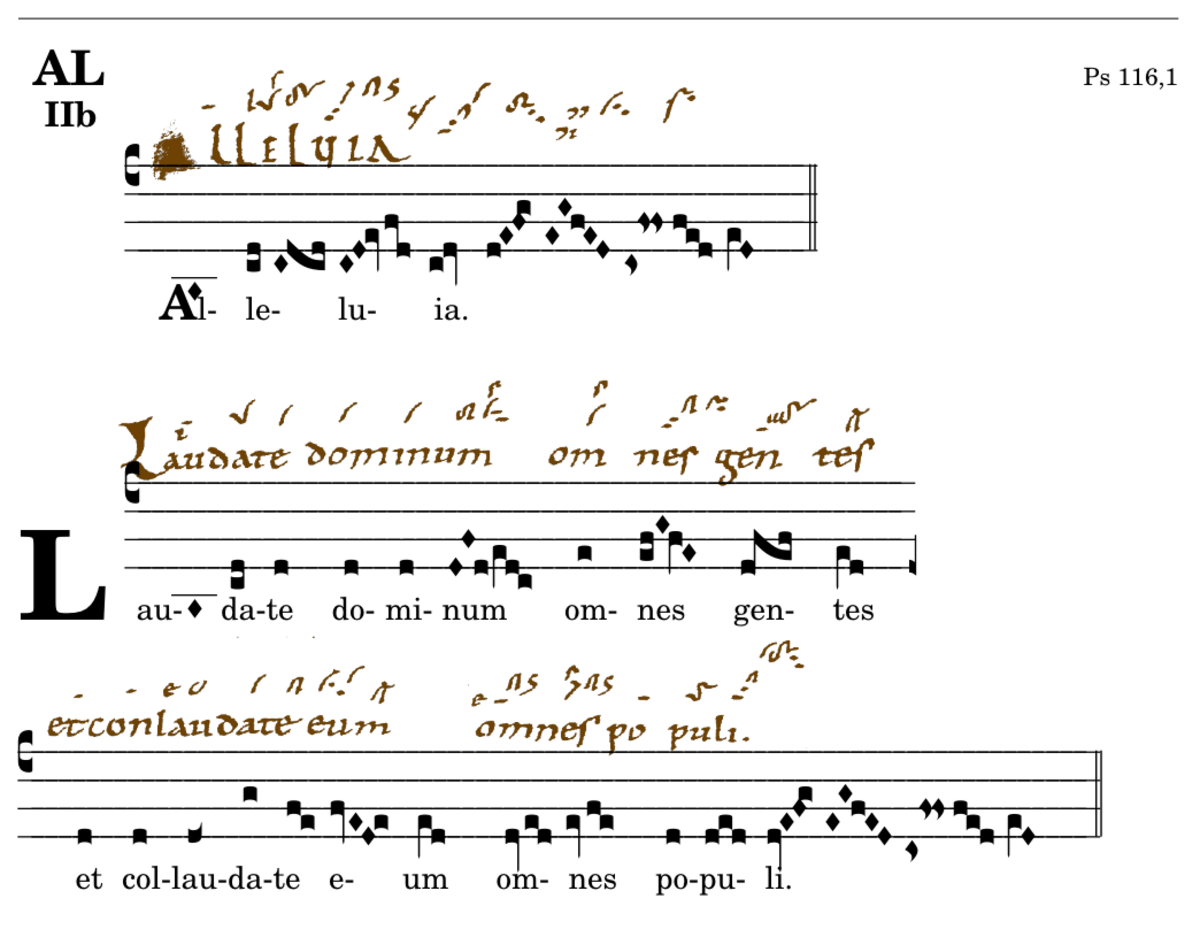
0376 AL Laudate dominum 1Modus 2b
0369 ⟽ AL 2 ⟾ 04010344 ⟽ AL 2b ⟾ 1317 xxx GT 273 - GN 1/241 - BzG 39/13 xxx ⏹️
 ~Clv am Ende des Jubilus: „mi-re“. GN fordert „fa-re“ Beleg dafür ist nur Bv; Kl als Handschrift der „do-Revision des Hochmittelalters“ („do-Rev“, vulgo:germanischer Choraldialekt) ist kein brauchbarer Zeuge.
Das AL Laudate dominum spielt mit der Spannung „re-mi“. Die grundsätzliche tonale Struktur des Gregorianischen Chorals ist die fallende Tonleiter: Daher ist GR „mi-re“ am Ende des Jubilus richtig.
V. Lobt den Herrn, alle Völker /
Und lobpreist ihn, alle Völker.

V. Praise the Lord, all peoples / And praise him, all peoples.
~Clv at the end of the Jubilus: ‘mi-re’. GN calls for ‘fa-re’; the only evidence for this is Bv; Kl, as a manuscript of the ‘do-revision of the High Middle Ages’ (‘do-rev’, commonly known as the Germanic choral dialect), is not a reliable source.\ \
The AL Laudate dominum plays with the tension ‘re-mi’. The fundamental tonal structure of Gregorian chant is the descending scale: therefore, GR ‘mi-re’ at the end of the Jubilus is correct.