🔘 IN GR TR AL OF CO xxxxx 1️⃣ 2️⃣ 3️⃣ 4️⃣ 5️⃣ 6️⃣ ✅ 8️⃣ xxxxx AN RP IV alia
0004 IN Aqua sapientiaeModus 7
0003 ⟽ IN 7 ⟾ 0005 xxx ⏹️xxx GT 202 - GN 1,173 - BzG 48,16
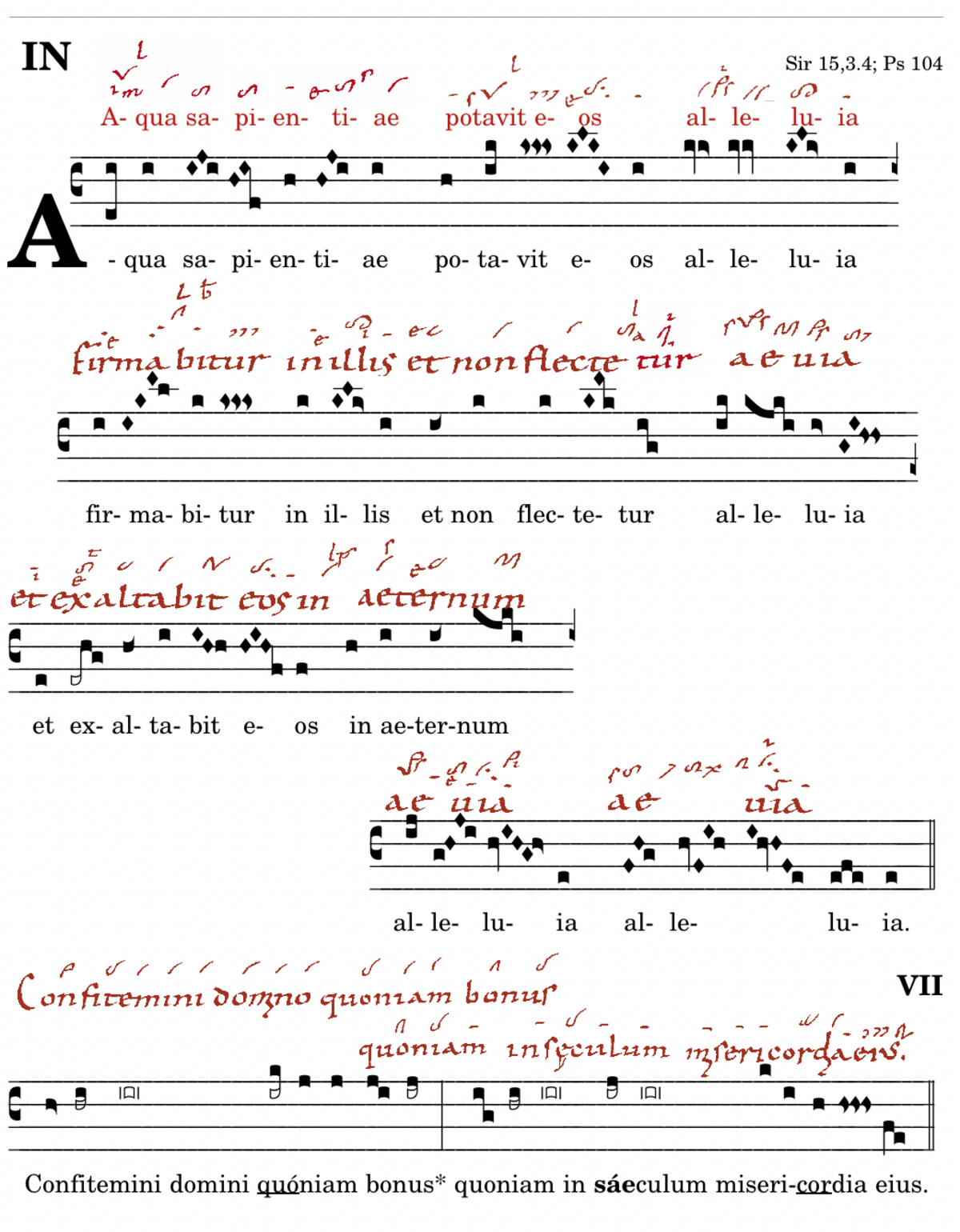
„sa-pi-entiae“
Trc „do-re-la“ (Bv + Mod) oder „do-re-si“ (A + Y + Mp).
Der in BzG 48/17 angesprochene „unisonische Anschluss zum folgenden Ton“ findet sich nur in Kl auf Grund der do-Revision, wenn dies auch für einen Trc „do-re-si“ spricht. A+Y gegen Bv wird seit jeher (LAg) als 50:50 interpretiert. L könnte für beide Lösungen stehen. Der weite Abstrich des Trc in Ch spricht eher für „do-re-la“, ebenso alle beneventaner Zeugen. Wollte man die Frage Tractulus (E + G339 + G374 + 376) oder Virga (G342 + Bam) für die folgende Silbe ins Spiel bringen, eine sehr zweifelhafte Argumentation, so spräche die Virga für „la“ und auch der Tractulus nicht dagegen. Ein sehr starkes Argument ist allerdings der lange Abstrich in Bam: „la“.
Hier sei ausnahmsweise auch ein aesthetisches Argument ins Spiel gebracht: Die „sapientia“ ist eher durch den weitschwingenden Quint-Ambitus ausgedrückt, als durch den Halbton geprägten Quartraum.
„et exaltabit“ TrcINT geht immer über die Quart, daher auch „et“ ein „sol“ trotz der diast.Quellen.
Mit dem Wasser der Weisheit hat er sie getränkt,
Halleluja.
Sie erstarkt in ihnen und wird nicht gebeugt,
Halleluja,
und er erhöht sie in Ewigkeit,
Halleluja, Halleluja.

He has watered them with the water of wisdom, Hallelujah.
They are strengthened within them and will not be bowed down, Hallelujah,
and he will exalt them forever, Hallelujah, Hallelujah.
“sa-pi-entiae” Trc “do-re-la” (Bv + Mod) or “do-re-si” (A + Y + Mp). The “unison connection to the following tone” mentioned in BzG 48/17 is only found in Kl due to the do revision, although this also argues in favor of a Trc “do-re-si.” A+Y against Bv has always been interpreted (LAg) as 50:50. L could stand for both solutions. The wide stroke of the Trc in Ch tends to favor “do-re-la,” as do all Beneventan witnesses. If one wanted to bring the question of Tractulus (E + G339 + G374 + 376) or Virga (G342 + Bam) into play for the following syllable, a very dubious argument, then Virga would argue for “la” and Tractulus would not argue against it. However, a very strong argument is the long stroke in Bam: “la.” Here, by way of exception, an aesthetic argument should also be brought into play: the “sapientia” is expressed more by the wide-swinging fifth ambitus than by the semitone-marked fourth space. “et exaltabit” TrcINT always goes over the fourth, hence “et” is a “sol” despite the diast. sources.