🔘 IN GR TR AL OF CO xxxxx 1️⃣ 2️⃣ 3️⃣ ✅ 5️⃣ 6️⃣ 7️⃣ 8️⃣ xxxxx AN RP IV alia
1070 OF Lauda anima mea V2Modus 4
OF – V1 – V2 xxx ⏹️ xxx OT 68 - ON xx - BzG xx/xx
FML alloq 4x
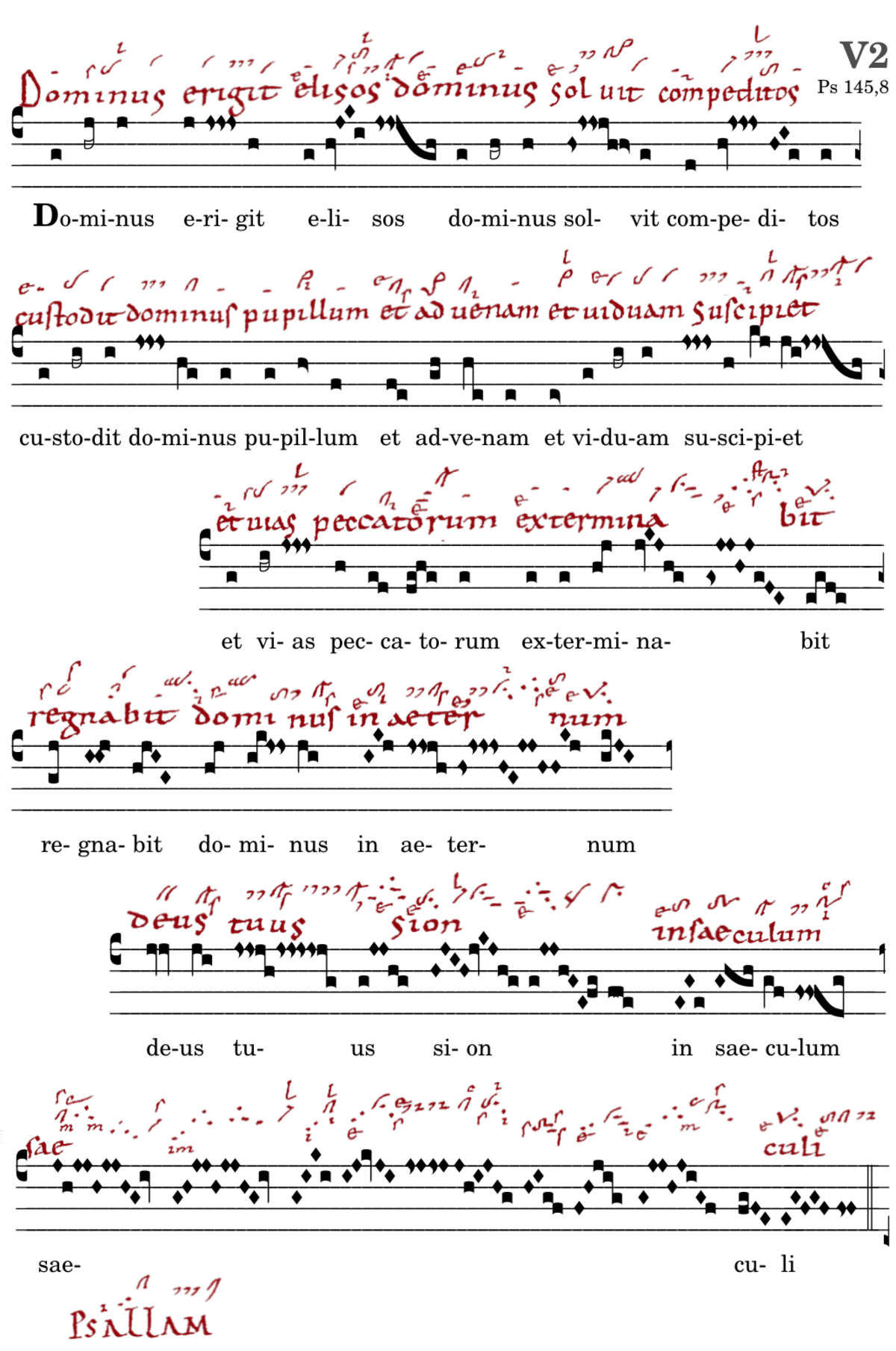
„Dominus“ Das 'sursum' zum kPes ist als Schritt zur plerosis zu verstehen.
„custodit“ L Der erste Ton des kPes steht zur Silbe davor unisonisch; sie auch Y + Mp.
„et viduam“ L unisonisch. Silbe „et“ in E 'levare' und zum nächsten Ton 'equaliter', daher entgegen allen diastematischen Quellen: Cephalicus „sol“.
„et vias“ Auch hier ist das 'sursum' zum kPes ist als Schritt zur plerosis zu verstehen. Diese Stelle als FML alloq zu lesen, es fehlt der Zielton “si“, ist eine Entwicklung aus den vorherigen Stellen.
V2. Der Herr richtet die Gestürzten auf / der Herr macht die Gefesselten los,\\
der Herr behütet die Fremden / Waise und Witwe nimmt er auf,\\
doch den Weg der Sünder macht er zunichte.\\
König ist der Herr in Ewigkeit / dein Gott, Zion, von Geschlecht
zu Geschlecht.

V2. The Lord lifts up the fallen / the Lord loosens those who are bound,\\
the Lord protects the stranger / he takes in the orphan and the widow,\\
but he destroys the way of sinners.\\
The Lord is king forever / your God, Zion, from generation to generation.
FML alloq 4x
“Dominus” The ‘sursum’ to the kPes is to be understood as a step towards plerosis.
“custodit” L The first note of the kPes is in unison with the syllable before it; it is also Y + Mp.
“et viduam” L unison. Syllable ‘et’ in E ‘levare’ and to the next note ‘equaliter’, therefore contrary to all diastematic sources: Cephalicus “sol”.
“et vias” Here, too, the ‘sursum’ to kPes is to be understood as a step toward plerosis.
Reading this passage as FML alloq, with the target tone “si” missing, is a development from the previous passages.