🔘 IN GR TR AL OF CO xxxxx ✅ 2️⃣ 3️⃣ 4️⃣ 5️⃣ 6️⃣ 7️⃣ 8️⃣ xxxxx AN RP IV alia
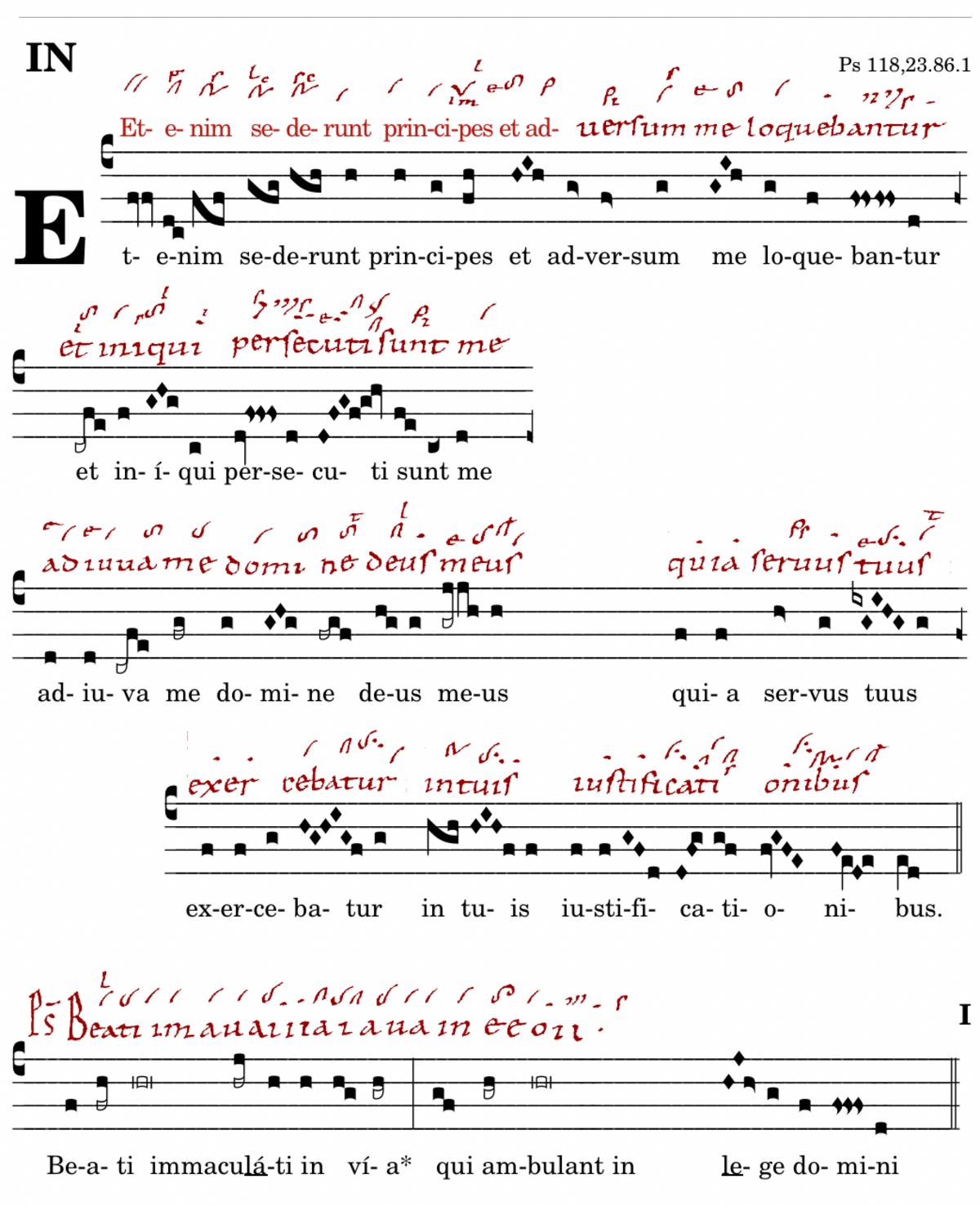
0050 IN Etenim sederunt principesModus 1
0046 ⟽ IN 1 ⟾ 0054 xxx ⏹️xxx GT 632 - GrN 40 - BzG 36/74
Dieser IN ist tonal vielschichtig. Er beginnt mit einem 2INC katab eine Terz nach oben transponiert. Das ändert wegen der pentatonischen Struktur nicht an den Intervallen außer im letzten Por, der eine kleine Terz höher stehen müsste, hier aber eine große Terz höher steht. Das 'sursum' auf „se-de-runt“ weist darauf hin.
Weiters verwendet der IN zweimal den TrcINT (Intonationsrotculus) des 7. Modus. Dieser hochgespanne Modus passt bestens zum Hilferuf: „et iniqui persecuti sunt me - adiuva me domine deus meus“.
“et adversum me„ der Trc „et“ muss zum „si“ führen, siehe Kl, nur Mp schreibt „sa“. Bei Trc „me“ schreibt auch Kl ein „sa“, obwohl in Kl mit dem Unterschwung zum „mi“ eine reine Quint zum „si“ möglich wäre. Keine adiastematische Quelle gibt zu dieser Frage irgendeinen Hinweis. Wir plädieren auch hier für „si“, trotz, ja wegen des offen liegenden Tritonus, der Text verlangt das geradezu: „principes adversum me loquebantur“.
Die Tritonus-Spannung prägt diesen IN. Das gilt auch für:
„exerce-ba-tur in tu-is“. Nur Mp und Zt schreiben „sa“, Kl führt zum „do“. Sehr frei müsste man Wegen dieses zweimaligen Tritonus müsste man den Text ebenfalls als Aufschrei verstehen: (sehr frei übersetzt: „ich halte mich ja an deine Gebote!“). Anders bei
„quia servus tu-us“. Hier ist das „sa“ in allen einschlägigen Quellen bestätigt.
In der Tat: Herrscher setzten sich und berieten gegen mich,
und Ungerechte verfolgten mich:
Hilf mir, Herr, mein Gott,
denn dein Knecht übte sich | in deinen Ordnungen.

Indeed, rulers sat down and took counsel against me,
and the unrighteous persecuted me:
Help me, O Lord my God,
for your servant practiced your ordinances.
This IN is tonally complex. It begins with a 2INC katab transposed up a third. Due to the pentatonic structure, this does not change the intervals except in the last por, which should be a minor third higher, but is a major third higher here. The 'sursum' on “se-de-runt” indicates this.
The IN also uses the TrcINT (intonation rotculus) of the 7th mode twice. This high-pitched mode fits perfectly with the cry for help: “et iniqui persecuti sunt me - adiuva me domine deus meus”.
“et adversum me” the Trc “et” must lead to “si”, see Kl, only Mp writes “sa”. With Trc “me”, Kl also writes “sa”, although a pure fifth to “si” would be possible in Kl with the underswing to “mi”. No adiastematic source gives any indication of this question. Here, too, we argue in favor of “si”, despite, indeed because of the overt tritone; the text virtually demands it: “principes adversum me loquebantur”.
The tritone tension characterizes this IN. This also applies to:
“exerce-/ba-tur in tu-is”. Only Mp and Zt write “sa”, Kl leads to “do”. Because of this double tritone, the text should also be understood as an outcry: (very freely translated: “I keep your commandments!”). Not so with
“quia servus tu-us”. Here the “sa” is confirmed in all relevant sources.