🔘 IN GR TR AL OF CO xxxxx 1️⃣ 2️⃣ ✅ 4️⃣ 5️⃣ 6️⃣ 7️⃣ 8️⃣ xxxxx AN RP IV alia
0943 OF Benedictus es --- in labiis V2Modus 3
OF – V1 – V2 – V3 xxx ⏹️ xxx OT 29 - ON xx - BzG xx/xx
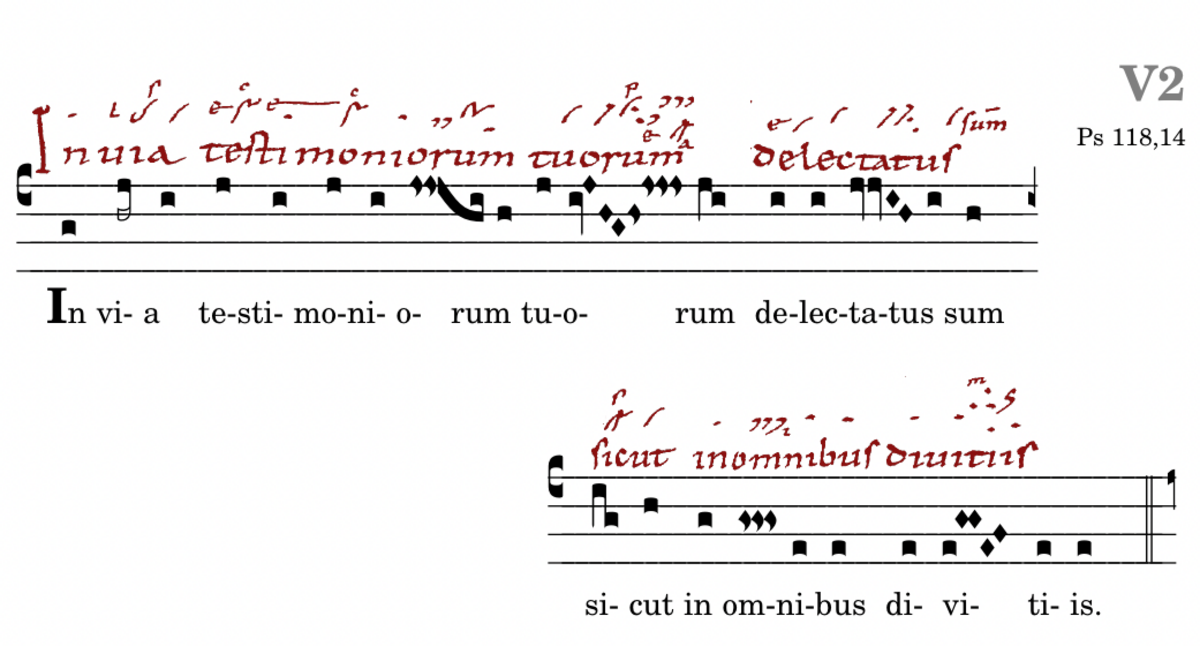
 „In via“ Das Incipi dieses 2. Verses ist eine FML alloquium, die aber in den Quellen ihre Entwicklung durch die Zeit erkennen lässt. In
L ist sie unverfälscht und fordert die Betonung „Ín via“ ein. Der erste Ton des Binnen-Pes ist bloß ein Portamento, unitonische der Silbe zuvor.
Ch hat ebenfalls kurrenten Binnenpes, setzt seinen ersten Ton aber eindeutig höher als die vorherige Silbe. IN
MR ist der Pes nk (Pes disgregatus) und wie in Ch höher beginnend.
E liefert die jüngste Stufe der Entwicklung. Die Betonung ist nun eindeutig „In vía“ und der nunmehr 'Akzentpes“ führt zum „do“, Ansatz zur do-Revision, wenn die Rezitation selbst noch das „si“ bleibt. Erst
Kl, Mod und Mp rezitieren durchgehend auf „do“.
V2. Auf dem Weg deiner Weisungen war ich voll Wonne / wie über alle Reichtümer.

V2. In the way of your instructions I was full of delight / as of all riches.
“In via” The incipit of this second verse is an FML alloquium, but its development over time can be seen in the sources. In
L it is unaltered and requires the emphasis “Ín via.” The first tone of the internal pes is merely a portamento, unitonic to the preceding syllable.
Ch also has a current internal pes, but sets its first tone clearly higher than the preceding syllable. IN
MR the pes is nk (pes disgregatus) and, as in Ch, begins higher.
E provides the most recent stage of development. The stress is now clearly “In vía” and the now ‘accent pes’ leads to “do”, an approach to the do revision, while the recitation itself remains ‘si’. Only
Kl, Mod, and Mp recite consistently on “do”.