🔘 IN GR TR AL OF CO xxxxx 1️⃣ 2️⃣ 3️⃣ 4️⃣ 5️⃣ 6️⃣ ✅ 8️⃣ xxxxx AN RP IV alia
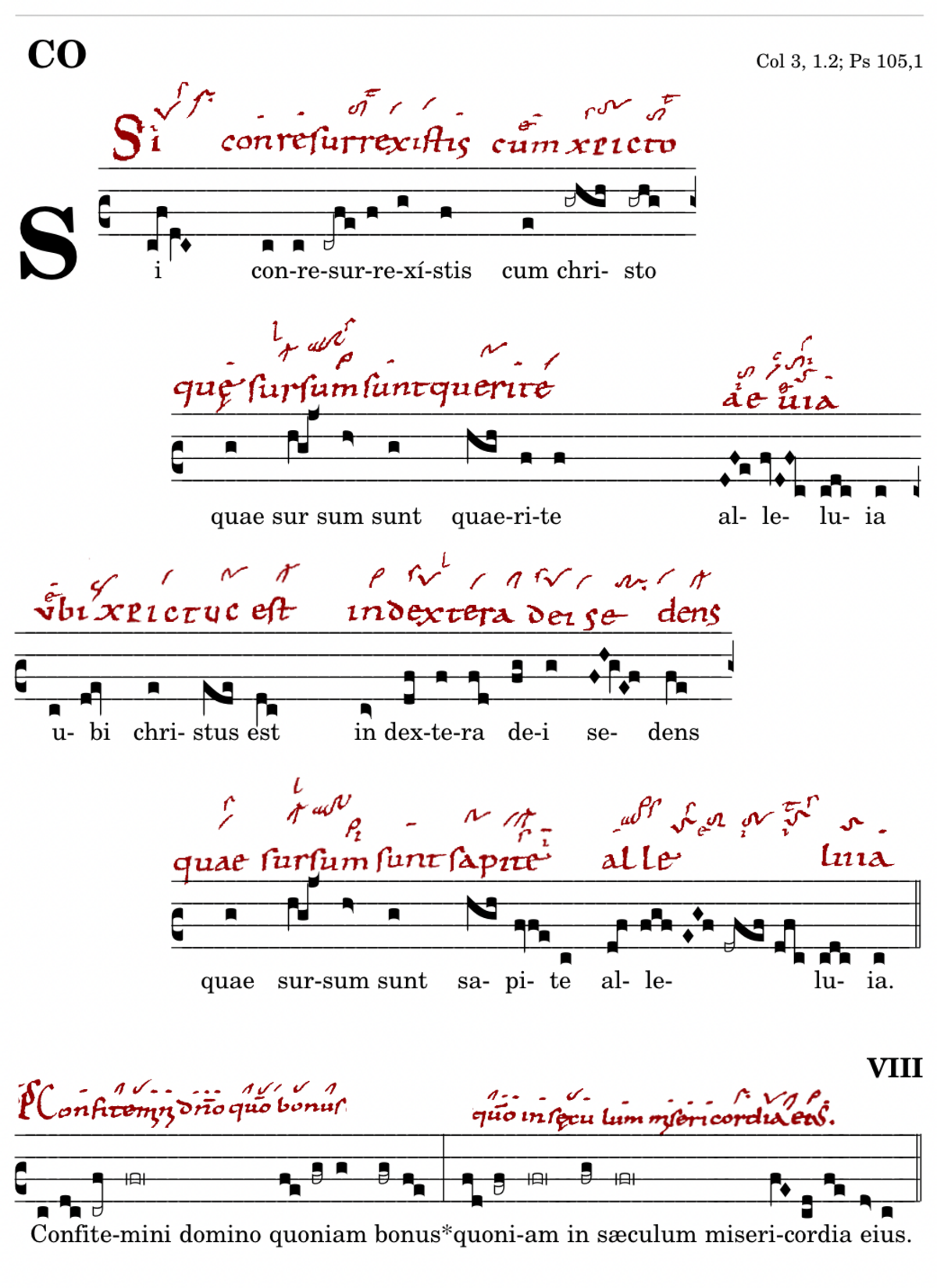
0732 CO Si consurrexistisModus 7
0724 ⟽ CO 7 ⟾ 0733 xxx ⏹️\xxx GT 205 - BzG 48/21 = GrN 1/176

„sur-sum“
„Si“ Der Pes subpunctis (PesSbp) ist die Neume „reverentia“
„consurrexistis“ klassischer Cento des Intonationstorculus (TrcINT)
Zweimal Porrectusbewegung „mi-re-sol“. 6tonig, 5tonig, 4tonig oder 3tonig? Die jüngeren Quellen Mp, Zt + Mod führen die Neume nur bis zum „fa“. Schon Kl, aber vor allem A + Y und Bv33 führen zum Zielton „sol“. In A + Bv33 ist auch klar, dass der Zielton liqueszent ist (Epiphonus).
Die BzG bezeichnen den Aufstieg der Neume als „Quilismapes mit angehängtem Epiphonus“. Abgesehen davon, dass der „Quilismapes“ von uns als „Virga quilismata“ verstanden wird (Quilisma ist kein Ton sondern ein Intervallhinweis), ist das „angehängt“ des Epiphonus genauer zu betrachten: Die Verbindung von Virga und Epiphonus ist bei Betrachtung von A+Y+Kl nicht unisonisch. Die Lösung im GrN ist nur nach Bv34 denkbar. Schon Bv20 + 40 verweisen auf die die Lösung wie Bv33 (das Quilismazeichen steht in Bv an der Stelle des Tones vor dem Abstand). Die Verbindung der „Virga“ mit dem Epiphonus lässt vermuten, dass es gar nicht zwei verschiedene Töne sind. Auch E ist durchaus in diese Richtung zu lesen. Bei L ist dann fast keine andere Lesart mehr zu denken als ein Porrectus: 3tonig. In den BzG wird L in keiner Weise erwähnt.
„al-le-luia“
Wenn ihr mit Christus auferstanden seid, so sucht nach dem, was oben [im Himmel] ist,
Halleluja,\\
wo Christus zur Rechten Gottes sitzt. Erkennt, was oben [im Himmel] ist,  Halleluja.

If you have risen with Christ, seek those things which are above [in heaven], alleluia,\\
where Christ is seated at the right hand of God. Know what is above [in heaven], alleluia.
‘sur-sum’
“Si” The Pes subpunctis (PesSbp) is the neume ‘reverentia’
‘consurrexistis’ classical Cento of the Intonationstorculus (TrcINT)
Two porrectus movements ‘mi-re-sol’. 6-note, 5-note, 4-note or 3-note? The later sources Mp, Zt + Mod lead the neume only as far as ‘fa’. Kl already does, but above all A + Y and Bv33 lead to the target note ‘sol’. In A + Bv33 it is also clear that the target note is liquefied (epiphonus).
The BzG describe the ascent of the neume as ‘quilismapes with an appended epiphonus’. Apart from the fact that we understand the “Quilismapes” as “Virga quilismata” (Quilisma is not a note but an interval indication), the “attached” nature of the Epiphonus requires closer examination: the connection between Virga and Epiphonus is not in unison when considering A+Y+Kl. The solution in the GrN is conceivable only according to Bv34. Even Bv20 + 40 point to the solution as in Bv33 (the quilisma sign appears in Bv at the position of the note before the interval). The connection between the “Virga” and the Epiphonus suggests that they are not two different notes at all. E can also certainly be read in this way. In L, then, almost no other reading is conceivable other than a Porrectus: 3-note. In the BzG, L is not mentioned in any way.
‘al-le-luia’