Dies ist eine alte Version des Dokuments!
🔘 IN GR TR AL OF CO xxxxx 1️⃣ 2️⃣ 3️⃣ 4️⃣ 5️⃣ 6️⃣ ✅ 8️⃣ xxxxx AN RP IV alia
0692 CO Notas mihi fecistiModus 7
0690 ⟽ CO 7 ⟾ 0707 xxx ⏹️ xxx GT 260 - BzG 38,16 - GN 1,223
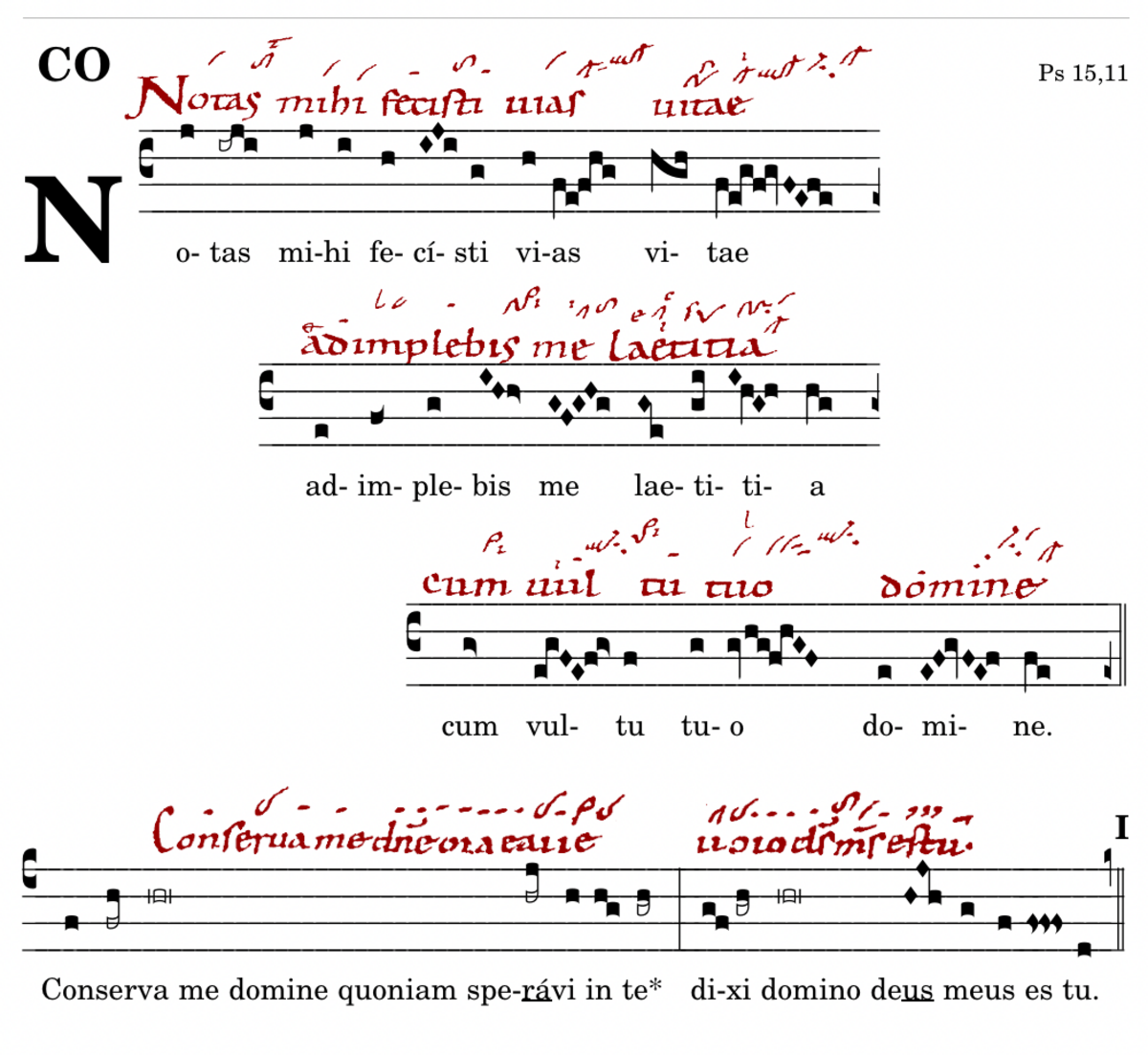
 „vul-tu tuo domine“ Die BzG haben sich für Bv+A entschieden, dem widersprechen sowohl E+Y als auch Ch+MR+L. Die Kernfrage ist hier die Silbe „tu-o“ alle adiastematischen Quellen außer E schreiben „si-do“. Auch der Blick auf die CAD des RP8 Ω v bringt keine endgültige Entscheidungshilfe.
Von L über Ch,MR und A,Bv zur offensichtlich letzten Stufe E, Y scheint sich eine Entwicklung vollzogen zu haben. Dabei bestätigen die St.Galler Codices G342, G374, G376 das Ergebnis von E nicht(!), sondern sind im Sinne von Ch,MR oder gar wie L zu lesen.
.
.
Du zeigtest mir / die Wege zum Leben.
Erfüllen wirst du mich / it Freude
mit deinem Angesicht / Herr.

You have shown me t/ he paths to life.
You will fill me / with joy
with your face / Lord.
‘vul-tu tuo domine’ The BzG have opted for Bv+A, a view contradicted by both E+Y and Ch+MR+L. The key issue here is the syllable ‘tu-o’; all adiastematic sources except E write ‘si-do’. Even a look at the CAD of RP8 Ω v does not provide definitive guidance.
It seems that a development has taken place from L via Ch, MR and A, Bv to the final stage, E, Y. The St. Gallen codices G342, G374 and G376 confirm the result of E not (!), but are to be read in the sense of Ch, MR or even L.