🔘 IN GR TR AL OF CO xxxxx 1️⃣ 2️⃣ 3️⃣ 4️⃣ 5️⃣ 6️⃣ 7️⃣ ✅ xxxxx AN RP IV alia
0083 IN Invocavit meModus 8
0082 ⟽ IN 8 ⟾ 0084 xxx ⏹️ xxx GT 71 - GN 1,60 - BzG 24/13
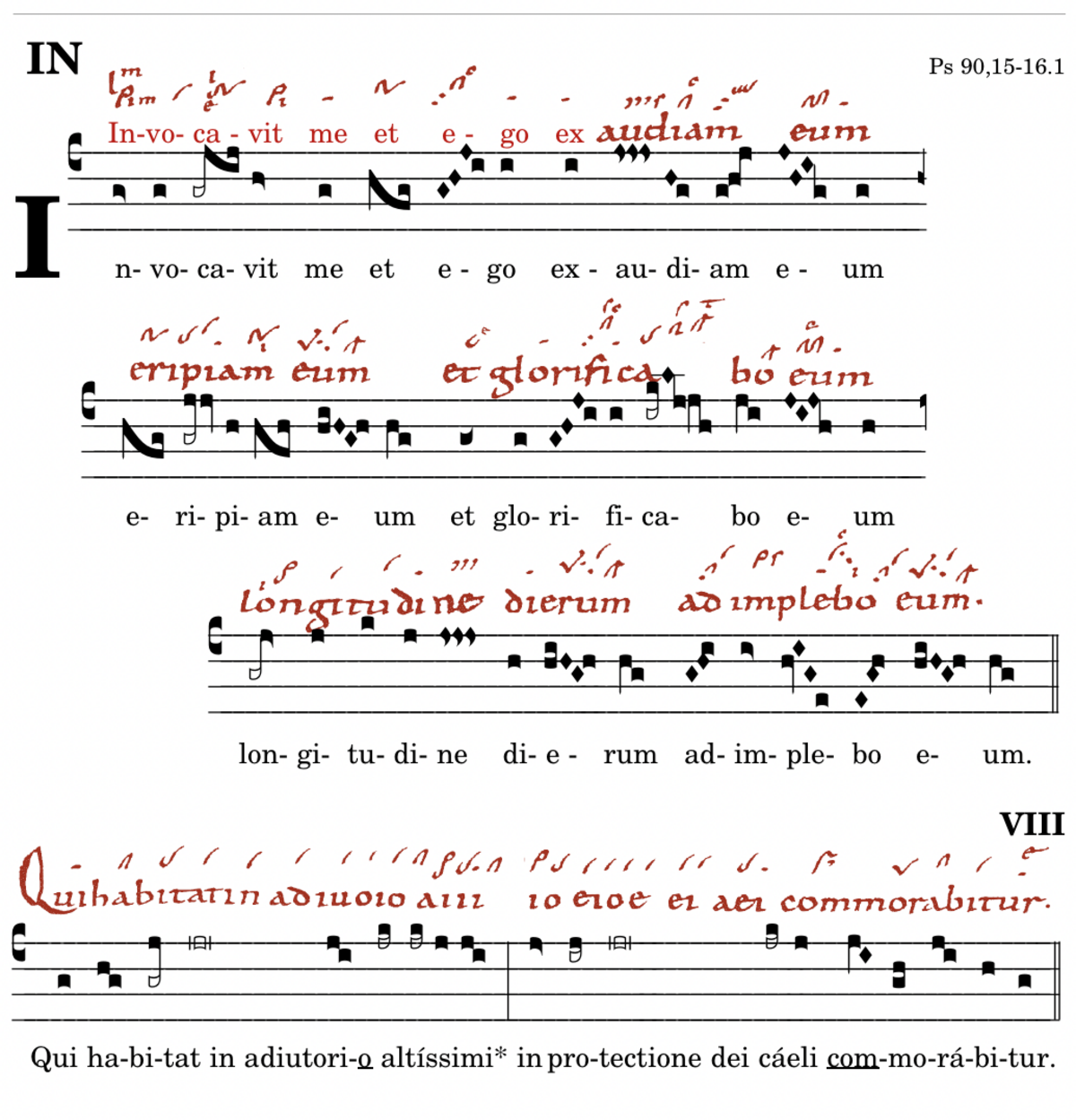
„Invo-ca-bit“ Der erste Ton „sol“ müsste nicht leicht notiert sein, die Neume ist sicher nicht i.d., aber wenn die zwei praetonischen Silben „invo-“ etwas gewichtiger gesprochen werden, muss der Akzent (TrcRes) schwungvoll aufsteigen. Auch das „la“ des ersten Tones in Mod, Mp + Zt lässt den ersten Ton der Akzentneume eher volatil erscheinen. Es geht hier um eine Dosierung.
„me et“„ Bv zieht den Por eine Silbe vor
„et e-go““ Der ScaFlx ist in allen artikulatorisch relevanten Handschriften (E, L, vide et MR !) durchgehend kurrent notiert. Ebenso bei „„glo-ri-ficabo“
„ego ex-“ Die Rezitation „si“ ist in E, L, Bv + A gesichert. Y, auf halbem Weg zur do-Revision (Kl, Mod, Zt) hebt wie so oft noch vor der Tristropha das „si“ zum „do“. Auffällig: auch Mp (!) rezitiert auf „si“.
„exaudi-am“ Das Quilisma ist kein Ton. Nur Bv + Mod ersetzen es durch einen Ton. In Kl + Zt ist die Neume ein 3toniger Sca „sol-la-do“. sic !
“e-um„ do-Revision nur in Kl + Zt.
„e-ri-piam“ Die Bivirga ist in MR + Mod urgens. Auch Kl weiß davon, muss aber die Tonwiederholung do-revidieren: nie zweimal hintereinander der selbe Ton.
“et glorificabo„ Der Epiphonus unterdrückt einen möglichen Akzentpes. Nur Zt + Mod schreiben einen Pes.
„glorifi-ca-bo eum“ Die 5stufige, aber 6tonige Akzentneume ScaSbp (L Oriscus !) artikuliert auf der 2.4.+ 5.Stufe. Die breiteste Artikulation ist auf „do“. Die Frage ist, inwieweit ein Oriscuszeichen mit der vorhergehenden unisonischen Note zu einem breiten, nachdrücklichen Ton verschmilzt. Hier sicher nicht in E. Kl vermeidet abermals die Tonwiederholung.
Die folgende Clivis ist nicht kurrent ( nkClv in E, L, Ch).
Der PorFlx auf „e-um“ ist hingegen kurrent, so in E, L, bedingt auch in Ch. In MR ist die Neume anfangsartikuliert.
„longitudine“ Der Musterfall eines Intonationstorculus, mit dem der Tonraum des 8. Modus neuerdings bestätigt wird. Das GN vertraut hier nicht dem inferius von E, sondern dem TerzTrc in Kl.
Wenn er mich anruft / dann will ich ihn erhören.
Ich befreie ihn / und bringe ihn zu Ehren.
Ich sättige ihn / mit langem Leben.

If he calls on me, I will answer him.
I will deliver him and bring him to honor.
I will fill him with long life.
“Invo-/ca-bit” The first note “sol” should not be written lightly, the neume is certainly not i.d., but if the two praetonic syllables “invo-” are pronounced somewhat more weightily, the accent (TrcRes) must rise with verve. The “la” of the first tone in Mod, Mp + Zt also makes the first tone of the accent neume appear rather volatile. This is a matter of metering.
“me et”“ Bv draws the por one syllable in front
”et e-go“” The ScaFlx is notated in all articulatory relevant manuscripts (E, L, vide et MR !) in a consistently curved form. Likewise with “”glo-/ri-ficabo“
”ego ex-“ The recitation ‘si’ is secured in E, L, Bv + A. Y, halfway to the do-revision (Kl, Mod, Zt) raises the “si” to “do” as so often before the tristropha. Striking: Mp (!) also recites on “si”.
“exaudi-am/” The quilisma is not a sound. Only Bv + Mod replace it with a tone. In Kl + Zt, the neume is a 3-note sca “sol-la-do”. sic !
“e-um” do-revision only in Kl + Zt.
“e-ri-piam” The bivirga is urgens in MR + Mod. Kl also knows about this, but must do-revise the tone repetition: never the same tone twice in a row.
“et glorificabo” The epiphonus suppresses a possible accent pes. Only Zt + Mod write a pes.
“glorifi-ca-bo eum” The 5-step but 6-note accent neume ScaSbp (L Oriscus !) articulates on the 2nd 4th + 5th step. The widest articulation is on “do”. The question is to what extent an Oriscus sign merges with the preceding unison note to form a broad, emphatic tone. Certainly not in E here. Kl again avoids the tone repetition.
The following clivis is not currente ( nkClv in E, L, Ch).
The PorFlx on “e-um” is currente, however, in E, L, conditionally also in Ch. In MR, the neume is articulated at the beginning.
“longitudine” The model case of an intonation torculus, with which the pitch space of the 8th mode is recently confirmed. The GN does not trust the inferius of E here, but the third trc in Kl.