🔘 IN GR TR AL OF CO xxxxx ✅ 2️⃣ 3️⃣ 4️⃣ 5️⃣ 6️⃣ 7️⃣ 8️⃣ xxxxx AN RP IV alia
1081 OF Viri galilaei V1Modus 1
OF – V1 xxx ⏹️ xxx OT 17 - GN xx - BzG xx/xx
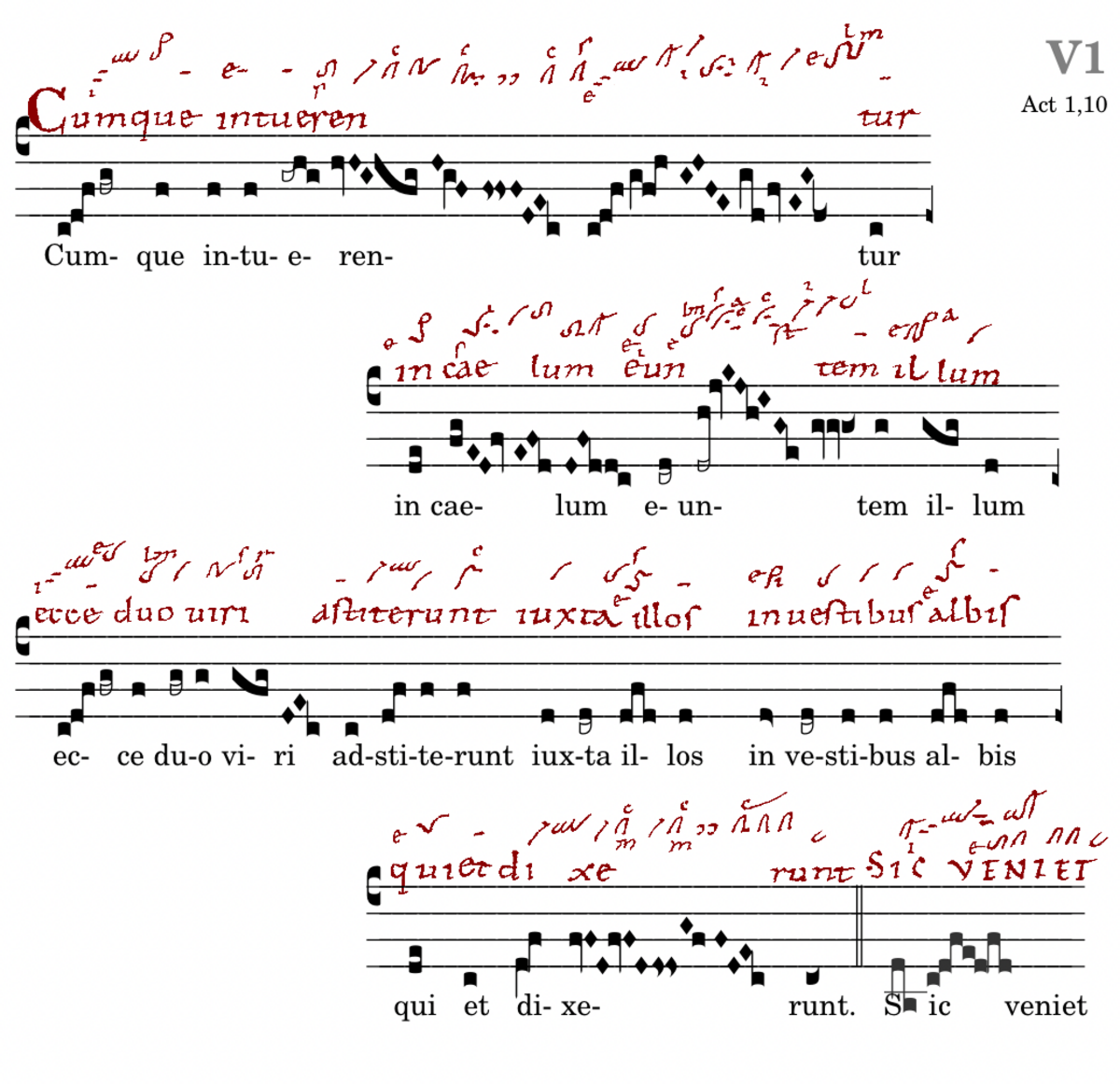
„intue-ren-tur“ Der Ton nach dem viertletzten Ton des Melismas (Virga episemata „fa“) muss „mi“ sein. Keine Quelle zeigt unisonischen Anschluss. Nur E schreibt 'equaliter' (= Halbton).
„e-un-tem“ si-be-molle in OT 173 zwischen „do“ und dem Zielton „mi“ ist unmöglich.Nur Mp schreibt „sa“, Kl „do“.
„adstite-runt“ Die Virga strata kündigt wie im Cento AN 2INC cad (e.g.: AN 0082) Terzsprung nach unten an.
„et di-xerunt“ Das Quilisma in allen adiastematischen Quellen ist in den diastematischen Quellen Bv, A, Y, Kl einfach ein TerzPes.
Ästhetisch betrachtet: Was tut eine verminderte Quint „sa-mi“ an Christi Himmelfahrt?
V1. Und als sie unverwandt zum Himmel blickten, wie er dahinfuhr,
Siehe, da standen zwei Männer in weißer Kleidung bei ihnen / die sagten:

V1 And as they looked steadfastly toward heaven as he passed by,
behold, two men stood by them in white apparel / saying:
„intue-/ren-tur“ The note after the fourth-last note of the melisma (Virga episemata „fa“) must be „mi“. No source shows a unison connection. Only E writes 'equaliter' (= semitone).
„e-un-tem“ si-be-molle in OT 173 between „do“ and the target note „mi“ is impossible.
„adstite-runt“ Only Mp writes „sa“, Kl „do“.
„adstite-runt“ The virga strata announces as in Cento AN 2INC cad (e. g.: AN 0082) downward leap of a third.
„et di-xerunt“ The quilisma in all adiastematic sources is simply a thirdPes in the diastematic sources Bv, A, Y, Kl.
Aesthetically speaking: What does a diminished fifth “sa-mi” do at Ascension?