🔘 IN GR TR AL OF CO xxxxx 1️⃣ ✅ 3️⃣ 4️⃣ 5️⃣ 6️⃣ 7️⃣ 8️⃣ xxxxx AN RP IV alia
0694 CO Omnes qui in christo baptizatiModus 2
0688 ⟽ CO 2 ⟾ 0710 xxx ⏹️ xxx GT 61 - GN 1/51 - BzG 23/27
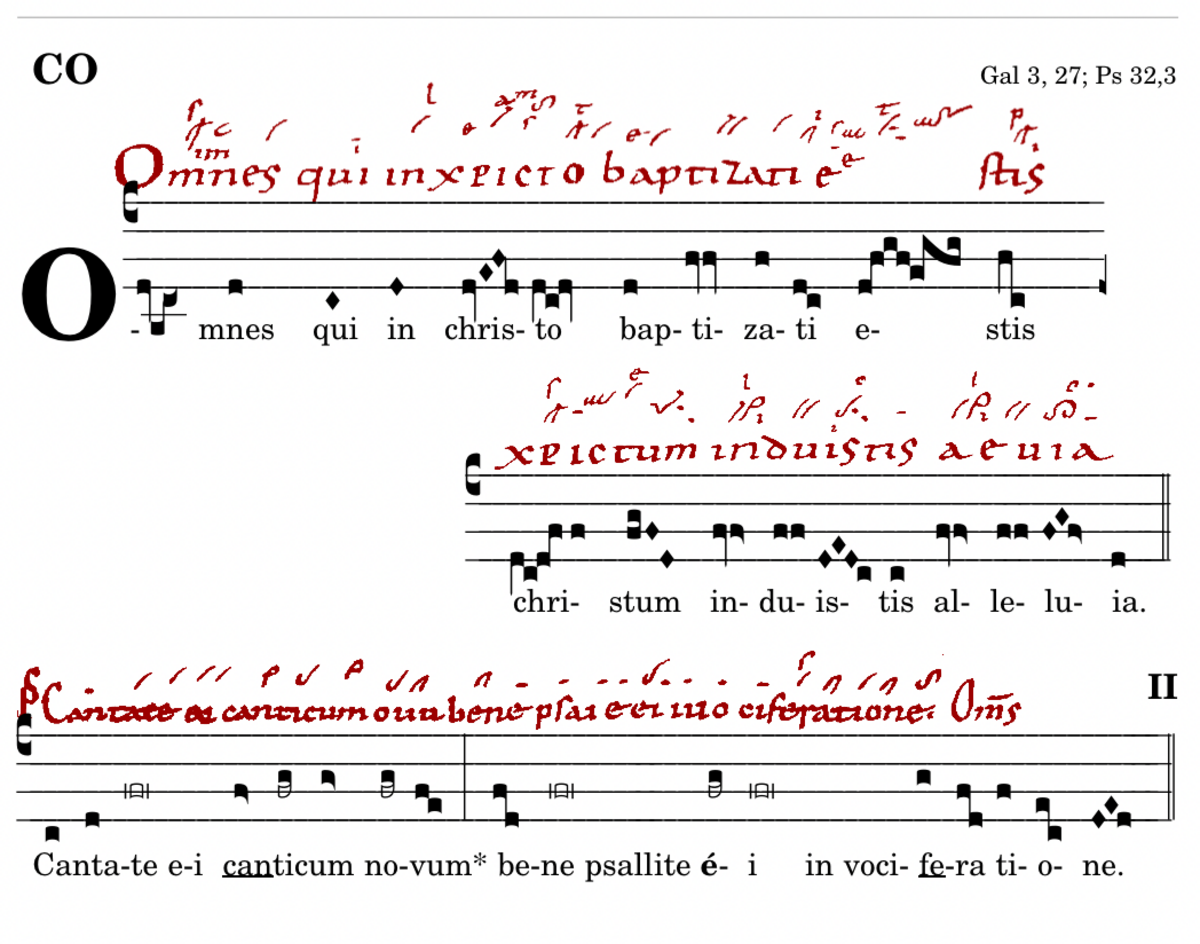
„baptiza-ti es-tis“ Ausgehend von der Clivis „re-do“ (L hift nicht, es kann so oder so gelesen werden!) wäre E eindeutig zu lesen (Clivis mit inferius und danach sursum, wenn nicht bei „es-tis“ außerdem ein korrigierendes equaliter stünde. So bleibt als Zeuge für den Clivis-Aufstieg „re-fa“ nur Ch und die meisten diastematischen Quellen.
„es-tis“ Für die Terzclivis sprechen die Aquitanier und eventuell L, für Quartclivis „fa-do“ spricht Ch, und alle Beneventaner,
ebenso das inferius in E.
„Óm-nes“ Das 'sursum' ist im Bezug auf den zweiten Ton zu lesen, 'inferius mediocriter' meint den dritten Ton in Bezug auf die nächste Silbe.
2x Prr „Óm-nes → qui in chrís-to → baptizáti és-tis“ der Porrectus treibt weiter, verhindert einen Abschluss.
2x PesSbp „chrís-tum indu-ís-tis“ Der Pes subpunctis weist immer auf etwas Bedenkenswertes hin.
„estis“ Die CAD PR1 D müsste in diesem Kontext mit Clv „sol-fa“ abschließen. Die Clv „fa-do“ macht sie zum colon.
Der zweite Teil der Communio ist von der Bivirga „fa-fa“ (5x) geprägt. Der TrcACC auf „alle-lú-ia“ bildet den schlichest möglichen Schluss.
Beginnend mit 2INC katab, zweimal nkPrr
Ihr alle, die ihr in Christus getauft seid,
Christus habt ihr [als Gewand] angezogen, Halleluja.
All of you who have been baptized into Christ,
You have put on Christ [as a robe], alleluia.
“baptiza-ti es-tis” Based on the clivis “re-do” (L does not help, it can be read either way!), E would clearly be read (clivis with inferius and then sursum, if there were not also a corrective equaliter at “es-tis”. This leaves only Ch and most diastematic sources as evidence for the clivis rise “re-fa.”
“es-tis” The Aquitanians and possibly L argue for the third clivis, while Ch and all Beneventans argue for the fourth clivis “fa-do,” as does the inferius in E.
“Óm-nes” The 'sursum' is to be read in relation to the second tone, 'inferius mediocriter' refers to the third tone in relation to the next syllable.
2x Prr “Óm-nes → qui in chrís-to → baptizáti és-tis” the Porrectus drives on, preventing a conclusion.
2x PesSbp “chrís-tum indu-ís-tis” The Pes subpunctis always indicates something worth considering.
“estis” The CAD PR1 D should end with Clv “sol-fa” in this context. The Clv “fa-do” makes it a colon.
The second part of the Communio is marked by the Bivirga “fa-fa” (5x). The TrcACC on “alle-lú-ia” forms the simplest possible conclusion.