Dies ist eine alte Version des Dokuments!
🔘 IN GR TR AL OF CO xxxxx ✅ 2️⃣ 3️⃣ 4️⃣ 5️⃣ 6️⃣ 7️⃣ 8️⃣ xxxxx AN RP IV alia
0587 OF Super fluminaModus 1
OF – V1 – V2 – V2/PS – V3 – V3/PS xxx ⏹️ xxx GT 345 - GN 1/334 - BzG 44/34
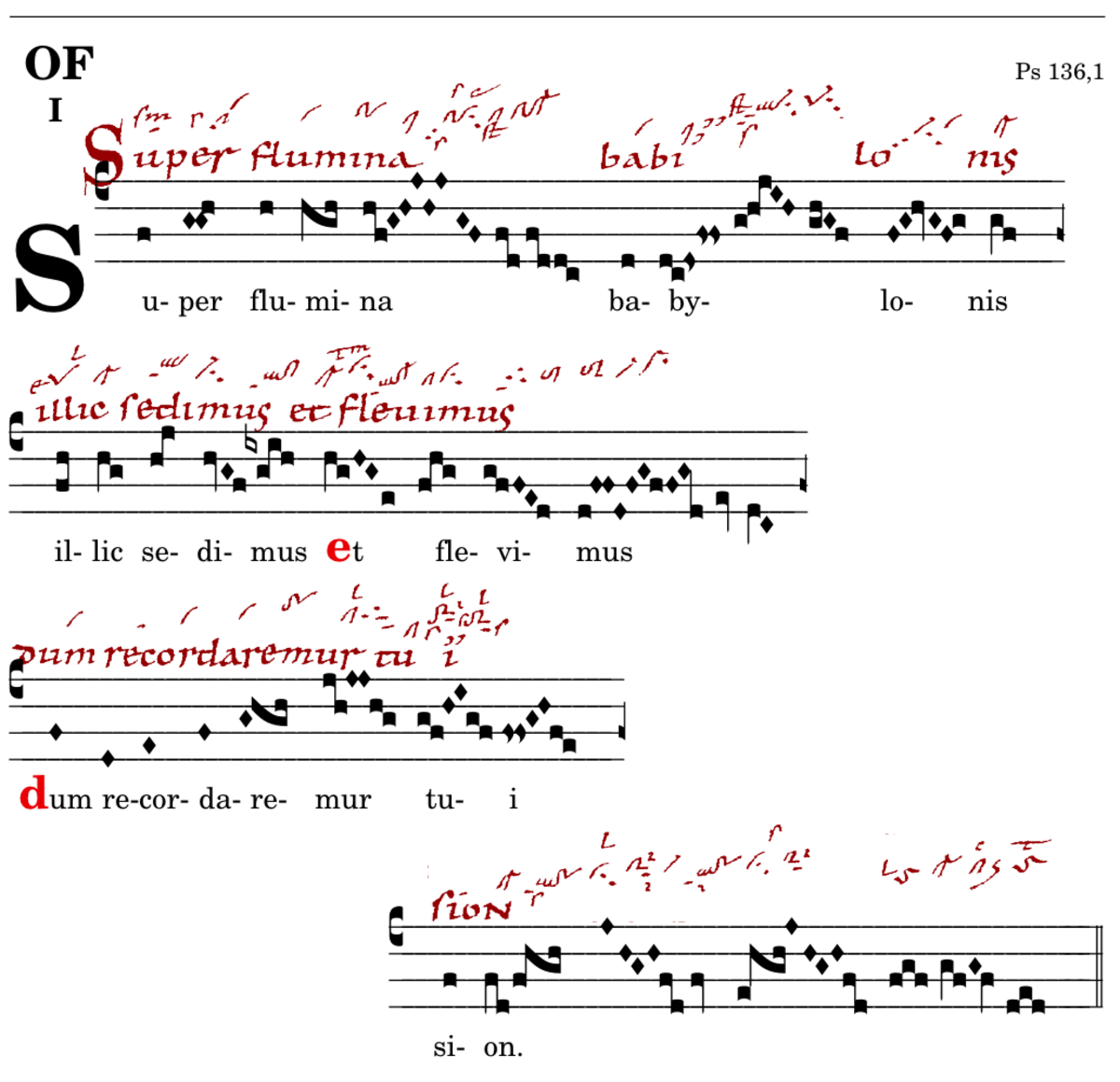
„illic sedi-mus“ Hier schreibt auch Kl ein sa.
„sedi-mus“ Wenn Kl auch sa schreibt, stellt sich doch die Frage, ob nicht wegen des Kontextes mit do und mi („se-di-mus“) doch ein si angebracht ist.
„tu-i“ Das sa steht nur in Mp+Zt und ist in Kl durch das do konterkariert. Der eigentliche Zeuge für si ist Y, das die entsprechende Stelle einen Ton tiefer setzt, um den Ganzton la-si, nun sol-la, zweifelsfrei zu retten.
Das OF Super flumina ist mit seinen 3 Versen eines der längsten des Repertoires. Die Benützung der Repetendae ist sehr komplex. Auf das eher kurze OF „Super flumina“ folgen die Verse
V1. „In salicibus“ besonders lange.
V2. „Si oblitus“ in Bv35 und Kl endet er mit „…non meminero“. Die anderen Hss (L, Ch, A, Y etc.) führen den Vers weiter mit „Qui dixerunt Super flumina babylonis“ (andere Melodie als im OF). Bv34, Bv39 und Ang spalten die Repetenda vom OF ab „Dum recordaremur“ und „Et flevimus“. In E ist „Qui dixerunt - Super flumina babylonis“ nicht Teil des V2. Es wird als isolierte Repetenda verwendet.
V3. „Memento“ eher kurz

Das OF beginnt im 1. Modus (OF+V1). V2+V3 sind aber dem 8.Modus zuzurechnen, allerdings zum Ténor sa (si-be-molle). Wir notieren ohne b, zum Ténor do, durch Custos entsprechend angegliedert.
B33 und Zt notiern wie üblich keine Verse. A+Y bringen zwei Prosulae zu den Versen 2 und 3.
An den Flüssen von Babylon / da saßen wir und weinten,
als wir an dich dachten, Zion.

By the rivers of Babylon / there we sat and wept,
as we thought of you, Zion.
‘illic sedi-mus’ Here, Kl also writes a si bémol.
‘sedi-mus’ If Kl also writes si bémol, the question arises as to whether, given the context with do and mi (‘se-di-mus’), a si might not be more appropriate.
‘tu-i’ The si bémol appears only in Mp+Zt and is contradicted in Kl by the do. The actual evidence for si comes from Y, which lowers the corresponding passage by a whole tone to preserve the la-si—now sol-si bémol—beyond any doubt.
With its three verses, the OF Super flumina is one of the longest in the repertoire. The use of the Repetendae is very complex. The rather short OF “Super flumina” is followed by the verses
V1. “In salicibus,” which are particularly long.
V2. “Si oblitus” in Bv35 and Kl ends with “…non meminero.” The other manuscripts (L, Ch, A, Y, etc.) continue the verse with “Qui dixerunt Super flumina babylonis” (different melody than in the OF). Bv34, Bv39, and Ang separate the Repetenda from the OF “Dum recordaremur” and “Et flevimus.” In E, “Qui dixerunt - Super flumina babylonis” is not part of V2. It is used as an isolated repetition.
V3. “Memento” rather short
The OF begins in mode 1 (OF+V1). V2+V3, however, belong to the 8th mode, but to the tenor sa (B flat). We notate without b, to the tenor do, appropriately attached by custos.
B33 and Zt do not notate any verses, as usual. A+Y bring two prosulae to verses 2 and 3.