🔘 IN GR TR AL OF CO xxxxx 1️⃣ 2️⃣ ✅ 4️⃣ 5️⃣ 6️⃣ 7️⃣ 8️⃣ xxxxx AN RP IV alia
0329 AL Domine deus salutisModus 3a
0309 ⟽ AL 3 ⟾ 03620309 ⟽ AL 3a ⟾ 0871 xxx ⏹️xxx GT 317 - GN 1/300 - BzG 31/18;48/37
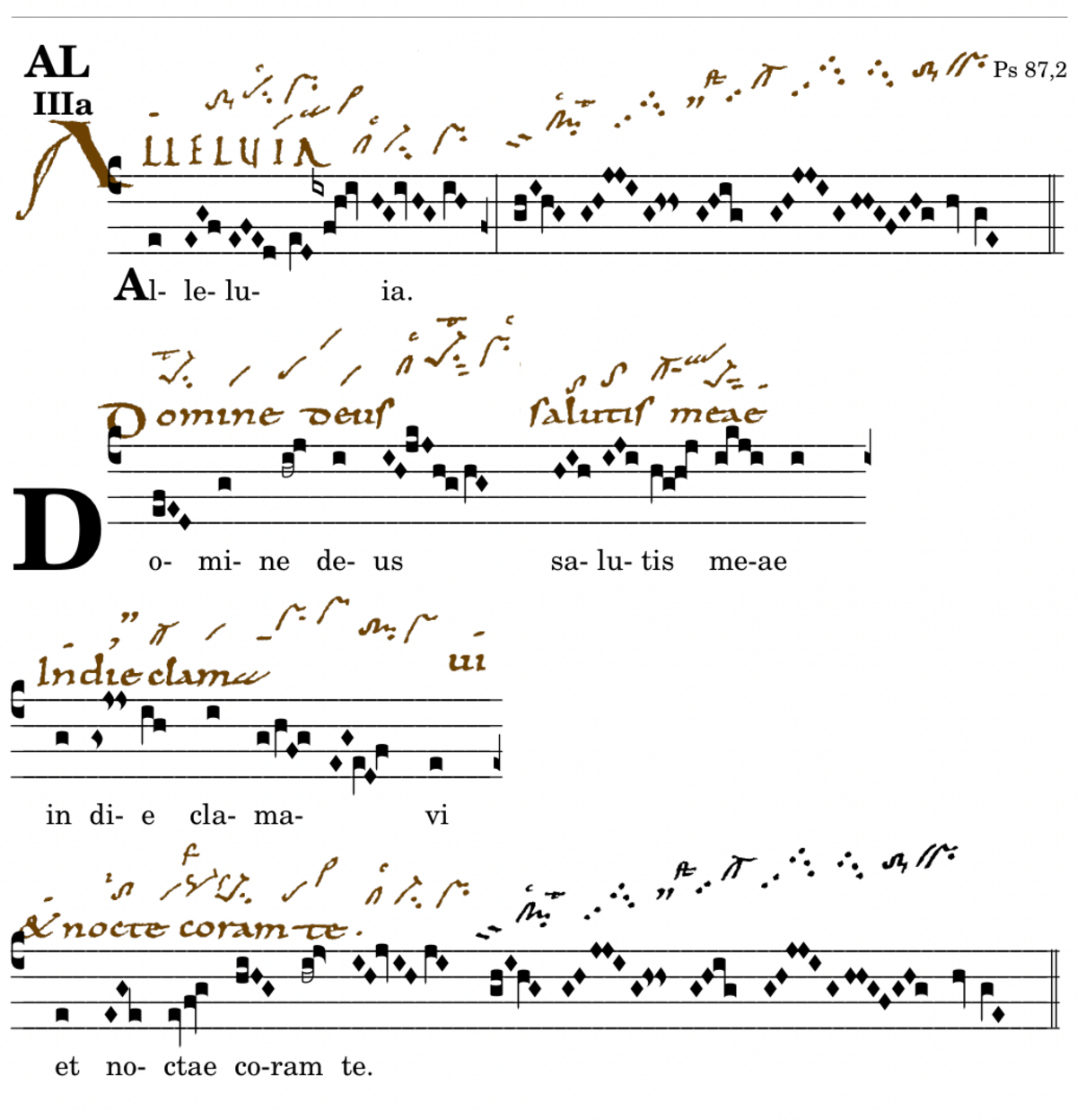
Das Prinzip der 'Notation in Originallage' ist hier so verstanden, dass jedwede Melodie in ihrem üblichen Tetrachord notiert ist. Modale Verschiebungen werden daher mit Custos und Divisio maior angezeigt, nicht mit Vorzeichen, um Vorzeichen wie fis, es etc. weitgehend zu vermeiden. Dieses AL hat im Verhältnis zum Rest der Komposition den Textteil „Al-le-lu-“ einen Ton höher gesetzt. Ein „fis“ ist vermieden. Das „b“ auf der Silbe „-lu-ia“ ist eigentlich bereits das „do“ des folgenden Jubilus.
„Al-le-luia“ Für den unisonischen Anschluss spricht nur das e = equaliter in Einsiedeln.

Die adiastematischen Handschriften -
Unterschiede in der Notation der Artikulation
MR bringt bei „in di-e“ einen Pressus, wo Ch, L, C eine nkClv schreiben. Darauf folgt eine Virga emphatica statt bloßer Virga „cla-mavi“.
Die Silbe „cla-ma-vi“ besteht aus drei Elementen:
• Pressus im Trc-Kontext („sol-la-fa“), hier schreiben MR und Ch zwei Töne „la“, L aber Oriscus.
• Die Schlussgruppe der Silbe bildet ein Pes subpunctis „mi-sol-mi-re“ mit resupiner Virga strata. In MR besteht der Pes subpunctis aus vier Tönen, in Ch und L ist das „mi“ , wenn der Oriscus ein Ton ist, verdoppelt.
• Das dritte Element ist die zweimalige resupine Virga strata. Im GN ist die erste als Bivirga „sol“ übertragen, die zweite als Halbtonpes „mi-fa“. In Ch und L ist der erste Ton des Pes subpunctis durch Einrundung aufgelöst, findet sich allerdings als letzter Ton der Gruppe zuvor wieder, wo die resupine Virga strata zum Pressus geworden ist.
V. Herr, Gott meines Heiles / bei Tag schrie ich, und nachts vor dir!
V. Lord, God of my salvation / by day I cried out, and by night before you!
The principle of “notation in original position” is understood here to mean that every melody is notated in its usual tetrachord. Modal shifts are therefore indicated with Custos and Divisio maior, not with accidentals, in order to largely avoid accidentals such as F sharp, E flat etc. This AL has the text part „Al-le-lu-“ set a tone higher in relation to the rest of the composition. An „f sharp“ is avoided. The „b“ on the syllable „-lu-ia“ is actually already the „do“ of the following jubilee.
The adiastematic manuscripts -
Differences in the notation of the articulation
MR brings a pressus at ‘in di-e’, where Ch, L, C write an nkClv. This is followed by a virga emphatica instead of just a virga ‘cla-mavi’.
The syllable ‘cla-ma-vi’ consists of three elements:
- Pressus in the Trc context (‘sol-la-fa’), here MR and Ch write two tones ‘la’, but L writes Oriscus.
- The final group of the syllable forms a pes subpunctis ‘mi-sol-mi-re’ with a resupine virga strata. In MR the pes subpunctis consists of four tones, in Ch and L the ‘mi’ is doubled if the oriscus is one tone.
- The third element is the double resupine virga strata. In the GN, the first is transcribed as the bivirga ‘sol’, the second as the semitone pes ‘mi-fa’. In Ch and L, the first note of the pes subpunctis is resolved by rounding, but is found again as the last note of the group above, where the resupine virga strata has become a pressus.