🔘 IN GR TR AL OF CO xxxxx 1️⃣ 2️⃣ 3️⃣ 4️⃣ 5️⃣ 6️⃣ 7️⃣ ✅ xxxxx AN RP IV alia
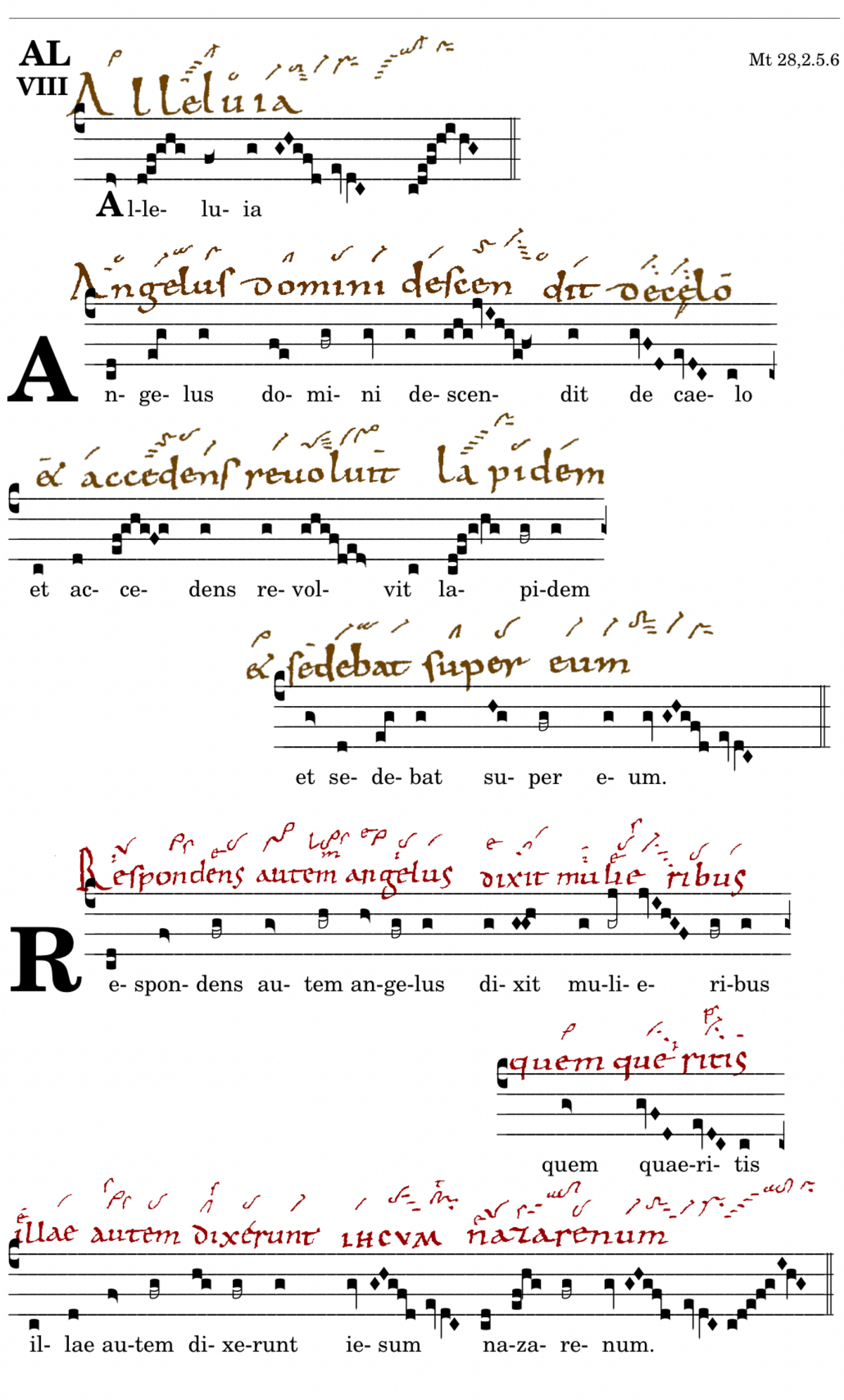
0293 AL Angelus domini (min)Modus 8
3597 ⟽ AL 8 ⟾ 03021397 ⟽ AL 8 alii ⟾ 0312 xxx ⏹️ xxx GT 201 - GN 1/171 - BzG 31/11
Die BzG verzichten hier auf C als Quelle, weil „Text und Neumen von späterer Hand“ sind und nehmen stattdessen E zur Basis ihrer Restitution. Die a.m. in C ist allerdings nicht (kaum) jünger als die Neumen in E.
„Al-leluia“ Es ist Regel des Hochmittelalters, dass das Incipit eines Stückes der Finalis entsprechen muss (vgl.: IN „Ad te levavi“ noch im GT! Dem entspricht hier nur E und Kl! Alle anderen beginnen wie der Vers mit dem Pes „do-re“). Der Cephalicus zeigt hier den Verzicht auf einen der beiden Töne an, ergo „re“ (vide Ch!, L ist leider radiert).
„Allelu-ia“ Es gibt keinen Grund im 8. Modus si-be-molle zu verwenden ; Kl (+A) geht zum „do“. Bereits Agustoni bezeichnet das si-be-molle im 8. Modus als „sehr fragwürdig“ (EIGC s.53).
„domi-ni“ Der Oriscus ist zwar eine Note aber kein Ton. Er ist ein Definitionszeichen und etabliert hier die „untere Grenzstufe des modalen Tonraumes“ (Agustoni s.o.), wie auch bei „revolvit“, „eum“ und im Jubilus. Das „do“ darunter ist die „seltene Ausweitung des Unteren Bereichs des Tonraumes“.
„revolvit“ Hier verwenden die BzG plötzlich E als Quelle satt C, weil die Graphie von C nicht in das Verständnis der Virga strata passt, wie sie die opinio communis von ihr hat.
V1. Ein Engel des Herrn stieg vom Himmel herab / trat [an das Grab] herzu,
wälzte den Stein [vom Eingang] hinweg / und setzte sich darauf.


V2. Der Engel antwortete, er sprach zu den Frauen / Wen sucht ihr?
Jene aber antworteten /
Jesus von Nazareth.

V1 An angel of the Lord descended from heaven / approached [the tomb],
rolled away the stone [from the entrance] / and sat on it.


V2. The angel answered and said to the women, / Whom seek ye?
But they answered / Jesus of Nazareth.
The BzG do without C as a source here because the „text and neumes are from a later hand“ and instead take E as the basis for their restitution. However, the a.m. in C is not (hardly) younger than the neumes in E.
„Al-leluia“ It is a rule of the High Middle Ages that the incipit of a piece must correspond to the finalis (cf: IN „Ad te levavi“ still in the GT! Only E and Kl correspond to this here! All others begin like the verse with the pes „do-re“). The cephalicus here indicates the abandonment of one of the two notes, ergo „re“ (vide Ch!, L is unfortunately erased).
„Allelu-ia“ There is no reason to use si-be-molle in the 8th mode; Kl (+A) goes to „do“. Agustoni already described the si-be-molle in the 8th mode as „very questionable“ (EIGC p.53).
„domi-ni“ The oriscus is a note but not a tone. It is a defining sign and establishes the „lower limit of the modal pitch space“ (Agustoni see above), as in „revolvit“, „eum“ and in the jubilee. The „do“ below it is the „rare extension of the lower range of the tonal space“.
“revolvit” Here, the BzG suddenly uses E as the source instead of C, because the spelling of C does not fit with the understanding of Virga strata as it is commonly understood.