Dies ist eine alte Version des Dokuments!
🔘 IN GR TR AL OF CO xxxxx 1️⃣ ✅ 3️⃣ 4️⃣ 5️⃣ 6️⃣ 7️⃣ 8️⃣ xxxxx AN RP IV alia
0035 IN Dominus illuminatioModus 2
0034 ⟽ IN 2 ⟾ 0040 xxx ⏹️ xxx GT 288 - GrN 1/261 - BzG 40/18
Der 2. Modus ist ein schlichter
PR ad3 (grau) Der 2. Modus hat zwei Möglichkeiten, Abwechslung die den Melodieverlauf zu bringen: einerseits
Katabasis (violett gesperrt), Ausbreitung ohne zu Betonen, andererseits das Heben des Tenor zum „sol“:
PR ad4 (fett). Den Text dieses IN einfach laut zu lesen und dabei die Stimme zu heben oder senken wie die Centones es darstellen, zeigt einen natürlich-logischen Melodieverlauf dieses Textes.
D o m i n u s illuminatio mea et salus mea : quem timebo
dominus defensor vitae meae a quo trepidabo
qui tribulant me inimici mei infirmati sunt et ceciderunt.

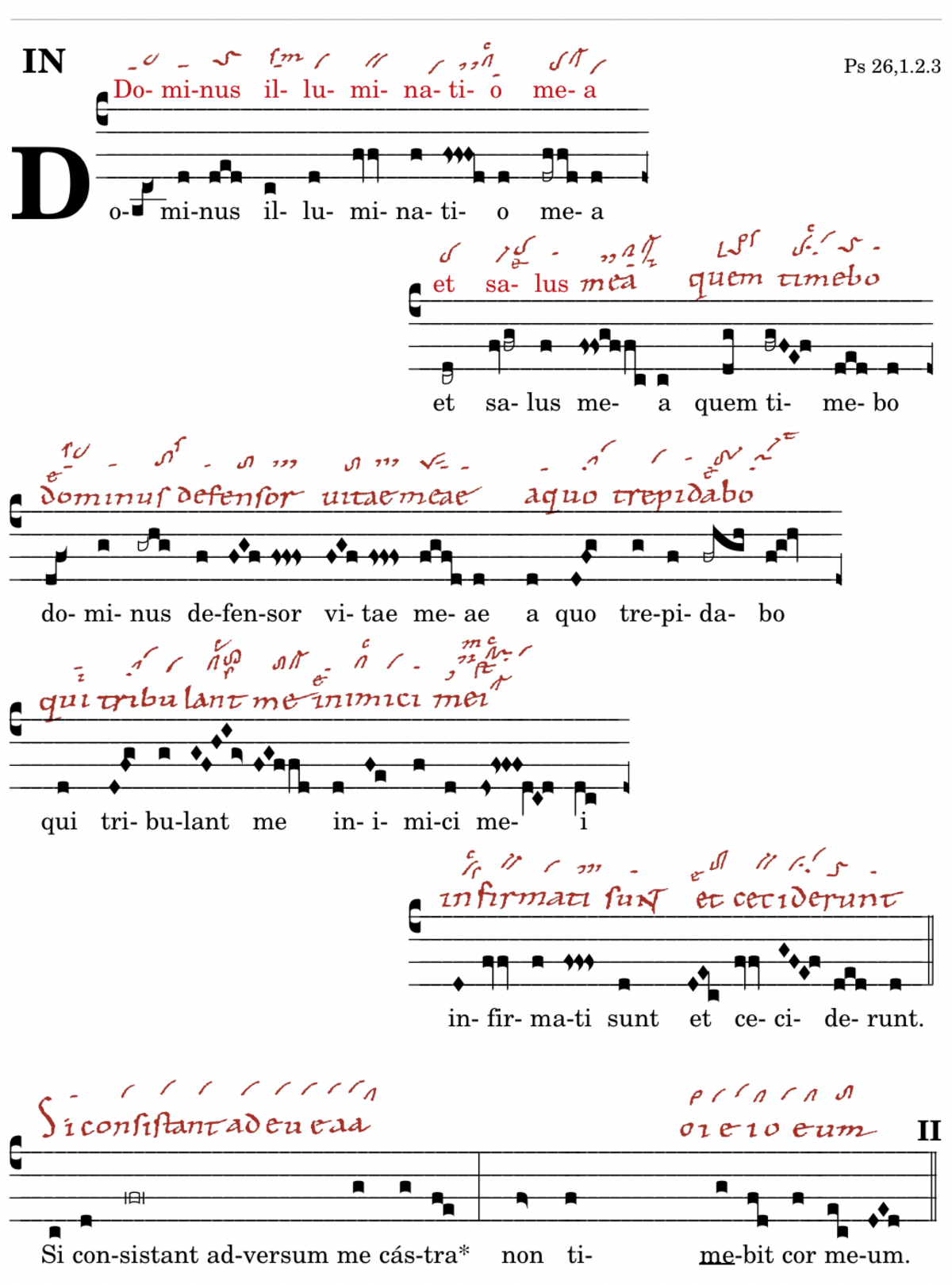
Von den drei Perioden sind die Schlüsse der 1. und 3. Periode parallel komponiert (die 1. Periode hat einen Einschub „et salus mea“ der mit „do“ endet) beginnend mit Bivirga und endend mit CAD minima, die der ClmRes zuvor zum jeweiligen Hauptakzent macht. Auch „illuminatio méa“ endet mit CAD minima, allerdings Trc zur Terz (Quilisma-Torculus), der den Sprache oben nicht wirklich abschließt sondern offen hält für das Folgende.
Die 1. Periode beginnt mit dem Wort „dominus“: Katabasis (eigentlich Anabasis) und endet mit nkTrc auf „re“.
Die 2. Periode beginnt ebenfalls mit „dominus“ und wiederholt den Quart-Aufstieg eine Quart höher (PR ad4). Der Trc ist kurrent notiert, Wortende-Torculus (-23). Das 'sursum' ist fragwürdig. Ist es emotional gemeint und somit eine Art den Trc Specials anzuzeigen, oder meint des die Melodie, die hier zum ersten mal das „la“ erreicht? Der weitere Verlauf, der Mittelteil der 2. Periode, rezitiert auf „fa“, alle drei Akzente mir Trc hervorgehoben „defénsor vítae méae“, wobei der letzte Trc zum nkPesSbp erweitert ist der zum „re“ führt. Vgl. dazu „et sales méa“, „tribulant mé“.
Die 3. Periode beginnt mit Sal „re-fa-sol“ entsprechend dem Incipit der 2. und auch der 1. Periode.„inimici mei“ kadenziert mit CAD PssR zum „do“: Colon.
Der Herr ist mein Licht
und mein Heil / Vor wem sollte ich mich fürchten?
Der Herr ist die Kraft meines Lebens / Vor wem sollte mir bangen?
Die mich quälen, meine Feinde /
sie strauchelten und sind gefallen.

The Lord is my light and my salvation / Of whom should I be afraid
The Lord is the strength of my life / Of whom should I be afraid?
Those who torment me, my enemies / They stumbled and fell.
The 2nd mode is a simple
PR ad3 (grey) The 2nd mode offers two ways to introduce variation into the melodic progression: on the one hand,
Katabasis (purple), a glide without emphasis; on the other hand, raising the tenor to the ‘sol’:
PR ad4 (bold). Simply reading the text of this IN aloud whilst raising or lowering the voice as the centones indicate reveals a natural, logical melodic progression of this text.
D o m i n u s illuminatio mea et salus mea : quem timebo
dominus defensor vitae meae a quo trepidabo
qui tribulant me inimici mei infirmati sunt et ceciderunt.
Of the three periods, the conclusions of the 1st and 3rd periods are composed in parallel (the 1st period has an insertion ‘et salus mea’ ending with ‘do’), beginning with Bivirga and ending with CAD minima, which the ClmRes previously makes the respective main accent. “illuminatio méa” also ends with CAD minima, though with a Trc to the third (Quilisma-Torculus), which does not really conclude the phrase but leaves it open for what follows.
The first period begins with the word “dominus”: Katabasis (actually Anabasis) and ends with nkTrc on “re”.
The second period also begins with “dominus” and repeats the fourth-interval ascent a fourth higher (PR ad4). The Trc is notated as a current, word-end Torculus (-23). The ‘sursum’ is questionable. Is it meant emotionally and thus a way of indicating the Trc Specials, or does it refer to the melody, which reaches the “la” here for the first time? The subsequent section, the middle part of the second period, is recited on “fa”, with all three accents highlighted by Trc: “defénsor vítae méae”, whereby the final Trc is extended to nkPesSbp, leading to “re”. Cf. “et sales méa”, “tribulant mé”.
The 3rd period begins with Sal “re-fa-sol” corresponding to the incipit of the 2nd and also the 1st period. “inimici mei” cadences with CAD PssR to “do”: Colon.