Dies ist eine alte Version des Dokuments!
🔘 IN GR TR AL OF CO xxxxx 1️⃣ ✅ 3️⃣ 4️⃣ 5️⃣ 6️⃣ 7️⃣ 8️⃣ xxxxx AN RP IV alia
0033 IN Dominus dixitModus 2
0013 ⟽ IN 2 ⟾ 0034 xxx ⏹️ xxx GT 41 - GrN 1/20 - BzG 12/7
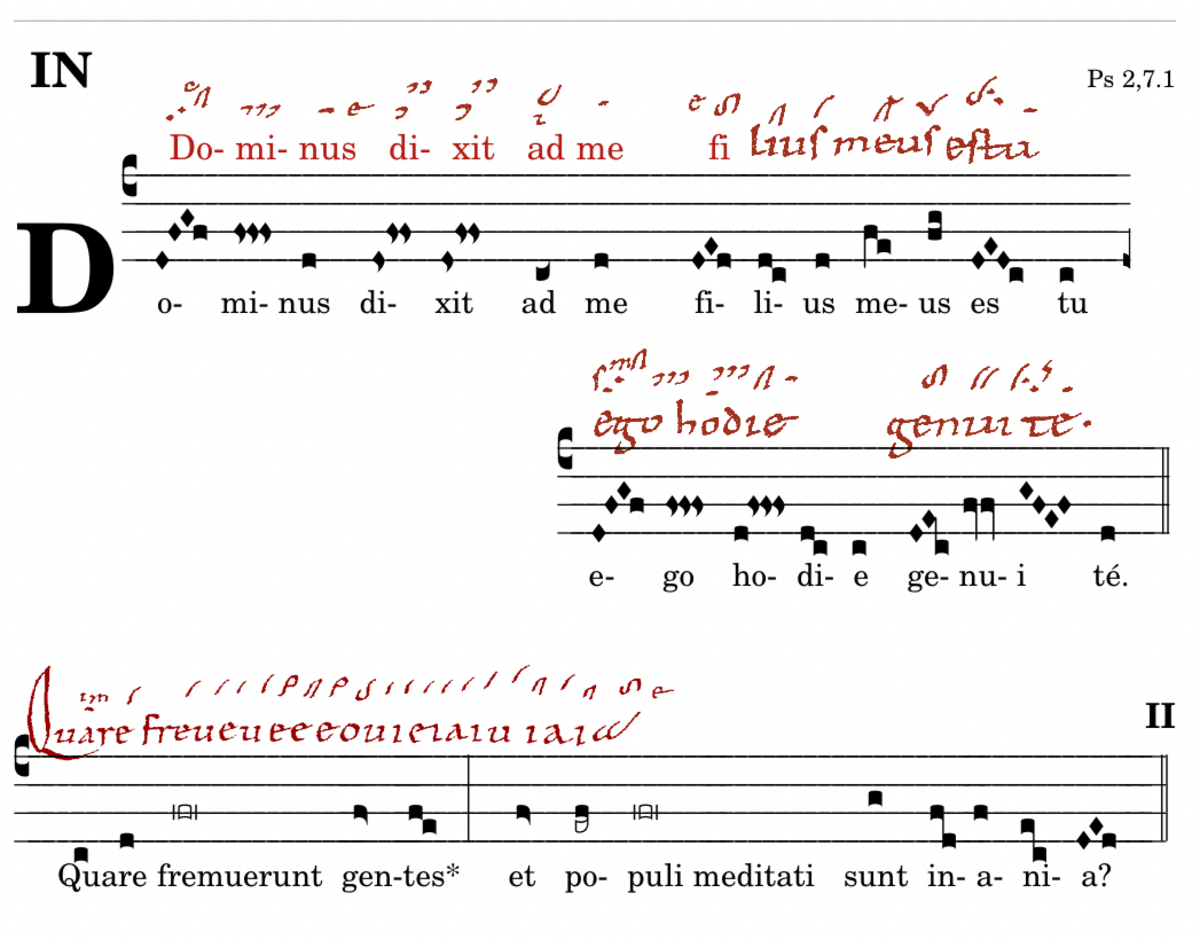
Der archaische IN geht von der Finalis “re“ aus und hebt die Akzentsilben zum Tenor „fa“.
Beide Perioden beginnen mit der ersten Silbe, dem je ersten Akzent der gleichzeitig die Nennung Gottes ist: „dóminus“, “égo„ mit kScaFlx 're-fa-sol-fa' („dominus“ mit 'celeriter', aber “ego“ etwas breiter 'mediocriter'. Diese Neume lässt die Silbe klingen ohne sie zu betonen. Die strophischen Silben haben die selbe Wirkung (Tristropha auf der Binnensilbe „do-mi-nus“ und strophischer Terz-Pes auf beiden Silben des Verbum „dixit“, entsprechend auch „ego hodie“. Alle diese Silben sind hervorgehoben, ohne sie mit einem Betonungsgewicht zu belasten. Der gesamte IN bleibt so mystisch verhalten (Nativitatis missa in nocte).
Der Abstieg zum „do“, unter die Finalis beendet die 1. Periode und den 3. Cento mit Doppelpunkt: colon.
Im 1. Cento bereitet das “do“ den Finalton “re“ vor. Dadurch bekommt auch das Wort „me“ Bedeutung, ohne durch ein Gewicht belastet zu sein. Ähnlich im 4. Cento der Trc „re-mi-do“ auf der Silbe “ge-nui„.
Beide Trc “fi-lius„ und “ge-nui„ kosten die jeweiligen wichtigen Verben aus. Die Hauptakzente sind aber die Possessiv-Pronomina „meus“, „tu“, „te“.
„meus“ könnte auch bloß syllabisch komponiert sein. Clv und Pes bilden aber eine Art umgekehrter FML PeCl. Wichtig ist aber der aufstieg zum „sol“: Hauptakzent des 2. Cento. Der PesSbp „es“ zeigt an, dieser Text ist eine genauere Überlegung wert.
„genui te“ Die Bivirga bereitet den folgenden ClmRes vor, der selbst das folgende Oxytonon „té“, obwohl auf der Finalis liegend, zum Hauptakzent des gesamten IN macht. Der Oriscus als resupiner Ton nimmt dessen Gewicht zurück.
Viermal steigt die Melodie bis zum „sol“, viermal führt sie unter die Finalis zum „do“. Jeder denkbare Akzent hat Bedeutung, aber nie Gewicht. Alles ist ineinander verwoben, alles ist stark zurückgenommen. Genau so muss das Reden über das „mysterium fidei“ um Mitternacht komponiert sein.
Der Herr sprach zu mir / Mein Sohn bist du / Heute habe ich dich geboren (gezeugt).

The Lord said to me / You are my son / Today I have begotten you (I become your father).
The archaic IN derives from the finalis “re” and raises the stressed syllables to the tenor “fa”.
Both periods begin with the first syllable, the first stress in each, which is simultaneously the invocation of God: “dóminus”, “égo” with kScaFlx ‘re-fa-sol-fa’ (“dominus” with ‘celeriter’, but “ego” somewhat broader, ‘mediocriter’. This neume allows the syllable to sound without emphasising it. The strophic syllables have the same effect (tristropha on the internal syllable “do-mi-nus” and strophic third-pes on both syllables of the verb “dixit”, and similarly “ego hodie”. All these syllables are emphasised without being burdened by a weight of stress. The entire IN thus remains mystically restrained (Nativitatis missa in nocte).
The descent to “do”, below the finalis, concludes the 1st period and the 3rd centum with a colon.
In the 1st centum, the “do” prepares the final note “re”. This also gives the word “me” meaning without being burdened by weight. Similarly in the 4th centum, the Trc “re-mi-do” on the syllable “ge-nui”.
Both Trc “fi-lius” and “ge-nui” emphasise the respective key verbs. The main accents, however, are the possessive pronouns “meus”, “tu”, “te”.
“meus” could also be composed purely syllabically. Clv and Pes, however, form a kind of inverted FML PeCl. What is important, however, is the rise to the ‘sol’: the main accent of the 2nd Cento. The PesSbp “es” indicates that this text is worth closer consideration.
‘genui te’ The Bivirga prepares the following ClmRes, which itself makes the following oxytonon ‘té’, although resting on the finalis, the main accent of the entire IN. The Oriscus, as a resupine tone, reduces its weight.
Four times the melody rises to the ‘sol’, four times it descends beneath the finalis to the “do”. Every conceivable accent has meaning, but never weight. Everything is interwoven, everything is strongly restrained. This is precisely how the discourse on the ‘mysterium fidei’ at midnight must be composed.